

Homework Answers
Add Answer to:
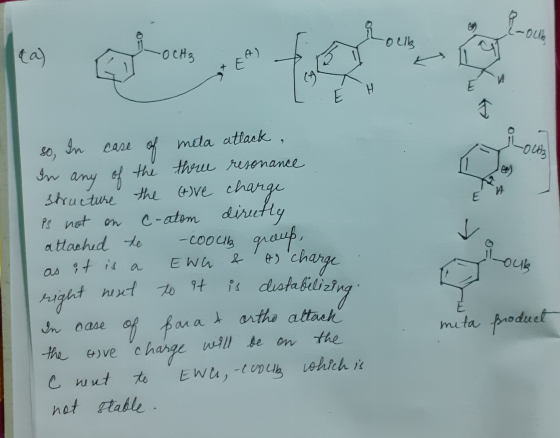
Add the following questions to the final report: a) Why does the carbomethoxy group directs the...
help with 3 and 4 on from risic vent for the ons formed POSTLAB QUESTIONS 1....
 help with 3 and 4
on from risic vent for the ons formed POSTLAB QUESTIONS 1. Sulfuric acid serves three functions in this action: 1) in the format dcia; 2) as the Lewis acid catalyst for electrophilic aromatic substituto reaction by dissolving the methul benzoate. Based on the procond explain why nitration occurs primarily at the meta position and no 2. What two techniques were used in this experiment to prevent dinica 3. What would be the structure of the...
help with 3 and 4
on from risic vent for the ons formed POSTLAB QUESTIONS 1. Sulfuric acid serves three functions in this action: 1) in the format dcia; 2) as the Lewis acid catalyst for electrophilic aromatic substituto reaction by dissolving the methul benzoate. Based on the procond explain why nitration occurs primarily at the meta position and no 2. What two techniques were used in this experiment to prevent dinica 3. What would be the structure of the...
There are 3 pictures, 18 exercises in total. Topics are Benzenes and their reactions No -I...
 There are 3 pictures, 18 exercises in total. Topics are Benzenes
and their reactions
No -I ab 0 CH3 Br nooit 1. Aromatic molecules contain Tt electrons. a. 4n b. 4n+2 c. An odd number d. 4n+1 c. Zero Condition needed for benzene halogenation to occur a. NaC1, 1120 b. C12, H20 c. C12, AICI3 d. NaCl, CH3OH e. C12, CC14 3. In an electrophilic aromatic substitution, the hydroxyl group orients ortho-para because a, removes electronic density from the benzene...
There are 3 pictures, 18 exercises in total. Topics are Benzenes
and their reactions
No -I ab 0 CH3 Br nooit 1. Aromatic molecules contain Tt electrons. a. 4n b. 4n+2 c. An odd number d. 4n+1 c. Zero Condition needed for benzene halogenation to occur a. NaC1, 1120 b. C12, H20 c. C12, AICI3 d. NaCl, CH3OH e. C12, CC14 3. In an electrophilic aromatic substitution, the hydroxyl group orients ortho-para because a, removes electronic density from the benzene...
the weight if the initial product was 3.4 grams of methyl benzoate. Who |o yald foR 3.91SSg st prodoc...
 the
weight if the initial product was 3.4 grams of methyl
benzoate.
Who |o yald foR 3.91SSg st prodoct nd product 2.14143 EXPERIMENTAL PROCEDURE SAFETY WEAR nitrile gloves for this experiment. The nitrating moture of sulfuric acidnitric acid (1:1) is a very strong acid system. Do not allow it to come in contact with your skin or clothing. It will cause acid burns if it comes in contact with your skin (and holes an your clothes). Wash any affected area...
the
weight if the initial product was 3.4 grams of methyl
benzoate.
Who |o yald foR 3.91SSg st prodoct nd product 2.14143 EXPERIMENTAL PROCEDURE SAFETY WEAR nitrile gloves for this experiment. The nitrating moture of sulfuric acidnitric acid (1:1) is a very strong acid system. Do not allow it to come in contact with your skin or clothing. It will cause acid burns if it comes in contact with your skin (and holes an your clothes). Wash any affected area...
Please help with questions 1-5. I have attached the additional lab information pages for help if...
 Please help with questions 1-5. I have attached the additional
lab information pages for help if you are unclear on anything
please review those.
We were unable to transcribe this imageEAS 97 5. Calculate the theoretical yiel te the theoretical yield of iodinated salicylamide (product) ass Todination reaction. (Show your calculations.) mide (product) assuming a mono- le, your starting material, is shown in Figure 4. ces in the functional group region of the spectrum IR spectrum of salicylamide, your starting...
Please help with questions 1-5. I have attached the additional
lab information pages for help if you are unclear on anything
please review those.
We were unable to transcribe this imageEAS 97 5. Calculate the theoretical yiel te the theoretical yield of iodinated salicylamide (product) ass Todination reaction. (Show your calculations.) mide (product) assuming a mono- le, your starting material, is shown in Figure 4. ces in the functional group region of the spectrum IR spectrum of salicylamide, your starting...
Calculate the theoretical yield and percent yield for experiments 7, 8, and 9. For experiment 9,...
 Calculate the theoretical yield and percent yield for
experiments 7, 8, and 9. For experiment 9, determine the
theoretical yield based on starting with 0.50g of 3-nitrobenzoic
acid. Show work
Acid I (experiment 7): Weight of methyl 3-nitrobenzoate = 1.9
g
Acid II (experiment 8): Weight of 3-nitrobenzoic acid = 1.75
g
Acid III (experiment 9): Weight of 3-nitrobenzamide = 0.30 g
Experiment 7:
-2.5 mL concentrated H2SO4
-1.75 mL concentrated HNO3 (16M)
-2.1 mL concentrated Methyl Benzoate
Experiment 8:...
Calculate the theoretical yield and percent yield for
experiments 7, 8, and 9. For experiment 9, determine the
theoretical yield based on starting with 0.50g of 3-nitrobenzoic
acid. Show work
Acid I (experiment 7): Weight of methyl 3-nitrobenzoate = 1.9
g
Acid II (experiment 8): Weight of 3-nitrobenzoic acid = 1.75
g
Acid III (experiment 9): Weight of 3-nitrobenzamide = 0.30 g
Experiment 7:
-2.5 mL concentrated H2SO4
-1.75 mL concentrated HNO3 (16M)
-2.1 mL concentrated Methyl Benzoate
Experiment 8:...
3-5 pls Post-Laboratory Questions-EXP 3 Nitration of Aromatic Compounds Name: Due after completing the lab. 1....
 3-5 pls
Post-Laboratory Questions-EXP 3 Nitration of Aromatic Compounds Name: Due after completing the lab. 1. Why is concentrated sulfuric acid employed in this reaction? What is the electrophile that is produced by the reaction of sulfuric acid and nitric acid? 2. Why is it important to maintain the reaction temperature low and the addition of nitric acid-sulfuric acid mixture carried out slowly? 3. Explain why concentrated H2SO, not concentrated HCl, was used in this experiment? 4. Which ring of...
3-5 pls
Post-Laboratory Questions-EXP 3 Nitration of Aromatic Compounds Name: Due after completing the lab. 1. Why is concentrated sulfuric acid employed in this reaction? What is the electrophile that is produced by the reaction of sulfuric acid and nitric acid? 2. Why is it important to maintain the reaction temperature low and the addition of nitric acid-sulfuric acid mixture carried out slowly? 3. Explain why concentrated H2SO, not concentrated HCl, was used in this experiment? 4. Which ring of...
numbers 1-3 Post-Laboratory Questions-EXP 3 Nitration of Aromatic Compounds Name: Due after completing the lab. 1....
 numbers 1-3
Post-Laboratory Questions-EXP 3 Nitration of Aromatic Compounds Name: Due after completing the lab. 1. Why is concentrated sulfuric acid emploved in thie on? What is the electrophile that is produced by the reaction of sulfuric acid and nitric acid? 2. Why is it important to maintain the reaction temperature low and the addition of nitric acid-sulfuric acid mixture carried out slowly? 3. Explain why concentrated H2SO4, not concentrated HC1, was used in this experiment? 4. Which ring of...
numbers 1-3
Post-Laboratory Questions-EXP 3 Nitration of Aromatic Compounds Name: Due after completing the lab. 1. Why is concentrated sulfuric acid emploved in thie on? What is the electrophile that is produced by the reaction of sulfuric acid and nitric acid? 2. Why is it important to maintain the reaction temperature low and the addition of nitric acid-sulfuric acid mixture carried out slowly? 3. Explain why concentrated H2SO4, not concentrated HC1, was used in this experiment? 4. Which ring of...
4 (6 pts) For each of the following compounds, indicate which statement (A-E) best describes the...
 4 (6 pts) For each of the following compounds, indicate which statement (A-E) best describes the reactivity of the benzene ring in electrophilic aromatic substitution reactions (e.g., nitration). A. The ortbo and para positions are activated and the meta position is deactivated. C. The ortho and para positions are deactivated and the meta position is activated. A. All positions are activated -ortho and para are more activated than meta. D. All positions are deactivated -ortbo and para are more deactivated...
250 ChemActivity 29 Electrophilic Aromatic Substitution no ChemActivity 29 Part A: Electrophilic Aromatic Substitution (What products...
 250 ChemActivity 29 Electrophilic Aromatic Substitution no ChemActivity 29 Part A: Electrophilic Aromatic Substitution (What products are formed when a strong electrophile is added to benzene?) Model 1: (review) Electrophilic Addition of HCI Rani o g cyclohexene carbocation intermediate Run 2 U X benzene This product carbocation intermediate DOES NOT Critical Thinking Questions 1 For Rxn I (above) draw curved arrows showing the mechanism of electrophilic addition of HCl. Include an appropriate carbocation intermediate in the box above. Figure 1:...
QUESTIONS 1. What is the purpose of the sulfuric acid (yes, it's a catalyst, but why...
 QUESTIONS 1. What is the purpose of the sulfuric acid (yes, it's a catalyst, but why is it a catalyst? What is it doing that makes the reaction possible? Would the reaction just go slower without it, or would the reaction not go at all? Why?) 2. If isobutyl alcohol (2 methyl propanol) is used instead of tert butyl alcohol, a mixture of products is obtained. One the products is the same as the product obtained with the tert butyl...
 help with 3 and 4
on from risic vent for the ons formed POSTLAB QUESTIONS 1. Sulfuric acid serves three functions in this action: 1) in the format dcia; 2) as the Lewis acid catalyst for electrophilic aromatic substituto reaction by dissolving the methul benzoate. Based on the procond explain why nitration occurs primarily at the meta position and no 2. What two techniques were used in this experiment to prevent dinica 3. What would be the structure of the...
help with 3 and 4
on from risic vent for the ons formed POSTLAB QUESTIONS 1. Sulfuric acid serves three functions in this action: 1) in the format dcia; 2) as the Lewis acid catalyst for electrophilic aromatic substituto reaction by dissolving the methul benzoate. Based on the procond explain why nitration occurs primarily at the meta position and no 2. What two techniques were used in this experiment to prevent dinica 3. What would be the structure of the...
 There are 3 pictures, 18 exercises in total. Topics are Benzenes
and their reactions
No -I ab 0 CH3 Br nooit 1. Aromatic molecules contain Tt electrons. a. 4n b. 4n+2 c. An odd number d. 4n+1 c. Zero Condition needed for benzene halogenation to occur a. NaC1, 1120 b. C12, H20 c. C12, AICI3 d. NaCl, CH3OH e. C12, CC14 3. In an electrophilic aromatic substitution, the hydroxyl group orients ortho-para because a, removes electronic density from the benzene...
There are 3 pictures, 18 exercises in total. Topics are Benzenes
and their reactions
No -I ab 0 CH3 Br nooit 1. Aromatic molecules contain Tt electrons. a. 4n b. 4n+2 c. An odd number d. 4n+1 c. Zero Condition needed for benzene halogenation to occur a. NaC1, 1120 b. C12, H20 c. C12, AICI3 d. NaCl, CH3OH e. C12, CC14 3. In an electrophilic aromatic substitution, the hydroxyl group orients ortho-para because a, removes electronic density from the benzene...
 the
weight if the initial product was 3.4 grams of methyl
benzoate.
Who |o yald foR 3.91SSg st prodoct nd product 2.14143 EXPERIMENTAL PROCEDURE SAFETY WEAR nitrile gloves for this experiment. The nitrating moture of sulfuric acidnitric acid (1:1) is a very strong acid system. Do not allow it to come in contact with your skin or clothing. It will cause acid burns if it comes in contact with your skin (and holes an your clothes). Wash any affected area...
the
weight if the initial product was 3.4 grams of methyl
benzoate.
Who |o yald foR 3.91SSg st prodoct nd product 2.14143 EXPERIMENTAL PROCEDURE SAFETY WEAR nitrile gloves for this experiment. The nitrating moture of sulfuric acidnitric acid (1:1) is a very strong acid system. Do not allow it to come in contact with your skin or clothing. It will cause acid burns if it comes in contact with your skin (and holes an your clothes). Wash any affected area...
 Please help with questions 1-5. I have attached the additional
lab information pages for help if you are unclear on anything
please review those.
We were unable to transcribe this imageEAS 97 5. Calculate the theoretical yiel te the theoretical yield of iodinated salicylamide (product) ass Todination reaction. (Show your calculations.) mide (product) assuming a mono- le, your starting material, is shown in Figure 4. ces in the functional group region of the spectrum IR spectrum of salicylamide, your starting...
Please help with questions 1-5. I have attached the additional
lab information pages for help if you are unclear on anything
please review those.
We were unable to transcribe this imageEAS 97 5. Calculate the theoretical yiel te the theoretical yield of iodinated salicylamide (product) ass Todination reaction. (Show your calculations.) mide (product) assuming a mono- le, your starting material, is shown in Figure 4. ces in the functional group region of the spectrum IR spectrum of salicylamide, your starting...
 Calculate the theoretical yield and percent yield for
experiments 7, 8, and 9. For experiment 9, determine the
theoretical yield based on starting with 0.50g of 3-nitrobenzoic
acid. Show work
Acid I (experiment 7): Weight of methyl 3-nitrobenzoate = 1.9
g
Acid II (experiment 8): Weight of 3-nitrobenzoic acid = 1.75
g
Acid III (experiment 9): Weight of 3-nitrobenzamide = 0.30 g
Experiment 7:
-2.5 mL concentrated H2SO4
-1.75 mL concentrated HNO3 (16M)
-2.1 mL concentrated Methyl Benzoate
Experiment 8:...
Calculate the theoretical yield and percent yield for
experiments 7, 8, and 9. For experiment 9, determine the
theoretical yield based on starting with 0.50g of 3-nitrobenzoic
acid. Show work
Acid I (experiment 7): Weight of methyl 3-nitrobenzoate = 1.9
g
Acid II (experiment 8): Weight of 3-nitrobenzoic acid = 1.75
g
Acid III (experiment 9): Weight of 3-nitrobenzamide = 0.30 g
Experiment 7:
-2.5 mL concentrated H2SO4
-1.75 mL concentrated HNO3 (16M)
-2.1 mL concentrated Methyl Benzoate
Experiment 8:...
 3-5 pls
Post-Laboratory Questions-EXP 3 Nitration of Aromatic Compounds Name: Due after completing the lab. 1. Why is concentrated sulfuric acid employed in this reaction? What is the electrophile that is produced by the reaction of sulfuric acid and nitric acid? 2. Why is it important to maintain the reaction temperature low and the addition of nitric acid-sulfuric acid mixture carried out slowly? 3. Explain why concentrated H2SO, not concentrated HCl, was used in this experiment? 4. Which ring of...
3-5 pls
Post-Laboratory Questions-EXP 3 Nitration of Aromatic Compounds Name: Due after completing the lab. 1. Why is concentrated sulfuric acid employed in this reaction? What is the electrophile that is produced by the reaction of sulfuric acid and nitric acid? 2. Why is it important to maintain the reaction temperature low and the addition of nitric acid-sulfuric acid mixture carried out slowly? 3. Explain why concentrated H2SO, not concentrated HCl, was used in this experiment? 4. Which ring of...
 numbers 1-3
Post-Laboratory Questions-EXP 3 Nitration of Aromatic Compounds Name: Due after completing the lab. 1. Why is concentrated sulfuric acid emploved in thie on? What is the electrophile that is produced by the reaction of sulfuric acid and nitric acid? 2. Why is it important to maintain the reaction temperature low and the addition of nitric acid-sulfuric acid mixture carried out slowly? 3. Explain why concentrated H2SO4, not concentrated HC1, was used in this experiment? 4. Which ring of...
numbers 1-3
Post-Laboratory Questions-EXP 3 Nitration of Aromatic Compounds Name: Due after completing the lab. 1. Why is concentrated sulfuric acid emploved in thie on? What is the electrophile that is produced by the reaction of sulfuric acid and nitric acid? 2. Why is it important to maintain the reaction temperature low and the addition of nitric acid-sulfuric acid mixture carried out slowly? 3. Explain why concentrated H2SO4, not concentrated HC1, was used in this experiment? 4. Which ring of...
 4 (6 pts) For each of the following compounds, indicate which statement (A-E) best describes the reactivity of the benzene ring in electrophilic aromatic substitution reactions (e.g., nitration). A. The ortbo and para positions are activated and the meta position is deactivated. C. The ortho and para positions are deactivated and the meta position is activated. A. All positions are activated -ortho and para are more activated than meta. D. All positions are deactivated -ortbo and para are more deactivated...
 250 ChemActivity 29 Electrophilic Aromatic Substitution no ChemActivity 29 Part A: Electrophilic Aromatic Substitution (What products are formed when a strong electrophile is added to benzene?) Model 1: (review) Electrophilic Addition of HCI Rani o g cyclohexene carbocation intermediate Run 2 U X benzene This product carbocation intermediate DOES NOT Critical Thinking Questions 1 For Rxn I (above) draw curved arrows showing the mechanism of electrophilic addition of HCl. Include an appropriate carbocation intermediate in the box above. Figure 1:...
 QUESTIONS 1. What is the purpose of the sulfuric acid (yes, it's a catalyst, but why is it a catalyst? What is it doing that makes the reaction possible? Would the reaction just go slower without it, or would the reaction not go at all? Why?) 2. If isobutyl alcohol (2 methyl propanol) is used instead of tert butyl alcohol, a mixture of products is obtained. One the products is the same as the product obtained with the tert butyl...
Most questions answered within 3 hours.
-
Where is the error in this code sequence?
String s1 = "Hello";
String s2 = "ello";...
asked 11 months ago -
Financial data for Joel de Paris, Inc., for last year
follow:
Joel de Paris, Inc.
Balance...
asked 11 months ago -
Consider this reaction:
Al2(SO4)3 (aq)+ BaCl3
(aq) Al2Cl6 (aq)- +
3BaSO4(s) . What is the...
asked 11 months ago -
Suppose that Savneet is considering increasing her
recent random sample from 20 car rentals to 40...
asked 11 months ago -
Trucks arrive at an unloading terminal at an average rate of 120
per hour.
Trucks arrive...
asked 11 months ago -
Why are methanol and ethanol completely soluble in water while
octanol is not very little soluble....
asked 11 months ago -
A facilities manager at a university reads in a research report
that the mean amount of...
asked 11 months ago -
When the CuSO4 is rehydrated by adding water to the anhydrous
compound, is this an endothermic...
asked 11 months ago -
A ray of sunlight is passing from diamond into crown glass; the
angle of incidence is...
asked 11 months ago -
A block of mass 0.249 kg is placed on top of a light, vertical
spring of...
asked 11 months ago -
how do the kidneys compensate in the presences of acidosis
a) trigger hyperventilate
b) reserve acid...
asked 11 months ago -
Question 501 pts
The rental rate of capital to the firm increases. Which of the
following...
asked 11 months ago