
Homework Answers
Question 2:

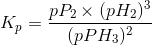
PPH3 = 0.023 atm
PP2 = 0.321 atm
PH2 = 0.732 atm
Therefore 

Question asks for answer without units. So, Kp = 238
Question 3.
Raising the temperature shifts the equilibrium towards the endothermic side of the reaction.
In this case, since the forward reaction is exothermic (delta H is negative 890 kJ), therefore the reverse reaction will be endothermic (delta H will be positive 890 kJ)
Thus raising the temperature will shift the equilibrium towards the reverse reaction, i.e, towards the left.
Add Answer to:
help please stressing
QUESTION 2 For the equilibrium 2PH3(e) = P2(8) +3H2(8), the equilibrium partial pressures...
QUESTION 19 For the equilibrium 2PH3(g) ⇌ P2(g) +3H2(g), the equilibrium partial pressures are PPH3=0.029 atm,...
QUESTION 19 For the equilibrium 2PH3(g) ⇌ P2(g) +3H2(g), the equilibrium partial pressures are PPH3=0.029 atm, PP2=0.699 atm, and PH2=0.557 atm at 738K. Calculate Kp. *Please report 3 significant figures. Numbers only, No unit. No scientific notation.
can someone please help me with these three please QUESTION 1 The rate law of a...
 can someone please help me with these three please
QUESTION 1 The rate law of a reaction is rate = k[X][Y][Z]. The units of the rate constant are O mol2 L-25-1 OL2 mol-25-1 mol L-lg-2 O L mol-lg-1 O mol L-15-1 QUESTION 2 For the equilibrium 2PH3(e) = P2(e)+3H2(g), the equilibrium partial pressures are PpH, -0.023 atm, PP, 0.32latm. and PH -0.732 atm at 738K. Calculate Kp. *Please report 3 significant figures. Numbers only, No unit. No scientific notation. QUESTION...
can someone please help me with these three please
QUESTION 1 The rate law of a reaction is rate = k[X][Y][Z]. The units of the rate constant are O mol2 L-25-1 OL2 mol-25-1 mol L-lg-2 O L mol-lg-1 O mol L-15-1 QUESTION 2 For the equilibrium 2PH3(e) = P2(e)+3H2(g), the equilibrium partial pressures are PpH, -0.023 atm, PP, 0.32latm. and PH -0.732 atm at 738K. Calculate Kp. *Please report 3 significant figures. Numbers only, No unit. No scientific notation. QUESTION...
For the equilibrium 2PH3(g) ⇌ P2(g) +3H2(g), the equilibrium partial pressures are PPH3=0.049 atm, PP2=0.498 atm,...
For the equilibrium 2PH3(g) ⇌ P2(g) +3H2(g), the equilibrium partial pressures are PPH3=0.049 atm, PP2=0.498 atm, and PH2=0.776 atm at 738K. Calculate Kp.
1) 2) 3) CaCO3(s) = CaO (s) + CO2 (g) At 658 °C, the reaction reaches...
 1)
2)
3)
CaCO3(s) = CaO (s) + CO2 (g) At 658 °C, the reaction reaches equilibrium. If PcO2 =2.17 atm, what is Kc value ? *Please report 3 significant figures. Numbers only, No unit. No scientific notation. The slope and intercept of an Arrhenius plot made for the first-order decomposition reaction are -7865.2 K and 26.098 at 303K, what is the value of the activation energy (KJ/mol) at this temperature? *Please report 3 significant figures. Numbers only, no unit....
1)
2)
3)
CaCO3(s) = CaO (s) + CO2 (g) At 658 °C, the reaction reaches equilibrium. If PcO2 =2.17 atm, what is Kc value ? *Please report 3 significant figures. Numbers only, No unit. No scientific notation. The slope and intercept of an Arrhenius plot made for the first-order decomposition reaction are -7865.2 K and 26.098 at 303K, what is the value of the activation energy (KJ/mol) at this temperature? *Please report 3 significant figures. Numbers only, no unit....
please help Question 38 (8 points) What element is oxidized and what is the oxidizing agent...
 please help
Question 38 (8 points) What element is oxidized and what is the oxidizing agent in the reaction below? Fe2O3(s) + 3CO(g) - 2Fe(s) + 3CO2(e) Iron is oxidized, and the oxidizing agent is Fe2O3. Carbon is oxidized, and the oxidizing agent is Fe2O3. Iron is oxidized, and the oxidizing agent is CO. Carbon is oxidized, and the oxidizing agent is Co. Question 39 (8 points) What isotope is depicted in the figure? Key =proton =neutron lithium-7 helium-3 helium-4...
please help
Question 38 (8 points) What element is oxidized and what is the oxidizing agent in the reaction below? Fe2O3(s) + 3CO(g) - 2Fe(s) + 3CO2(e) Iron is oxidized, and the oxidizing agent is Fe2O3. Carbon is oxidized, and the oxidizing agent is Fe2O3. Iron is oxidized, and the oxidizing agent is CO. Carbon is oxidized, and the oxidizing agent is Co. Question 39 (8 points) What isotope is depicted in the figure? Key =proton =neutron lithium-7 helium-3 helium-4...
help with this please Ca(OH)2(aq) + 2 HCl(aq) +CaCl2(8) + 2 H2O(1) Using the standard thermodynamic...
 help with this please
Ca(OH)2(aq) + 2 HCl(aq) +CaCl2(8) + 2 H2O(1) Using the standard thermodynamic data in the tables linked above, calculate the equilibrium constant for this reaction at 298.15K ANSWER: N2(g) + O2(g) +2NO(g) Using the standard thermodynamic data in the tables linked above, calculate the equilibrium constant for this reaction at 298.15K ANSWER: 2CO(g) + O2(g) +2002(9) - der e en manos de 20, ali ne more than one so mi dicogna undan Using standard thermodynamic data...
help with this please
Ca(OH)2(aq) + 2 HCl(aq) +CaCl2(8) + 2 H2O(1) Using the standard thermodynamic data in the tables linked above, calculate the equilibrium constant for this reaction at 298.15K ANSWER: N2(g) + O2(g) +2NO(g) Using the standard thermodynamic data in the tables linked above, calculate the equilibrium constant for this reaction at 298.15K ANSWER: 2CO(g) + O2(g) +2002(9) - der e en manos de 20, ali ne more than one so mi dicogna undan Using standard thermodynamic data...
 can someone please help me with these three please
QUESTION 1 The rate law of a reaction is rate = k[X][Y][Z]. The units of the rate constant are O mol2 L-25-1 OL2 mol-25-1 mol L-lg-2 O L mol-lg-1 O mol L-15-1 QUESTION 2 For the equilibrium 2PH3(e) = P2(e)+3H2(g), the equilibrium partial pressures are PpH, -0.023 atm, PP, 0.32latm. and PH -0.732 atm at 738K. Calculate Kp. *Please report 3 significant figures. Numbers only, No unit. No scientific notation. QUESTION...
can someone please help me with these three please
QUESTION 1 The rate law of a reaction is rate = k[X][Y][Z]. The units of the rate constant are O mol2 L-25-1 OL2 mol-25-1 mol L-lg-2 O L mol-lg-1 O mol L-15-1 QUESTION 2 For the equilibrium 2PH3(e) = P2(e)+3H2(g), the equilibrium partial pressures are PpH, -0.023 atm, PP, 0.32latm. and PH -0.732 atm at 738K. Calculate Kp. *Please report 3 significant figures. Numbers only, No unit. No scientific notation. QUESTION...
 1)
2)
3)
CaCO3(s) = CaO (s) + CO2 (g) At 658 °C, the reaction reaches equilibrium. If PcO2 =2.17 atm, what is Kc value ? *Please report 3 significant figures. Numbers only, No unit. No scientific notation. The slope and intercept of an Arrhenius plot made for the first-order decomposition reaction are -7865.2 K and 26.098 at 303K, what is the value of the activation energy (KJ/mol) at this temperature? *Please report 3 significant figures. Numbers only, no unit....
1)
2)
3)
CaCO3(s) = CaO (s) + CO2 (g) At 658 °C, the reaction reaches equilibrium. If PcO2 =2.17 atm, what is Kc value ? *Please report 3 significant figures. Numbers only, No unit. No scientific notation. The slope and intercept of an Arrhenius plot made for the first-order decomposition reaction are -7865.2 K and 26.098 at 303K, what is the value of the activation energy (KJ/mol) at this temperature? *Please report 3 significant figures. Numbers only, no unit....
 please help
Question 38 (8 points) What element is oxidized and what is the oxidizing agent in the reaction below? Fe2O3(s) + 3CO(g) - 2Fe(s) + 3CO2(e) Iron is oxidized, and the oxidizing agent is Fe2O3. Carbon is oxidized, and the oxidizing agent is Fe2O3. Iron is oxidized, and the oxidizing agent is CO. Carbon is oxidized, and the oxidizing agent is Co. Question 39 (8 points) What isotope is depicted in the figure? Key =proton =neutron lithium-7 helium-3 helium-4...
please help
Question 38 (8 points) What element is oxidized and what is the oxidizing agent in the reaction below? Fe2O3(s) + 3CO(g) - 2Fe(s) + 3CO2(e) Iron is oxidized, and the oxidizing agent is Fe2O3. Carbon is oxidized, and the oxidizing agent is Fe2O3. Iron is oxidized, and the oxidizing agent is CO. Carbon is oxidized, and the oxidizing agent is Co. Question 39 (8 points) What isotope is depicted in the figure? Key =proton =neutron lithium-7 helium-3 helium-4...
 help with this please
Ca(OH)2(aq) + 2 HCl(aq) +CaCl2(8) + 2 H2O(1) Using the standard thermodynamic data in the tables linked above, calculate the equilibrium constant for this reaction at 298.15K ANSWER: N2(g) + O2(g) +2NO(g) Using the standard thermodynamic data in the tables linked above, calculate the equilibrium constant for this reaction at 298.15K ANSWER: 2CO(g) + O2(g) +2002(9) - der e en manos de 20, ali ne more than one so mi dicogna undan Using standard thermodynamic data...
help with this please
Ca(OH)2(aq) + 2 HCl(aq) +CaCl2(8) + 2 H2O(1) Using the standard thermodynamic data in the tables linked above, calculate the equilibrium constant for this reaction at 298.15K ANSWER: N2(g) + O2(g) +2NO(g) Using the standard thermodynamic data in the tables linked above, calculate the equilibrium constant for this reaction at 298.15K ANSWER: 2CO(g) + O2(g) +2002(9) - der e en manos de 20, ali ne more than one so mi dicogna undan Using standard thermodynamic data...
Most questions answered within 3 hours.
-
Where is the error in this code sequence?
String s1 = "Hello";
String s2 = "ello";...
asked 1 year ago -
Financial data for Joel de Paris, Inc., for last year
follow:
Joel de Paris, Inc.
Balance...
asked 1 year ago -
Consider this reaction:
Al2(SO4)3 (aq)+ BaCl3
(aq) Al2Cl6 (aq)- +
3BaSO4(s) . What is the...
asked 1 year ago -
Suppose that Savneet is considering increasing her
recent random sample from 20 car rentals to 40...
asked 1 year ago -
Trucks arrive at an unloading terminal at an average rate of 120
per hour.
Trucks arrive...
asked 1 year ago -
Why are methanol and ethanol completely soluble in water while
octanol is not very little soluble....
asked 1 year ago -
A facilities manager at a university reads in a research report
that the mean amount of...
asked 1 year ago -
When the CuSO4 is rehydrated by adding water to the anhydrous
compound, is this an endothermic...
asked 1 year ago -
A ray of sunlight is passing from diamond into crown glass; the
angle of incidence is...
asked 1 year ago -
A block of mass 0.249 kg is placed on top of a light, vertical
spring of...
asked 1 year ago -
how do the kidneys compensate in the presences of acidosis
a) trigger hyperventilate
b) reserve acid...
asked 1 year ago -
Question 501 pts
The rental rate of capital to the firm increases. Which of the
following...
asked 1 year ago