For the equilibrium 2PH3(g) ⇌ P2(g) +3H2(g), the equilibrium partial pressures are PPH3=0.049 atm, PP2=0.498 atm,...
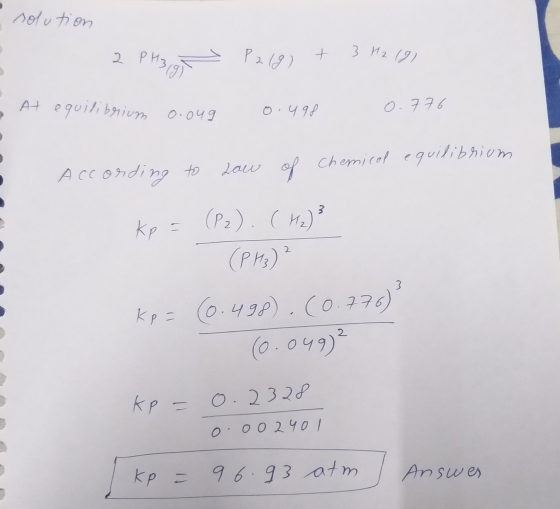
For the equilibrium 2PH3(g) ⇌ P2(g) +3H2(g), the equilibrium partial pressures are PPH3=0.049 atm, PP2=0.498 atm, and PH2=0.776 atm at 738K.
Calculate Kp.
Homework Answers
Add Answer to:
For the equilibrium 2PH3(g) ⇌ P2(g)
+3H2(g), the equilibrium partial pressures are
PPH3=0.049 atm,
PP2=0.498 atm,...
QUESTION 19 For the equilibrium 2PH3(g) ⇌ P2(g) +3H2(g), the equilibrium partial pressures are PPH3=0.029 atm,...
QUESTION 19 For the equilibrium 2PH3(g) ⇌ P2(g) +3H2(g), the equilibrium partial pressures are PPH3=0.029 atm, PP2=0.699 atm, and PH2=0.557 atm at 738K. Calculate Kp. *Please report 3 significant figures. Numbers only, No unit. No scientific notation.
Phosphine (PH3) decomposes at elevated temperatures, yielding gaseous P2 and H2: 2PH3(g)⇌P2(g)+3H2(g) Kp= 398 at 873...
Phosphine (PH3) decomposes at elevated temperatures, yielding gaseous P2 and H2: 2PH3(g)⇌P2(g)+3H2(g) Kp= 398 at 873 K When a mixture of PH3, P2, and H2 comes to equilibrium at 873 K, PP2= 0.422 atm and PH2= 0.822 atm. What is PPH3?
help please stressing QUESTION 2 For the equilibrium 2PH3(e) = P2(8) +3H2(8), the equilibrium partial pressures...
 help please stressing
QUESTION 2 For the equilibrium 2PH3(e) = P2(8) +3H2(8), the equilibrium partial pressures are Ppzz-0.023 atm, Pp,-0.321 atm, and PH, -0.732 atm at 738K. Calculate Kp. *Please report 3 significant figures. Numbers only, No unit. No scientific notation. QUESTION 3 CH4(g) + 2 O2(g) = CO2(g) + 2 H2O(1) AH° -- 890 kJ Raising the temperature will result in shift the equilibrium to the right shift the equilibrium to the left O more information is needed Keq...
help please stressing
QUESTION 2 For the equilibrium 2PH3(e) = P2(8) +3H2(8), the equilibrium partial pressures are Ppzz-0.023 atm, Pp,-0.321 atm, and PH, -0.732 atm at 738K. Calculate Kp. *Please report 3 significant figures. Numbers only, No unit. No scientific notation. QUESTION 3 CH4(g) + 2 O2(g) = CO2(g) + 2 H2O(1) AH° -- 890 kJ Raising the temperature will result in shift the equilibrium to the right shift the equilibrium to the left O more information is needed Keq...
HQ14.35 Unanswered The reaction mixture N2(g) +3H2(g)2NH3(g) has the following equilibrium partial pressures: PN2- 2.40 atm,...
 HQ14.35 Unanswered The reaction mixture N2(g) +3H2(g)2NH3(g) has the following equilibrium partial pressures: PN2- 2.40 atm, PH2-1.60 atm, and PNH3 22.10 atm. Calculate the equilibrium constant Kp. Report your answer to the correct number of significant figures. Type your response
1) 2) 3) CaCO3(s) = CaO (s) + CO2 (g) At 658 °C, the reaction reaches...
 1)
2)
3)
CaCO3(s) = CaO (s) + CO2 (g) At 658 °C, the reaction reaches equilibrium. If PcO2 =2.17 atm, what is Kc value ? *Please report 3 significant figures. Numbers only, No unit. No scientific notation. The slope and intercept of an Arrhenius plot made for the first-order decomposition reaction are -7865.2 K and 26.098 at 303K, what is the value of the activation energy (KJ/mol) at this temperature? *Please report 3 significant figures. Numbers only, no unit....
1)
2)
3)
CaCO3(s) = CaO (s) + CO2 (g) At 658 °C, the reaction reaches equilibrium. If PcO2 =2.17 atm, what is Kc value ? *Please report 3 significant figures. Numbers only, No unit. No scientific notation. The slope and intercept of an Arrhenius plot made for the first-order decomposition reaction are -7865.2 K and 26.098 at 303K, what is the value of the activation energy (KJ/mol) at this temperature? *Please report 3 significant figures. Numbers only, no unit....
1. At equilibrium, the concentrations of reactants and products can be predicted using the equilibrium constant,...
1. At equilibrium, the concentrations of reactants and products can be predicted using the equilibrium constant, Kc, which is a mathematical expression based on the chemical equation. For example, in the reaction aA+bB⇌cC+dD where a, b, c, and d are the stoichiometric coefficients, the equilibrium constant is Kc=[C]c[D]d[A]a[B]b where [A], [B], [C], and [D] are the equilibrium concentrations. If the reaction is not at equilibrium, the quantity can still be calculated, but it is called the reaction quotient, Qc, instead...
For: N2(g) + 3H2(g) ⬄ 2NH3(g), Kp = 4.72 x 10⁻⁴ at 475 oC. At equilibrium...
For: N2(g) + 3H2(g) ⬄ 2NH3(g), Kp = 4.72 x 10⁻⁴ at 475 oC. At equilibrium at 475 oC, PH2 = 0.237 atm and PN2 = 0.582 atm. What is the partial pressure of ammonia at equilibrium?
can someone please help me with these three please QUESTION 1 The rate law of a...
 can someone please help me with these three please
QUESTION 1 The rate law of a reaction is rate = k[X][Y][Z]. The units of the rate constant are O mol2 L-25-1 OL2 mol-25-1 mol L-lg-2 O L mol-lg-1 O mol L-15-1 QUESTION 2 For the equilibrium 2PH3(e) = P2(e)+3H2(g), the equilibrium partial pressures are PpH, -0.023 atm, PP, 0.32latm. and PH -0.732 atm at 738K. Calculate Kp. *Please report 3 significant figures. Numbers only, No unit. No scientific notation. QUESTION...
can someone please help me with these three please
QUESTION 1 The rate law of a reaction is rate = k[X][Y][Z]. The units of the rate constant are O mol2 L-25-1 OL2 mol-25-1 mol L-lg-2 O L mol-lg-1 O mol L-15-1 QUESTION 2 For the equilibrium 2PH3(e) = P2(e)+3H2(g), the equilibrium partial pressures are PpH, -0.023 atm, PP, 0.32latm. and PH -0.732 atm at 738K. Calculate Kp. *Please report 3 significant figures. Numbers only, No unit. No scientific notation. QUESTION...
Consider the following reaction: A(g)?2B(g) Find the equilibrium partial pressures of A and Bfor each of...
Consider the following reaction: A(g)?2B(g) Find the equilibrium partial pressures of A and Bfor each of the following different values of Kp. Assume that the initial partial pressure of B in each case is 1.0 atm and that the initial partial pressure of A is 0.0 atm. Make any appropriate simplifying assumptions. Kp= 1.8 Kp= 1.6×10?4 Kp= 1.8×10⁵
Consider the following reaction: A(g)⇌2B(g) Find the equilibrium partial pressures of A and Bfor each of...
Consider the following reaction: A(g)⇌2B(g) Find the equilibrium partial pressures of A and Bfor each of the following different values of Kp. Assume that the initial partial pressure of B in each case is 1.0 atm and that the initial partial pressure of A is 0.0 atm. Make any appropriate simplifying assumptions. A.)Kp= 2.0 B.) Kp= 1.6×10⁻⁴ C.)Kp= 1.4×10⁵
 help please stressing
QUESTION 2 For the equilibrium 2PH3(e) = P2(8) +3H2(8), the equilibrium partial pressures are Ppzz-0.023 atm, Pp,-0.321 atm, and PH, -0.732 atm at 738K. Calculate Kp. *Please report 3 significant figures. Numbers only, No unit. No scientific notation. QUESTION 3 CH4(g) + 2 O2(g) = CO2(g) + 2 H2O(1) AH° -- 890 kJ Raising the temperature will result in shift the equilibrium to the right shift the equilibrium to the left O more information is needed Keq...
help please stressing
QUESTION 2 For the equilibrium 2PH3(e) = P2(8) +3H2(8), the equilibrium partial pressures are Ppzz-0.023 atm, Pp,-0.321 atm, and PH, -0.732 atm at 738K. Calculate Kp. *Please report 3 significant figures. Numbers only, No unit. No scientific notation. QUESTION 3 CH4(g) + 2 O2(g) = CO2(g) + 2 H2O(1) AH° -- 890 kJ Raising the temperature will result in shift the equilibrium to the right shift the equilibrium to the left O more information is needed Keq...
 HQ14.35 Unanswered The reaction mixture N2(g) +3H2(g)2NH3(g) has the following equilibrium partial pressures: PN2- 2.40 atm, PH2-1.60 atm, and PNH3 22.10 atm. Calculate the equilibrium constant Kp. Report your answer to the correct number of significant figures. Type your response
 1)
2)
3)
CaCO3(s) = CaO (s) + CO2 (g) At 658 °C, the reaction reaches equilibrium. If PcO2 =2.17 atm, what is Kc value ? *Please report 3 significant figures. Numbers only, No unit. No scientific notation. The slope and intercept of an Arrhenius plot made for the first-order decomposition reaction are -7865.2 K and 26.098 at 303K, what is the value of the activation energy (KJ/mol) at this temperature? *Please report 3 significant figures. Numbers only, no unit....
1)
2)
3)
CaCO3(s) = CaO (s) + CO2 (g) At 658 °C, the reaction reaches equilibrium. If PcO2 =2.17 atm, what is Kc value ? *Please report 3 significant figures. Numbers only, No unit. No scientific notation. The slope and intercept of an Arrhenius plot made for the first-order decomposition reaction are -7865.2 K and 26.098 at 303K, what is the value of the activation energy (KJ/mol) at this temperature? *Please report 3 significant figures. Numbers only, no unit....
 can someone please help me with these three please
QUESTION 1 The rate law of a reaction is rate = k[X][Y][Z]. The units of the rate constant are O mol2 L-25-1 OL2 mol-25-1 mol L-lg-2 O L mol-lg-1 O mol L-15-1 QUESTION 2 For the equilibrium 2PH3(e) = P2(e)+3H2(g), the equilibrium partial pressures are PpH, -0.023 atm, PP, 0.32latm. and PH -0.732 atm at 738K. Calculate Kp. *Please report 3 significant figures. Numbers only, No unit. No scientific notation. QUESTION...
can someone please help me with these three please
QUESTION 1 The rate law of a reaction is rate = k[X][Y][Z]. The units of the rate constant are O mol2 L-25-1 OL2 mol-25-1 mol L-lg-2 O L mol-lg-1 O mol L-15-1 QUESTION 2 For the equilibrium 2PH3(e) = P2(e)+3H2(g), the equilibrium partial pressures are PpH, -0.023 atm, PP, 0.32latm. and PH -0.732 atm at 738K. Calculate Kp. *Please report 3 significant figures. Numbers only, No unit. No scientific notation. QUESTION...
Most questions answered within 3 hours.
-
Where is the error in this code sequence?
String s1 = "Hello";
String s2 = "ello";...
asked 10 months ago -
Financial data for Joel de Paris, Inc., for last year
follow:
Joel de Paris, Inc.
Balance...
asked 10 months ago -
Consider this reaction:
Al2(SO4)3 (aq)+ BaCl3
(aq) Al2Cl6 (aq)- +
3BaSO4(s) . What is the...
asked 10 months ago -
Suppose that Savneet is considering increasing her
recent random sample from 20 car rentals to 40...
asked 10 months ago -
Trucks arrive at an unloading terminal at an average rate of 120
per hour.
Trucks arrive...
asked 10 months ago -
Why are methanol and ethanol completely soluble in water while
octanol is not very little soluble....
asked 10 months ago -
A facilities manager at a university reads in a research report
that the mean amount of...
asked 10 months ago -
When the CuSO4 is rehydrated by adding water to the anhydrous
compound, is this an endothermic...
asked 10 months ago -
A ray of sunlight is passing from diamond into crown glass; the
angle of incidence is...
asked 10 months ago -
A block of mass 0.249 kg is placed on top of a light, vertical
spring of...
asked 10 months ago -
how do the kidneys compensate in the presences of acidosis
a) trigger hyperventilate
b) reserve acid...
asked 10 months ago -
Question 501 pts
The rental rate of capital to the firm increases. Which of the
following...
asked 10 months ago