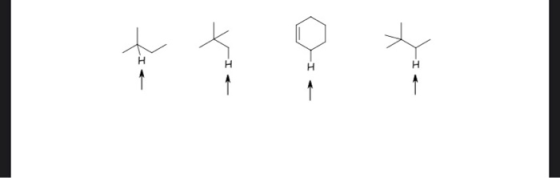
Draw the radical that results from abstraction (homolytic cleavage) of the indicated hydrogen. Rank the resulting...
Homework Answers
 Homolytic cleavage
is symmetrical breaking of bond which forms free radicals.
Homolytic cleavage
is symmetrical breaking of bond which forms free radicals.
Add Answer to:
Draw the radical that results from abstraction (homolytic cleavage)
of the indicated hydrogen. Rank the resulting...
help with this worksheet please! 1. Determine the radical stability with 1 the most stable and...
 help with this worksheet please!
1. Determine the radical stability with 1 the most stable and 4 the least stable 2. What is the major product of 2-methylpropane mono-chlorination? Cl2 light 3. Calclate AH for chlorination of methane (DHe for CHa-H is 440 kJ/mol; DH° for Cl-Cl is 243 kJ/mol; DH° for CH3-Cl is 432 kJ/mol; and DH° for H-Cl is 353 kJ/mol 4. Draw structure of the most stable radical formed by hydrogen radical abstraction from 3- methylcyclohexene 5....
help with this worksheet please!
1. Determine the radical stability with 1 the most stable and 4 the least stable 2. What is the major product of 2-methylpropane mono-chlorination? Cl2 light 3. Calclate AH for chlorination of methane (DHe for CHa-H is 440 kJ/mol; DH° for Cl-Cl is 243 kJ/mol; DH° for CH3-Cl is 432 kJ/mol; and DH° for H-Cl is 353 kJ/mol 4. Draw structure of the most stable radical formed by hydrogen radical abstraction from 3- methylcyclohexene 5....
11. Which of the following best explains why the synthetic route shown below would be unsuccessful?...
 11. Which of the following best explains why the synthetic route shown below would be unsuccessful? 2) NaNH2 3) (CHs)hCBr A) The alkynide anion is not a strong enough nucleophile to react with 1-bromopropane in step 1 m amide is not a strong enough base to deprotonate the terminal alkyne in step anion formed by reaction with sodium amide will facilitate an E2 (rather C) The alkynide than SN2) reaction with t-butyl bromide. 5oth substtution reactions will occur on the...
CHEM 6100-Radicals/Carbenes Problem set Rank the radicals below 1 through 4 in order of increasing stability (1 bei...
 CHEM 6100-Radicals/Carbenes Problem set Rank the radicals below 1 through 4 in order of increasing stability (1 being the most stable; 4 the least stable). 1. CH3 CH3 CH2 CH3 CH3 Hас Hас
Step Question/Exam 3: Draw a radical mechanism for the following photohalogenation reaction Brg t th to...
 Step Question/Exam 3: Draw a radical mechanism for the following photohalogenation reaction Brg t th to you ? + H-Br UV light (h) 90% UV-light and a halogen...these are great radical initiation conditions! 1.) Look for a weak bond that would be able to homolytically cleave to form two radicals Draw the resulting radicals: 2.) Identify the most stable site for a radical to sit. Your product distribution will predict where this is FYI. Again, the reactivity of radicals is...
2. Numerically rank the radical species below in order of increasing stability 3. Draw all relevant...
 2. Numerically rank the radical species below in order of increasing stability 3. Draw all relevant resonance structure for each of the radical species shown below. 4. Predict the major product for the radical chlorination reactions shown below. (i)
3. (8 pts) Utilizing the boxes below, rank the following radicals in order of increasing stability....
 3. (8 pts) Utilizing the boxes below, rank the following radicals in order of increasing stability. Below the boxes, fully explain the reasoning behind the ranking. CH3 А в со Least Stable Least Stable O O O O Most Stable Most stable
1 = least stable 4= most stable 3. Rank the following alkenes in order to increasing...
 1 = least stable 4= most stable 3. Rank the following alkenes in order to increasing stability. Irasubstituceda 4. Draw the mechanism for the following E2 reactions.
please explain/walkthrough! Problem 1 (30 pts) a) Circle the radical that is most stable. b) Order...
 please explain/walkthrough!
Problem 1 (30 pts) a) Circle the radical that is most stable. b) Order the compounds in terms of increasing oxidation state (1 highest, 3- lowest) он c) The reaction below is an example of.... heat 2 b) substitution a) addition d) heterolytic cleavage c) homolytic cleavage d) Circle the compound with the most acidic protons. H H c=C CHз CH3CH2CH3 Нас-СЕС-н H
please explain/walkthrough!
Problem 1 (30 pts) a) Circle the radical that is most stable. b) Order the compounds in terms of increasing oxidation state (1 highest, 3- lowest) он c) The reaction below is an example of.... heat 2 b) substitution a) addition d) heterolytic cleavage c) homolytic cleavage d) Circle the compound with the most acidic protons. H H c=C CHз CH3CH2CH3 Нас-СЕС-н H
6. Draw the two ring interconversion structures each for cis and trans 1-ethyl-4-butylcyclohexane and rank all...
 6. Draw the two ring interconversion structures each for cis and trans 1-ethyl-4-butylcyclohexane and rank all four according to stability (code: 1 = most stable to 4 = least stable). Be sure to also draw in all hydrogen atoms and justify your four stability choices. I
16.) Within each of the following sets of alkyl radicals, name each radical; identify each as...
16.) Within each of the following sets of alkyl radicals, name each radical; identify each as either primary, secondary, or tertiary; rank in order of decreasing stability; and sketch an orbital picture of the most stable radical, showing the hyper conjugative interaction(s). (a) CH3CH2C·HCH3 and CH3CH2CH2CH2 · (b) (CH3CH2)2CHCH2 · and (CH3CH2)2C·CH3 (c) (CH3)2CHC·HCH3 , (CH3)2C·CH2CH3 and (CH3)2CHCH2CH2· (I put the lone electron after the radical carbon.) Also, my main question is in bold. The rest I know and understand....
 help with this worksheet please!
1. Determine the radical stability with 1 the most stable and 4 the least stable 2. What is the major product of 2-methylpropane mono-chlorination? Cl2 light 3. Calclate AH for chlorination of methane (DHe for CHa-H is 440 kJ/mol; DH° for Cl-Cl is 243 kJ/mol; DH° for CH3-Cl is 432 kJ/mol; and DH° for H-Cl is 353 kJ/mol 4. Draw structure of the most stable radical formed by hydrogen radical abstraction from 3- methylcyclohexene 5....
help with this worksheet please!
1. Determine the radical stability with 1 the most stable and 4 the least stable 2. What is the major product of 2-methylpropane mono-chlorination? Cl2 light 3. Calclate AH for chlorination of methane (DHe for CHa-H is 440 kJ/mol; DH° for Cl-Cl is 243 kJ/mol; DH° for CH3-Cl is 432 kJ/mol; and DH° for H-Cl is 353 kJ/mol 4. Draw structure of the most stable radical formed by hydrogen radical abstraction from 3- methylcyclohexene 5....
 11. Which of the following best explains why the synthetic route shown below would be unsuccessful? 2) NaNH2 3) (CHs)hCBr A) The alkynide anion is not a strong enough nucleophile to react with 1-bromopropane in step 1 m amide is not a strong enough base to deprotonate the terminal alkyne in step anion formed by reaction with sodium amide will facilitate an E2 (rather C) The alkynide than SN2) reaction with t-butyl bromide. 5oth substtution reactions will occur on the...
 CHEM 6100-Radicals/Carbenes Problem set Rank the radicals below 1 through 4 in order of increasing stability (1 being the most stable; 4 the least stable). 1. CH3 CH3 CH2 CH3 CH3 Hас Hас
 Step Question/Exam 3: Draw a radical mechanism for the following photohalogenation reaction Brg t th to you ? + H-Br UV light (h) 90% UV-light and a halogen...these are great radical initiation conditions! 1.) Look for a weak bond that would be able to homolytically cleave to form two radicals Draw the resulting radicals: 2.) Identify the most stable site for a radical to sit. Your product distribution will predict where this is FYI. Again, the reactivity of radicals is...
 2. Numerically rank the radical species below in order of increasing stability 3. Draw all relevant resonance structure for each of the radical species shown below. 4. Predict the major product for the radical chlorination reactions shown below. (i)
 3. (8 pts) Utilizing the boxes below, rank the following radicals in order of increasing stability. Below the boxes, fully explain the reasoning behind the ranking. CH3 А в со Least Stable Least Stable O O O O Most Stable Most stable
 1 = least stable 4= most stable 3. Rank the following alkenes in order to increasing stability. Irasubstituceda 4. Draw the mechanism for the following E2 reactions.
 please explain/walkthrough!
Problem 1 (30 pts) a) Circle the radical that is most stable. b) Order the compounds in terms of increasing oxidation state (1 highest, 3- lowest) он c) The reaction below is an example of.... heat 2 b) substitution a) addition d) heterolytic cleavage c) homolytic cleavage d) Circle the compound with the most acidic protons. H H c=C CHз CH3CH2CH3 Нас-СЕС-н H
please explain/walkthrough!
Problem 1 (30 pts) a) Circle the radical that is most stable. b) Order the compounds in terms of increasing oxidation state (1 highest, 3- lowest) он c) The reaction below is an example of.... heat 2 b) substitution a) addition d) heterolytic cleavage c) homolytic cleavage d) Circle the compound with the most acidic protons. H H c=C CHз CH3CH2CH3 Нас-СЕС-н H
 6. Draw the two ring interconversion structures each for cis and trans 1-ethyl-4-butylcyclohexane and rank all four according to stability (code: 1 = most stable to 4 = least stable). Be sure to also draw in all hydrogen atoms and justify your four stability choices. I
Most questions answered within 3 hours.
-
Where is the error in this code sequence?
String s1 = "Hello";
String s2 = "ello";...
asked 11 months ago -
Financial data for Joel de Paris, Inc., for last year
follow:
Joel de Paris, Inc.
Balance...
asked 11 months ago -
Consider this reaction:
Al2(SO4)3 (aq)+ BaCl3
(aq) Al2Cl6 (aq)- +
3BaSO4(s) . What is the...
asked 11 months ago -
Suppose that Savneet is considering increasing her
recent random sample from 20 car rentals to 40...
asked 11 months ago -
Trucks arrive at an unloading terminal at an average rate of 120
per hour.
Trucks arrive...
asked 11 months ago -
Why are methanol and ethanol completely soluble in water while
octanol is not very little soluble....
asked 11 months ago -
A facilities manager at a university reads in a research report
that the mean amount of...
asked 11 months ago -
When the CuSO4 is rehydrated by adding water to the anhydrous
compound, is this an endothermic...
asked 11 months ago -
A ray of sunlight is passing from diamond into crown glass; the
angle of incidence is...
asked 11 months ago -
A block of mass 0.249 kg is placed on top of a light, vertical
spring of...
asked 11 months ago -
how do the kidneys compensate in the presences of acidosis
a) trigger hyperventilate
b) reserve acid...
asked 11 months ago -
Question 501 pts
The rental rate of capital to the firm increases. Which of the
following...
asked 11 months ago