

Homework Answers
Add Answer to:
1 point An assay is a method or technique that measures an aspect of a reaction...
1 point The plot below shows the energy diagram for a catalyzed (red) and uncatalyzed (dashed...
 1 point The plot below shows the energy diagram for a catalyzed (red) and uncatalyzed (dashed magenta). Which parameter of the process is decreased by an enzyme?* Transition State Uncatalyzed Reaction, ESI Energy Enzyme ES Reaction EP E + P Reaction Coordinate O deltag O energy required to reach the transition state (delta double dagger) rate of reaction energy between the reactants/substrate and products 1 point An assay is a method or technique that measures an aspect of a reaction...
1.Predict the effect of a large amount of acetyl-CoA on the activity of pyruvate dehydrogenase and...
1.Predict the effect of a large amount of acetyl-CoA on the activity of pyruvate dehydrogenase and the rate of glycolysis. Note: pyruvate dehydrogenase is the enzyme that catalyzes the formation of acetyl-CoA from pyruvate. a. Pyruvate dehydrogenase activity will decrease while the rate of glycolysis will increase. b. Both pyruvate dehydrogenase activity and the rate of glycolysis will decrease. c. Pyruvate dehydrogenase activity will increase while the rate of glycolysis will decrease. d. The rate of glycolysis will increase, thereby,...
15. Genetic defect in pyruvate dehydrogenase complex lead a. maple syrup urine disease b. phenyike d....
 15. Genetic defect in pyruvate dehydrogenase complex lead a. maple syrup urine disease b. phenyike d. lactic acidemia e. pellagra syrup urine disease b, phenylketonuria c. galactosemia 10. Chemical modification by phosphorylation of pyruvate dehydros a. deactivates the enzyme b. activates the enzyme lation of pyruvate dehydrogenase complex : 17. Pyruvate carboxylase is positively ated through the allosteric mechanism by : a. ATP b. NADH c. Acetyl-SCOA d. TPP e. Biotin 18. Which of the listed coenzymes does not particip...
21 point Which of the following statements about the following reaction is correct? CO01 CH2-C00- GDP...
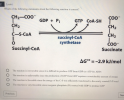 21 point Which of the following statements about the following reaction is correct? CO01 CH2-C00- GDP + P; GTP COA-SH CH2 C-s-coa CH2 succinyl-CoA synthetase COO- Succinyl-CoA Succinate O AG'º = -2.9 kJ/mol The reaction is irreversible since it is difficult to produce GTP from GDP (or ATP fro ADP) The reaction is unfavorable since the production of GTP from GDP requires a considerable amount of energy The reaction is favorable since the energy of the C-S was efficiently transferred...
please answer all 1. A type of adipose tissue in many organisms is called brown fat....
please answer all 1. A type of adipose tissue in many organisms is called brown fat. Which of the following statements is correct for brown fat? Hibernating bears have very little of this type of adipose tissue. It produces a great deal of heat as a result of the presence of thermogenin. The efficiency of oxidative phosphorylation is high in this tissue. Its color is derived from high blood supply. 2. What statement illustrates the role of Ca2+ in regulation...
1. 2. 3. 4. Select all that apply. Identify the reaction(s) of glycolysis inhibited by ATP □ glyceraldehyde-3-phosphate → 1,3-bisphosphoglycerate phosphoenolpyruvate +pyruvate 3-phosphoglycerate...
 1.
2.
3.
4.
Select all that apply. Identify the reaction(s) of glycolysis inhibited by ATP □ glyceraldehyde-3-phosphate → 1,3-bisphosphoglycerate phosphoenolpyruvate +pyruvate 3-phosphoglycerate ~2-phosphoglycerate 1) fructose-6-phosphate→ fructose-1,6-bisphosphate . glucose glucose-6-phosphate Select all that apply. Alcohol fermentation: consumes ATP as it produces ethanol. O produces carbon dioxide begins as pyruvate is decarboxylated to acetaldehyde in a reaction catalyzed by alcohol dehydrogenase m regenerates NAD requires the enzyme alcohol dehydrogenase, In the figure below, what is the reaction occurring at the location...
1.
2.
3.
4.
Select all that apply. Identify the reaction(s) of glycolysis inhibited by ATP □ glyceraldehyde-3-phosphate → 1,3-bisphosphoglycerate phosphoenolpyruvate +pyruvate 3-phosphoglycerate ~2-phosphoglycerate 1) fructose-6-phosphate→ fructose-1,6-bisphosphate . glucose glucose-6-phosphate Select all that apply. Alcohol fermentation: consumes ATP as it produces ethanol. O produces carbon dioxide begins as pyruvate is decarboxylated to acetaldehyde in a reaction catalyzed by alcohol dehydrogenase m regenerates NAD requires the enzyme alcohol dehydrogenase, In the figure below, what is the reaction occurring at the location...
7) Why do hydrolysis reactions occur more readily in solution than dehydration reactions? A) Hydrolysis reactions...
 7) Why do hydrolysis reactions occur more readily in solution than dehydration reactions? A) Hydrolysis reactions increase G, or Gibbs free energy of the system, B) Hydrolysis reactions are endergonic and increase entropy of the system. C) Hydrolysis reactions are exergonic and decrease entropy of the system. D) Hydrolysis reactions are exergonic and increase entropy of the system. 8) How do cells use the ATP cycle illustrated in the figure? AAA W A) Cells use the cycle to recycle ADP...
QUESTION 1 Imagine you want to get rich by genetically engineering tobacco plants to produce acai...
 QUESTION 1 Imagine you want to get rich by genetically engineering tobacco plants to produce acai berry juice. To do so, you insert the genes for each of the enzymes in the hypothetical acai synthesis pathway, the first step of which is (hypothetically) conversion of glucose to fructose. The challenge is that glucose must be maintained at or above a minimum concentration or the plant will die because it can no longer make ATP. For the reaction pathway shown below,...
Question 1 2 pts How does a noncompetitive inhibitor decrease the rate of an enzyme-catalyzed reaction?...
 Question 1 2 pts How does a noncompetitive inhibitor decrease the rate of an enzyme-catalyzed reaction? by decreasing the free-energy change of the reaction catalyzed by the enzyme by binding to an allosteric site, thus changing the shape of the active site of the enzyme by binding to the active site of the enzyme, thus preventing binding of the normal substrate by binding to the substrate, thus changing its shape so that it no longer binds to the active site...
1) A decrease in entropy is associated with which type of reaction? A) dehydration B) catabolic...
 1) A decrease in entropy is associated with which type of reaction? A) dehydration B) catabolic C) depolymerization D) hydrolysis 2) Which of the following statements is an important consequence of the first law of thermodynamics for a living organism? A) The energy content of an organism is constant. B) An organism ultimately must obtain all of the necessary energy for life from its environment. C) The entropy of an organism decreases with time as the organism grows in complexity....
 1 point The plot below shows the energy diagram for a catalyzed (red) and uncatalyzed (dashed magenta). Which parameter of the process is decreased by an enzyme?* Transition State Uncatalyzed Reaction, ESI Energy Enzyme ES Reaction EP E + P Reaction Coordinate O deltag O energy required to reach the transition state (delta double dagger) rate of reaction energy between the reactants/substrate and products 1 point An assay is a method or technique that measures an aspect of a reaction...
 15. Genetic defect in pyruvate dehydrogenase complex lead a. maple syrup urine disease b. phenyike d. lactic acidemia e. pellagra syrup urine disease b, phenylketonuria c. galactosemia 10. Chemical modification by phosphorylation of pyruvate dehydros a. deactivates the enzyme b. activates the enzyme lation of pyruvate dehydrogenase complex : 17. Pyruvate carboxylase is positively ated through the allosteric mechanism by : a. ATP b. NADH c. Acetyl-SCOA d. TPP e. Biotin 18. Which of the listed coenzymes does not particip...
 21 point Which of the following statements about the following reaction is correct? CO01 CH2-C00- GDP + P; GTP COA-SH CH2 C-s-coa CH2 succinyl-CoA synthetase COO- Succinyl-CoA Succinate O AG'º = -2.9 kJ/mol The reaction is irreversible since it is difficult to produce GTP from GDP (or ATP fro ADP) The reaction is unfavorable since the production of GTP from GDP requires a considerable amount of energy The reaction is favorable since the energy of the C-S was efficiently transferred...
 1.
2.
3.
4.
Select all that apply. Identify the reaction(s) of glycolysis inhibited by ATP □ glyceraldehyde-3-phosphate → 1,3-bisphosphoglycerate phosphoenolpyruvate +pyruvate 3-phosphoglycerate ~2-phosphoglycerate 1) fructose-6-phosphate→ fructose-1,6-bisphosphate . glucose glucose-6-phosphate Select all that apply. Alcohol fermentation: consumes ATP as it produces ethanol. O produces carbon dioxide begins as pyruvate is decarboxylated to acetaldehyde in a reaction catalyzed by alcohol dehydrogenase m regenerates NAD requires the enzyme alcohol dehydrogenase, In the figure below, what is the reaction occurring at the location...
1.
2.
3.
4.
Select all that apply. Identify the reaction(s) of glycolysis inhibited by ATP □ glyceraldehyde-3-phosphate → 1,3-bisphosphoglycerate phosphoenolpyruvate +pyruvate 3-phosphoglycerate ~2-phosphoglycerate 1) fructose-6-phosphate→ fructose-1,6-bisphosphate . glucose glucose-6-phosphate Select all that apply. Alcohol fermentation: consumes ATP as it produces ethanol. O produces carbon dioxide begins as pyruvate is decarboxylated to acetaldehyde in a reaction catalyzed by alcohol dehydrogenase m regenerates NAD requires the enzyme alcohol dehydrogenase, In the figure below, what is the reaction occurring at the location...
 7) Why do hydrolysis reactions occur more readily in solution than dehydration reactions? A) Hydrolysis reactions increase G, or Gibbs free energy of the system, B) Hydrolysis reactions are endergonic and increase entropy of the system. C) Hydrolysis reactions are exergonic and decrease entropy of the system. D) Hydrolysis reactions are exergonic and increase entropy of the system. 8) How do cells use the ATP cycle illustrated in the figure? AAA W A) Cells use the cycle to recycle ADP...
 QUESTION 1 Imagine you want to get rich by genetically engineering tobacco plants to produce acai berry juice. To do so, you insert the genes for each of the enzymes in the hypothetical acai synthesis pathway, the first step of which is (hypothetically) conversion of glucose to fructose. The challenge is that glucose must be maintained at or above a minimum concentration or the plant will die because it can no longer make ATP. For the reaction pathway shown below,...
 Question 1 2 pts How does a noncompetitive inhibitor decrease the rate of an enzyme-catalyzed reaction? by decreasing the free-energy change of the reaction catalyzed by the enzyme by binding to an allosteric site, thus changing the shape of the active site of the enzyme by binding to the active site of the enzyme, thus preventing binding of the normal substrate by binding to the substrate, thus changing its shape so that it no longer binds to the active site...
 1) A decrease in entropy is associated with which type of reaction? A) dehydration B) catabolic C) depolymerization D) hydrolysis 2) Which of the following statements is an important consequence of the first law of thermodynamics for a living organism? A) The energy content of an organism is constant. B) An organism ultimately must obtain all of the necessary energy for life from its environment. C) The entropy of an organism decreases with time as the organism grows in complexity....
Most questions answered within 3 hours.
-
Where is the error in this code sequence?
String s1 = "Hello";
String s2 = "ello";...
asked 10 months ago -
Financial data for Joel de Paris, Inc., for last year
follow:
Joel de Paris, Inc.
Balance...
asked 10 months ago -
Consider this reaction:
Al2(SO4)3 (aq)+ BaCl3
(aq) Al2Cl6 (aq)- +
3BaSO4(s) . What is the...
asked 10 months ago -
Suppose that Savneet is considering increasing her
recent random sample from 20 car rentals to 40...
asked 10 months ago -
Trucks arrive at an unloading terminal at an average rate of 120
per hour.
Trucks arrive...
asked 10 months ago -
Why are methanol and ethanol completely soluble in water while
octanol is not very little soluble....
asked 10 months ago -
A facilities manager at a university reads in a research report
that the mean amount of...
asked 10 months ago -
When the CuSO4 is rehydrated by adding water to the anhydrous
compound, is this an endothermic...
asked 10 months ago -
A ray of sunlight is passing from diamond into crown glass; the
angle of incidence is...
asked 10 months ago -
A block of mass 0.249 kg is placed on top of a light, vertical
spring of...
asked 10 months ago -
how do the kidneys compensate in the presences of acidosis
a) trigger hyperventilate
b) reserve acid...
asked 10 months ago -
Question 501 pts
The rental rate of capital to the firm increases. Which of the
following...
asked 10 months ago