


Homework Answers
Ans. The given plot shows the difference between enzyme catalyzed reaction and in absence of enzyme.enzyme increases the rate of reaction,not decreases.it neither affectes the delta g or Gibbs free energy.so,in the given plot enzymes affects the energy required to stabilize the substrate in the transition state.means whatever the energy is require,enzyme decreases that energy and stabilize in transition state within minimum time.
Add Answer to:
1 point The plot below shows the energy diagram for a catalyzed (red) and uncatalyzed (dashed...
1 point An assay is a method or technique that measures an aspect of a reaction...
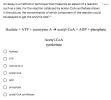 1 point An assay is a method or technique that measures an aspect of a reaction such as a rate. For the reaction catalyzed by acetyl-CoA synthetase shown in the picture, the concentration of which component of the reaction could be assayed to get the enzyme rate? * Acetate + ATP + coenzyme A → acetyl-CoA + ADP + phosphate Acetyl-CoA synthetase Acetate ОАТР O O O coenzyme A acetyl-CoA ADP O phosphate acetyl-CoA synthetase 7 points Match the component...
8. Below is a figure depicting the energy diagram of a reaction. Both uncatalyzed and catalyzed...
 8. Below is a figure depicting the energy diagram of a reaction. Both uncatalyzed and catalyzed version of the reaction are shown. Use the figure to answer the following questions. 5 1 AAG (the reduction in AG by the catalyst) G 2 3 A+B=P+Q Reaction coordinate a. Number 4 corresponds to which of the following? a. Products (P+) b. Reactants (A+B) C. Transition state d AG of the reaction b. Which number refers to the energy diagram of the uncatalyzed...
please help! thanks TABLE 12-4 Standard Free Energy Change for Phosphate Hydrolysis Compound AGⓇ' (kJ. mol-')...
 please help! thanks
TABLE 12-4 Standard Free Energy Change for Phosphate Hydrolysis Compound AGⓇ' (kJ. mol-') Phosphoenolpyruvate -61.9 1,3-Bisphosphoglycerate -49.4 ATP → AMP + PP, -45.6 Phosphocreatine -43.1 ATP ADP + P -30.5 Glucose-1-phosphate -20.9 PP, 2P, -19.2 Glucose-6-phosphate -13.8 Glycerol-3-phosphate -9.2 thioester bond AGⓇ' = -31.5 kJ•mol-1 H20 O CH3 -C-s-CoA I CH3 -C-0- + COA-SH Acetyl-CoA The formation of acetyl CoA from acetate is an ATP driven reaction: Acetate + ATP + COA <--> acetyl COA + AMP...
please help! thanks
TABLE 12-4 Standard Free Energy Change for Phosphate Hydrolysis Compound AGⓇ' (kJ. mol-') Phosphoenolpyruvate -61.9 1,3-Bisphosphoglycerate -49.4 ATP → AMP + PP, -45.6 Phosphocreatine -43.1 ATP ADP + P -30.5 Glucose-1-phosphate -20.9 PP, 2P, -19.2 Glucose-6-phosphate -13.8 Glycerol-3-phosphate -9.2 thioester bond AGⓇ' = -31.5 kJ•mol-1 H20 O CH3 -C-s-CoA I CH3 -C-0- + COA-SH Acetyl-CoA The formation of acetyl CoA from acetate is an ATP driven reaction: Acetate + ATP + COA <--> acetyl COA + AMP...
Match the term to the correct description. Choices may only be used once. Group of...
Match the term to the correct description. Choices may only be used once. Group of answer choices [ Choose ] An inhibitor molecule binds to the active site. Part of an enzyme where the substrate binds to Protein molecules that function as biological catalysts An inhibitor molecule binds to an allosteric site and prevents the substrate from binding to the active site. A substance...
Citrate Utilization Test OBSERVATIONS AND INTERPRETATIONS 1 Using Table 5-10, page 340, as a guide, enter...
 Citrate Utilization Test OBSERVATIONS AND INTERPRETATIONS 1 Using Table 5-10, page 340, as a guide, enter your results in the table below. Organism Color Result (+ or -) Interpretation Control QUESTIONS 1 Consider the uninoculated tube. a. Is it a positive or a negative control? b. What information is provided by the uninoculated control? Rus. ay Manry bacteria that are able to metabolize citrate (as seen in the citric acid cycle) produce negative e this test. Why? Be specific. ative...
1. According to the paper, what does lactate dehydrogenase (LDH) do and what does it allow...
 1. According to the paper, what does lactate dehydrogenase
(LDH) do and what does it allow to happen within the myofiber? (5
points)
2. According to the paper, what is the major disadvantage of
relying on glycolysis during high-intensity exercise? (5
points)
3. Using Figure 1 in the paper, briefly describe the different
sources of ATP production at 50% versus 90% AND explain whether you
believe this depiction of ATP production applies to a Type IIX
myofiber in a human....
1. According to the paper, what does lactate dehydrogenase
(LDH) do and what does it allow to happen within the myofiber? (5
points)
2. According to the paper, what is the major disadvantage of
relying on glycolysis during high-intensity exercise? (5
points)
3. Using Figure 1 in the paper, briefly describe the different
sources of ATP production at 50% versus 90% AND explain whether you
believe this depiction of ATP production applies to a Type IIX
myofiber in a human....
 1 point An assay is a method or technique that measures an aspect of a reaction such as a rate. For the reaction catalyzed by acetyl-CoA synthetase shown in the picture, the concentration of which component of the reaction could be assayed to get the enzyme rate? * Acetate + ATP + coenzyme A → acetyl-CoA + ADP + phosphate Acetyl-CoA synthetase Acetate ОАТР O O O coenzyme A acetyl-CoA ADP O phosphate acetyl-CoA synthetase 7 points Match the component...
 8. Below is a figure depicting the energy diagram of a reaction. Both uncatalyzed and catalyzed version of the reaction are shown. Use the figure to answer the following questions. 5 1 AAG (the reduction in AG by the catalyst) G 2 3 A+B=P+Q Reaction coordinate a. Number 4 corresponds to which of the following? a. Products (P+) b. Reactants (A+B) C. Transition state d AG of the reaction b. Which number refers to the energy diagram of the uncatalyzed...
 please help! thanks
TABLE 12-4 Standard Free Energy Change for Phosphate Hydrolysis Compound AGⓇ' (kJ. mol-') Phosphoenolpyruvate -61.9 1,3-Bisphosphoglycerate -49.4 ATP → AMP + PP, -45.6 Phosphocreatine -43.1 ATP ADP + P -30.5 Glucose-1-phosphate -20.9 PP, 2P, -19.2 Glucose-6-phosphate -13.8 Glycerol-3-phosphate -9.2 thioester bond AGⓇ' = -31.5 kJ•mol-1 H20 O CH3 -C-s-CoA I CH3 -C-0- + COA-SH Acetyl-CoA The formation of acetyl CoA from acetate is an ATP driven reaction: Acetate + ATP + COA <--> acetyl COA + AMP...
please help! thanks
TABLE 12-4 Standard Free Energy Change for Phosphate Hydrolysis Compound AGⓇ' (kJ. mol-') Phosphoenolpyruvate -61.9 1,3-Bisphosphoglycerate -49.4 ATP → AMP + PP, -45.6 Phosphocreatine -43.1 ATP ADP + P -30.5 Glucose-1-phosphate -20.9 PP, 2P, -19.2 Glucose-6-phosphate -13.8 Glycerol-3-phosphate -9.2 thioester bond AGⓇ' = -31.5 kJ•mol-1 H20 O CH3 -C-s-CoA I CH3 -C-0- + COA-SH Acetyl-CoA The formation of acetyl CoA from acetate is an ATP driven reaction: Acetate + ATP + COA <--> acetyl COA + AMP...
 Citrate Utilization Test OBSERVATIONS AND INTERPRETATIONS 1 Using Table 5-10, page 340, as a guide, enter your results in the table below. Organism Color Result (+ or -) Interpretation Control QUESTIONS 1 Consider the uninoculated tube. a. Is it a positive or a negative control? b. What information is provided by the uninoculated control? Rus. ay Manry bacteria that are able to metabolize citrate (as seen in the citric acid cycle) produce negative e this test. Why? Be specific. ative...
 1. According to the paper, what does lactate dehydrogenase
(LDH) do and what does it allow to happen within the myofiber? (5
points)
2. According to the paper, what is the major disadvantage of
relying on glycolysis during high-intensity exercise? (5
points)
3. Using Figure 1 in the paper, briefly describe the different
sources of ATP production at 50% versus 90% AND explain whether you
believe this depiction of ATP production applies to a Type IIX
myofiber in a human....
1. According to the paper, what does lactate dehydrogenase
(LDH) do and what does it allow to happen within the myofiber? (5
points)
2. According to the paper, what is the major disadvantage of
relying on glycolysis during high-intensity exercise? (5
points)
3. Using Figure 1 in the paper, briefly describe the different
sources of ATP production at 50% versus 90% AND explain whether you
believe this depiction of ATP production applies to a Type IIX
myofiber in a human....
Most questions answered within 3 hours.
-
Where is the error in this code sequence?
String s1 = "Hello";
String s2 = "ello";...
asked 10 months ago -
Financial data for Joel de Paris, Inc., for last year
follow:
Joel de Paris, Inc.
Balance...
asked 10 months ago -
Consider this reaction:
Al2(SO4)3 (aq)+ BaCl3
(aq) Al2Cl6 (aq)- +
3BaSO4(s) . What is the...
asked 10 months ago -
Suppose that Savneet is considering increasing her
recent random sample from 20 car rentals to 40...
asked 10 months ago -
Trucks arrive at an unloading terminal at an average rate of 120
per hour.
Trucks arrive...
asked 10 months ago -
Why are methanol and ethanol completely soluble in water while
octanol is not very little soluble....
asked 10 months ago -
A facilities manager at a university reads in a research report
that the mean amount of...
asked 10 months ago -
When the CuSO4 is rehydrated by adding water to the anhydrous
compound, is this an endothermic...
asked 10 months ago -
A ray of sunlight is passing from diamond into crown glass; the
angle of incidence is...
asked 10 months ago -
A block of mass 0.249 kg is placed on top of a light, vertical
spring of...
asked 10 months ago -
how do the kidneys compensate in the presences of acidosis
a) trigger hyperventilate
b) reserve acid...
asked 10 months ago -
Question 501 pts
The rental rate of capital to the firm increases. Which of the
following...
asked 10 months ago