

Homework Answers
Comment if any problem.
Add Answer to:
Question 4 How will the pressure change if a sample of an ideal gas in a...
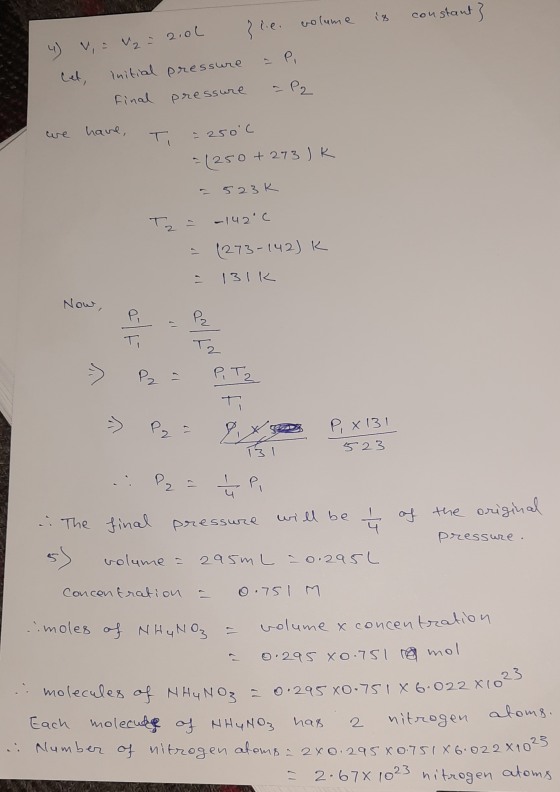
How will the pressure change if a sample of an ideal gas in a rigid 2.0...
 How will the pressure change if a sample of an ideal gas in a rigid 2.0 L container initially at 250 °C is cooled to -142 °C? • The final pressure will be 1/4 of the original pressure. The final pressure will be 1/2 of the original pressure. The final pressure will be the same as the original pressure. The final pressure will be 4 times the original pressure. The gas pressure is reduced to zero The final pressure will...
4. Suppose we change the pressure of an ideal gas at constant temperature. How is the...
 4. Suppose we change the pressure of an ideal gas at constant temperature. How is the corresponding AG related to its AS for the same process? For example, are they proportional to each other, and - if so - what is the proportionality constant?
a. 242 m/s b. 1.21 x 10³ m/s c. 822 m/s d. 483 m/s 25. Is this rms speed the same or different from the nitrogen molecules in the sample? Explain. 26. An ideal gas sample of 11 moles initially at STP...
 a. 242 m/s b. 1.21 x 10³ m/s c. 822 m/s d. 483 m/s 25. Is this rms speed the same or different from the nitrogen molecules in the sample? Explain. 26. An ideal gas sample of 11 moles initially at STP is isothermally compressed to half its original volume. What must be its final pressure? a. 4.8 atm b. 3 atm c. 2 atm d. 4 atm 27. In the previous question, by what factor does the internal energy...
A sample of ideal gas at room temperature occupies a volume of 31.0 L at a pressure of 862 torr. If the press...
 A sample of ideal gas at room temperature occupies a volume of 31.0 L at a pressure of 862 torr. If the pressure changes to 4310 torr, with no change in the temperature or moles of gas, what is the new volume, V2? Express your answer with the appropriate units. ► View Avallable Hint(s) V2 = 6.20 L Submit Previous Answers Correct Part B If the volume of the original sample in Part A (P1 - 862 torr. Vi =...
The temperature used in the ideal gas law must be expressed in a. Celsius b. Fahrenheit...
 The temperature used in the ideal gas law must be expressed in a. Celsius b. Fahrenheit c. Kelvin d. Pascale e. Any of the above 680 Fahrenheit is equivalent to a. 273 Kelvin b. 298 Kelvin c. 0 Celsius d. 212° Fahrenheit e. None of the above Which has more mass, a mole of Nitrogen and a mole of Hydrogen a. 1. 2. 3. Nitroger b. Hydrogen c. Both have same mass d. Neither has any mass 4. Two identical...
Constants Part A A volume of air (assumed to be an ideal gas) is first cooled...
 Constants Part A A volume of air (assumed to be an ideal gas) is first cooled without changing its volume and then expanded without changing its pressure, as shown by the path abc in the figure (Figure 1). How does the final temperature of the gas compare with its initial temperature? Express your answer using two significant figures T1.0 T. Figure < 1011 > Previous Answers p (Pa) Correct 3.0 x 10 2.0 × 10⁵ PartB 1.0 × 10⁵ b...
Problems 1. According to the Ideal Gas Law, which of the following is/are correct for a...
 Problems 1. According to the Ideal Gas Law, which of the following is/are correct for a gas cylinder of fixed volume filled with one mole of oxygen gas? Please explain each one. a. When the temperature of the cylinder changes from 15 °C to 30 °C, the pressure inside the cylinder doubles. b. When a second mole of oxygen is added to the cylinder, the ratio T/P remains constant. C. An identical cylinder filled with the same pressure of hydrogen...
Calculate molar volume of an ideal gas in m^3 at room temperature and pressure (or RTP)....
 Calculate molar volume of an ideal gas in m^3 at room temperature and pressure (or RTP). Id other words, calculate how much volume one mole of an ideal gas at 1.01 times 10^5 Pa and 298 K takes up. Then convert it to liters (l), where 1 t - 0.001 m^3 Measured at 18.00 C, a lead rod has a length of 52.44 cm, and an iron rod has a length of 52.61 cm. Both rods are heated to 86.0...
chemistry. really need help QUESTION 3 4.(9 points) Consider 0.333 mL of an ideal gas initially...
 chemistry. really need help
QUESTION 3 4.(9 points) Consider 0.333 mL of an ideal gas initially at 44.00 °C in a sealed container. What is the final volume after the gas is heated to 100.00 °C at constant pressure? Report your answer in mL with three decimal places. QUESTION 4 7.(7 points) What is the total pressure of a gas mixture composed of 0.622 atm He gas, 844 torr Ne gas and 378 mmHg Ar gas? Report your answer in...
chemistry. really need help
QUESTION 3 4.(9 points) Consider 0.333 mL of an ideal gas initially at 44.00 °C in a sealed container. What is the final volume after the gas is heated to 100.00 °C at constant pressure? Report your answer in mL with three decimal places. QUESTION 4 7.(7 points) What is the total pressure of a gas mixture composed of 0.622 atm He gas, 844 torr Ne gas and 378 mmHg Ar gas? Report your answer in...
Question 1 (1 point) Calculate the density of nitrogen gas in a 4.32 L container at...
Question 1 (1 point) Calculate the density of nitrogen gas in a 4.32 L container at 1.0 atm and 25°C. Question 1 options: 0.57 g/L 0.74 g/L 1.15 g/L 1.31 g/L 1.56 g/L Save Question 2 (1 point) What volume is occupied by 1.00 kg of nitrogen gas at 5.00?C at a pressure of 735 Torr? Question 2 options: 1686 L 1242 L 843 L 738 L 621 L Save Question 3 (1 point) The ideal gas law fails to...
 How will the pressure change if a sample of an ideal gas in a rigid 2.0 L container initially at 250 °C is cooled to -142 °C? • The final pressure will be 1/4 of the original pressure. The final pressure will be 1/2 of the original pressure. The final pressure will be the same as the original pressure. The final pressure will be 4 times the original pressure. The gas pressure is reduced to zero The final pressure will...
 4. Suppose we change the pressure of an ideal gas at constant temperature. How is the corresponding AG related to its AS for the same process? For example, are they proportional to each other, and - if so - what is the proportionality constant?
 a. 242 m/s b. 1.21 x 10³ m/s c. 822 m/s d. 483 m/s 25. Is this rms speed the same or different from the nitrogen molecules in the sample? Explain. 26. An ideal gas sample of 11 moles initially at STP is isothermally compressed to half its original volume. What must be its final pressure? a. 4.8 atm b. 3 atm c. 2 atm d. 4 atm 27. In the previous question, by what factor does the internal energy...
 A sample of ideal gas at room temperature occupies a volume of 31.0 L at a pressure of 862 torr. If the pressure changes to 4310 torr, with no change in the temperature or moles of gas, what is the new volume, V2? Express your answer with the appropriate units. ► View Avallable Hint(s) V2 = 6.20 L Submit Previous Answers Correct Part B If the volume of the original sample in Part A (P1 - 862 torr. Vi =...
 The temperature used in the ideal gas law must be expressed in a. Celsius b. Fahrenheit c. Kelvin d. Pascale e. Any of the above 680 Fahrenheit is equivalent to a. 273 Kelvin b. 298 Kelvin c. 0 Celsius d. 212° Fahrenheit e. None of the above Which has more mass, a mole of Nitrogen and a mole of Hydrogen a. 1. 2. 3. Nitroger b. Hydrogen c. Both have same mass d. Neither has any mass 4. Two identical...
 Constants Part A A volume of air (assumed to be an ideal gas) is first cooled without changing its volume and then expanded without changing its pressure, as shown by the path abc in the figure (Figure 1). How does the final temperature of the gas compare with its initial temperature? Express your answer using two significant figures T1.0 T. Figure < 1011 > Previous Answers p (Pa) Correct 3.0 x 10 2.0 × 10⁵ PartB 1.0 × 10⁵ b...
 Problems 1. According to the Ideal Gas Law, which of the following is/are correct for a gas cylinder of fixed volume filled with one mole of oxygen gas? Please explain each one. a. When the temperature of the cylinder changes from 15 °C to 30 °C, the pressure inside the cylinder doubles. b. When a second mole of oxygen is added to the cylinder, the ratio T/P remains constant. C. An identical cylinder filled with the same pressure of hydrogen...
 Calculate molar volume of an ideal gas in m^3 at room temperature and pressure (or RTP). Id other words, calculate how much volume one mole of an ideal gas at 1.01 times 10^5 Pa and 298 K takes up. Then convert it to liters (l), where 1 t - 0.001 m^3 Measured at 18.00 C, a lead rod has a length of 52.44 cm, and an iron rod has a length of 52.61 cm. Both rods are heated to 86.0...
 chemistry. really need help
QUESTION 3 4.(9 points) Consider 0.333 mL of an ideal gas initially at 44.00 °C in a sealed container. What is the final volume after the gas is heated to 100.00 °C at constant pressure? Report your answer in mL with three decimal places. QUESTION 4 7.(7 points) What is the total pressure of a gas mixture composed of 0.622 atm He gas, 844 torr Ne gas and 378 mmHg Ar gas? Report your answer in...
chemistry. really need help
QUESTION 3 4.(9 points) Consider 0.333 mL of an ideal gas initially at 44.00 °C in a sealed container. What is the final volume after the gas is heated to 100.00 °C at constant pressure? Report your answer in mL with three decimal places. QUESTION 4 7.(7 points) What is the total pressure of a gas mixture composed of 0.622 atm He gas, 844 torr Ne gas and 378 mmHg Ar gas? Report your answer in...
Most questions answered within 3 hours.
-
Where is the error in this code sequence?
String s1 = "Hello";
String s2 = "ello";...
asked 10 months ago -
Financial data for Joel de Paris, Inc., for last year
follow:
Joel de Paris, Inc.
Balance...
asked 10 months ago -
Consider this reaction:
Al2(SO4)3 (aq)+ BaCl3
(aq) Al2Cl6 (aq)- +
3BaSO4(s) . What is the...
asked 10 months ago -
Suppose that Savneet is considering increasing her
recent random sample from 20 car rentals to 40...
asked 10 months ago -
Trucks arrive at an unloading terminal at an average rate of 120
per hour.
Trucks arrive...
asked 10 months ago -
Why are methanol and ethanol completely soluble in water while
octanol is not very little soluble....
asked 10 months ago -
A facilities manager at a university reads in a research report
that the mean amount of...
asked 10 months ago -
When the CuSO4 is rehydrated by adding water to the anhydrous
compound, is this an endothermic...
asked 10 months ago -
A ray of sunlight is passing from diamond into crown glass; the
angle of incidence is...
asked 10 months ago -
A block of mass 0.249 kg is placed on top of a light, vertical
spring of...
asked 10 months ago -
how do the kidneys compensate in the presences of acidosis
a) trigger hyperventilate
b) reserve acid...
asked 10 months ago -
Question 501 pts
The rental rate of capital to the firm increases. Which of the
following...
asked 10 months ago