From a 2,000 μg/mL BSA stock, create 1 mL of each of the following stock solutions...
From a 2,000 μg/mL BSA stock, create 1 mL of each of the following stock solutions in 0.02 M phosphate buffer using individual microcentrifuge tubes: 50 μg/mL, 250 μg/mL, 500 μg/mL, 1,000 μg/mL, 1,250 μg/mL, 1,500 μg/mL. Calculate the volume of BSA stock that will be required to make the standard solutions needed to create the BSA standard curve. Be sure to show your work and include the volume of 0.02 M phosphate buffer required to reach a final volume of 1 mL.
Homework Answers
Okay before I start with the answer, let me explain something about the formula which is used to determine the amount of stock solution we need to make a standard solution.
The formula is M1 * V1 = M2 * V2
In this formula,
M1= The concentration (molarity) of the stock solution
V1= The amount (volume) which we have to take from the stock solution to make the standard solution.
M2= It is the concentration (molarity) of the standard solution which we have to make.
V2= It is the final volume of our standard solution which we are making.
So let's take one standard solution from your question.
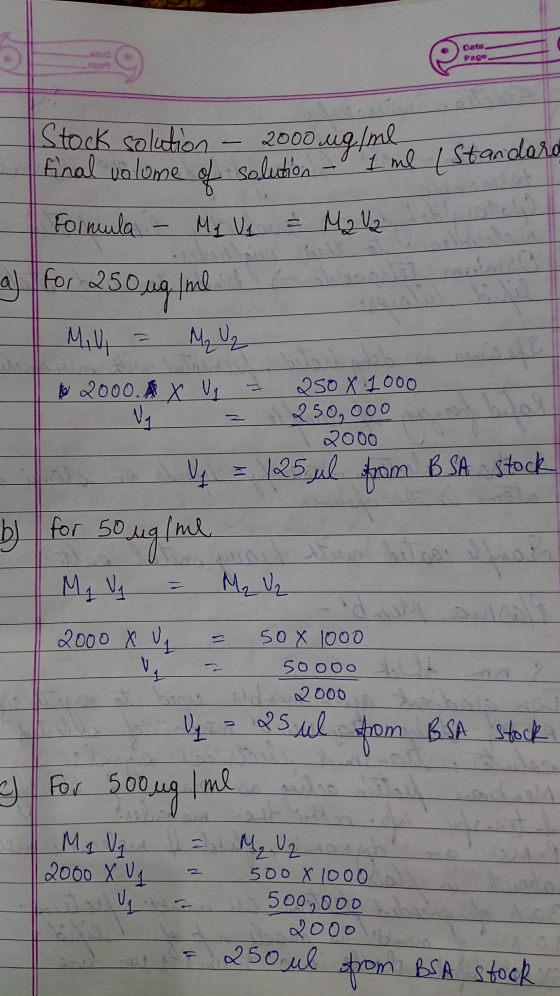
You have to make 50 μg/ml of stock from the 2000 μg/ml. You've to make 1 ml of this 50 μg/ml solution.
So here:-
M1 is 2000 μg/ml
V1 is what we have to find.
M2 is 50 μg/ml
V2 is 1 ml ( we will convert it into μl by multiplying quantity in ml with 1000, thus 1 ml = 1000 μl)
So putting the value in the formula, we have
2000 * V1 = 50 * 1000
2000 * V1 = 50,000 (Multiplying 50 with 1000)
V1 = 50,000 / 2000 (Since we took over 2000 to other side of the equation, the signs have reversed)
V1 = 25 μl (since it's volume, the unit is litre)
So you'll take 25 μl from BSA stock and add it in your diluent (solvent). Since you're using Phosphate buffer as diluent, you'll add the BSA solution in it.
Your final volume should be 1 ml, and since volume taken from BSA stock solution is 25 μl, the rest should be the buffer.
So, 1000 - 25 = 975
You'll add 25 μl BSA stock in 975 μl of Phosphate buffer solution. This will make you final volume 1 ml.
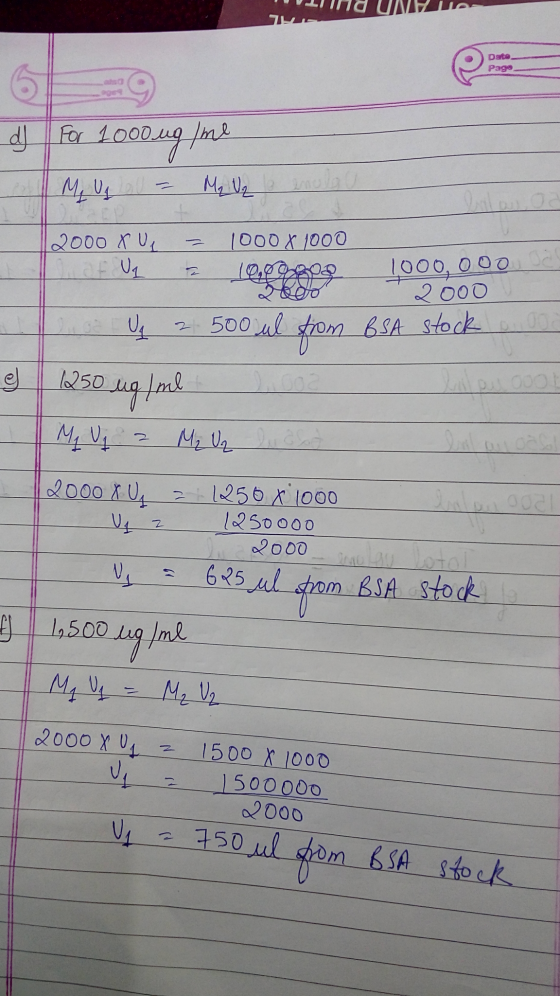
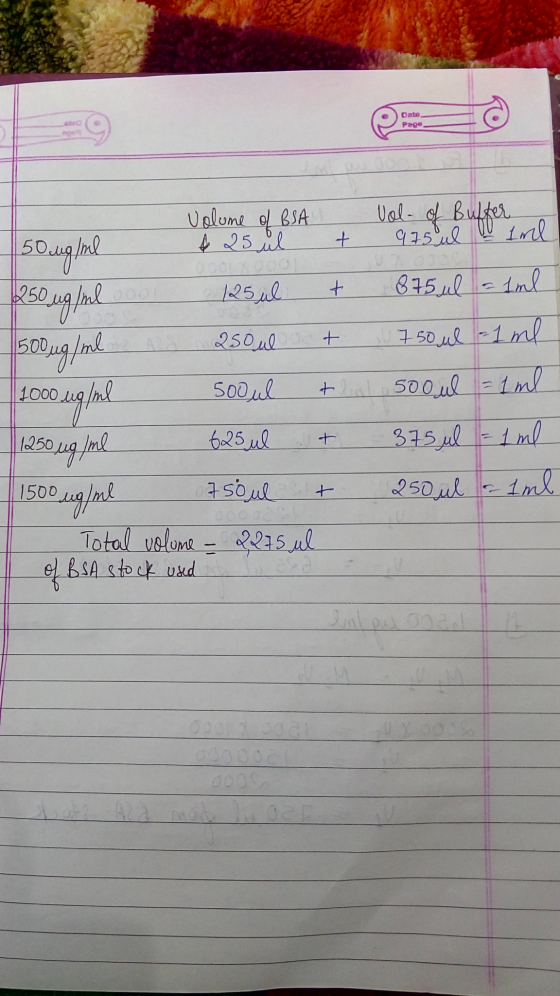
I have added how much phosphate buffer solution you will need to make the final volume 1ml in every case
Total volume of BSA which you'll be using in this is 2,275 μl.
Thank you
Add Answer to:
From a 2,000 μg/mL BSA stock, create 1 mL of each of the
following stock solutions...
1. During the extraction process, the protein samples must be kept on ice. Why? 2. What...
1. During the extraction process, the protein samples must be kept on ice. Why? 2. What is the role of the bovine serum albumin (BSA) in this experiment? 3. Calculate the volume of BSA stock that will be required to make the standard solutions needed to create the BSA standard curve. Be sure to show your work and include the volume of 0.02 M phosphate buffer required to reach a final volume of 1 mL.
ncetoi paper) 1. BSA stock solution A has a concentration of 3.50 mg/mL. 1.00 mL of...
 ncetoi paper) 1. BSA stock solution A has a concentration of 3.50 mg/mL. 1.00 mL of stock solution A is diluted to a final volume of 5.00 mL to prepare solution B. 1.00 mL of solution B is diluted to a final volume of 5.00 mL to prepare solution C. 1.00 mL of solution C is diluted to a final volume of 10.00 mL to prepare solution D. Calculate the concentrations of solutions E, C, and D. Show your work....
You need to calibrate an instrument by creating four ~100 mL standardized stock solutions. The first...
You need to calibrate an instrument by creating four ~100 mL standardized stock solutions. The first solution will be 0.3114 M phosphoric acid. The phosphoric acid is both solid and anhydrous. The remaining three solutions will be serial dilutions of factor 3/10 from the first standard stock solution. Lay out a detailed procedure, protocol, method, and/or recipe for exactly how to create these 4 solutions including all necessary calculations and final molarities. Be sure to be specific into the exact...
You need to calibrate an instrument by creating four ~100 mL standardized stock solutions. The first...
You need to calibrate an instrument by creating four ~100 mL standardized stock solutions. The first solution will be 0.195 M copper (II) nitrite. The copper (II) nitrite is both solid and anhydrous. The remaining three solutions will be serial dilutions of factor 1/10 from the first standard stock solution. Lay out a detailed procedure, protocol, method, and/or recipe for exactly how to create these 4 solutions including all necessary calculations and final molarities. Be sure to be specific into...
1. A series of dilute NaCl solutions are prepared starting with an initial stock solution of...
1. A series of dilute NaCl solutions are prepared starting with an initial stock solution of 0.100 M NaCl. Solution A is prepared by pipeting 10 mL of the stock solution into a 250-mL volumetric flask and diluting to volume. Solution B is prepared by pipeting 25 mL of solution A into a 100-mL volumetric flask and diluting to volume. Solution C is prepared by pipeting 20 mL of solution B into a 500-mL volumetric flask and diluting to volume....
can someone help with #2 150 mL of 10-1-(WA) SDS 1w/veg of solute/100 ml 10g: 100...
 can
someone help with #2
150 mL of 10-1-(WA) SDS 1w/veg of solute/100 ml 10g: 100 ml 150 ml 10g) 15g SDS in 150 ml dd Haa (100ml) b. 200 mL of 250mm tris buffer, por 7.5 Tris 1210 g/mol PH 7.5 es pot - 14-7.5 = 6.5 Pka of tris: 205 -> pkb - 14-pka = 5.94 POH pkb + log [ BH"] Balt [B]-* [et] Tel : antilog (6.5-5.94) - 3.631 [4] . 3.631 [8] [BHT] + [b],...
can
someone help with #2
150 mL of 10-1-(WA) SDS 1w/veg of solute/100 ml 10g: 100 ml 150 ml 10g) 15g SDS in 150 ml dd Haa (100ml) b. 200 mL of 250mm tris buffer, por 7.5 Tris 1210 g/mol PH 7.5 es pot - 14-7.5 = 6.5 Pka of tris: 205 -> pkb - 14-pka = 5.94 POH pkb + log [ BH"] Balt [B]-* [et] Tel : antilog (6.5-5.94) - 3.631 [4] . 3.631 [8] [BHT] + [b],...
1.Calculate the number of moles of avidin added for each titration based on the added volume...
1.Calculate the number of moles of avidin added for each titration based on the added volume of avidin stock solution and a MW of 68,000 g/mol. Conduct the following steps for each titration: 1) Add Vbuffer of 0.02 M sodium phosphate buffer, pH 7, to a disposable plastic cuvette. 2) Add Vavidin of a solution of 10 mg/mL avidin in 0.02 M sodium phosphate buffer, pH 7. Mix thoroughly by micropipetting up and down. 3) Put the cuvette in the...
1) Calculate the pH of the solution that results from each of the following mixtures. A) 150.0 mL...
1) Calculate the pH of the solution that results from each of the following mixtures. A) 150.0 mL of 0.26 M HF with 225.0 mL of 0.32 M NaF B) 165.0 mL of 0.12 M C2H5NH2 with 275.0 mL of 0.22 M C2H5NH3Cl 2) A) As a technician in a large pharmaceutical research firm, you need to produce 100. mLof a potassium dihydrogen phosphate buffer solution of pH = 6.91. The pKa of H2PO4− is 7.21. You have the following...
Experiment # Starting Substrate Concentration Actual Substrate Concentration Substrate Added (ml) Buffer Added (ml) 1.5 mm...
 Experiment # Starting Substrate Concentration Actual Substrate Concentration Substrate Added (ml) Buffer Added (ml) 1.5 mm 1.5 1.0 mm Nm 1.0 0.5 mm 0.50 0.250 mm 0.250 0.125 mm 0.120 1.38 0.060 MM 0.060 1.44 0.030 mm 0.030 1.47 0.015 mm 0.015 1.485 *Actual substrate concentration is calculated by taking the starting substrate concentration into the final volume of each reaction after enzyme has been added. Note that the total volume for each reaction prior to the addition of enzyme...
Laboratory goggles must be worn! A) Preparation of Solutions from Concentrated Solution In this part the...
 Laboratory goggles must be worn! A) Preparation of Solutions from Concentrated Solution In this part the experiment you will prepare several dilute solutions from the more concentrated cobalt nitrate solution 1. Read the label on the provided cobalt nitrate solution and record the molarity accurately. su-olu 563/ 316.603:48 صلاح 2. 3. 4. Molarity of Ca(NO3)2 solution 182.95 g/mol Obtain a 25-ml buret. Examine its markings, the line that spans the entire circumference occur for each milliliter. The smaller lines indicate...
 ncetoi paper) 1. BSA stock solution A has a concentration of 3.50 mg/mL. 1.00 mL of stock solution A is diluted to a final volume of 5.00 mL to prepare solution B. 1.00 mL of solution B is diluted to a final volume of 5.00 mL to prepare solution C. 1.00 mL of solution C is diluted to a final volume of 10.00 mL to prepare solution D. Calculate the concentrations of solutions E, C, and D. Show your work....
 can
someone help with #2
150 mL of 10-1-(WA) SDS 1w/veg of solute/100 ml 10g: 100 ml 150 ml 10g) 15g SDS in 150 ml dd Haa (100ml) b. 200 mL of 250mm tris buffer, por 7.5 Tris 1210 g/mol PH 7.5 es pot - 14-7.5 = 6.5 Pka of tris: 205 -> pkb - 14-pka = 5.94 POH pkb + log [ BH"] Balt [B]-* [et] Tel : antilog (6.5-5.94) - 3.631 [4] . 3.631 [8] [BHT] + [b],...
can
someone help with #2
150 mL of 10-1-(WA) SDS 1w/veg of solute/100 ml 10g: 100 ml 150 ml 10g) 15g SDS in 150 ml dd Haa (100ml) b. 200 mL of 250mm tris buffer, por 7.5 Tris 1210 g/mol PH 7.5 es pot - 14-7.5 = 6.5 Pka of tris: 205 -> pkb - 14-pka = 5.94 POH pkb + log [ BH"] Balt [B]-* [et] Tel : antilog (6.5-5.94) - 3.631 [4] . 3.631 [8] [BHT] + [b],...
 Experiment # Starting Substrate Concentration Actual Substrate Concentration Substrate Added (ml) Buffer Added (ml) 1.5 mm 1.5 1.0 mm Nm 1.0 0.5 mm 0.50 0.250 mm 0.250 0.125 mm 0.120 1.38 0.060 MM 0.060 1.44 0.030 mm 0.030 1.47 0.015 mm 0.015 1.485 *Actual substrate concentration is calculated by taking the starting substrate concentration into the final volume of each reaction after enzyme has been added. Note that the total volume for each reaction prior to the addition of enzyme...
 Laboratory goggles must be worn! A) Preparation of Solutions from Concentrated Solution In this part the experiment you will prepare several dilute solutions from the more concentrated cobalt nitrate solution 1. Read the label on the provided cobalt nitrate solution and record the molarity accurately. su-olu 563/ 316.603:48 صلاح 2. 3. 4. Molarity of Ca(NO3)2 solution 182.95 g/mol Obtain a 25-ml buret. Examine its markings, the line that spans the entire circumference occur for each milliliter. The smaller lines indicate...
Most questions answered within 3 hours.
-
Where is the error in this code sequence?
String s1 = "Hello";
String s2 = "ello";...
asked 11 months ago -
Financial data for Joel de Paris, Inc., for last year
follow:
Joel de Paris, Inc.
Balance...
asked 11 months ago -
Consider this reaction:
Al2(SO4)3 (aq)+ BaCl3
(aq) Al2Cl6 (aq)- +
3BaSO4(s) . What is the...
asked 11 months ago -
Suppose that Savneet is considering increasing her
recent random sample from 20 car rentals to 40...
asked 11 months ago -
Trucks arrive at an unloading terminal at an average rate of 120
per hour.
Trucks arrive...
asked 11 months ago -
Why are methanol and ethanol completely soluble in water while
octanol is not very little soluble....
asked 11 months ago -
A facilities manager at a university reads in a research report
that the mean amount of...
asked 11 months ago -
When the CuSO4 is rehydrated by adding water to the anhydrous
compound, is this an endothermic...
asked 11 months ago -
A ray of sunlight is passing from diamond into crown glass; the
angle of incidence is...
asked 11 months ago -
A block of mass 0.249 kg is placed on top of a light, vertical
spring of...
asked 11 months ago -
how do the kidneys compensate in the presences of acidosis
a) trigger hyperventilate
b) reserve acid...
asked 11 months ago -
Question 501 pts
The rental rate of capital to the firm increases. Which of the
following...
asked 11 months ago