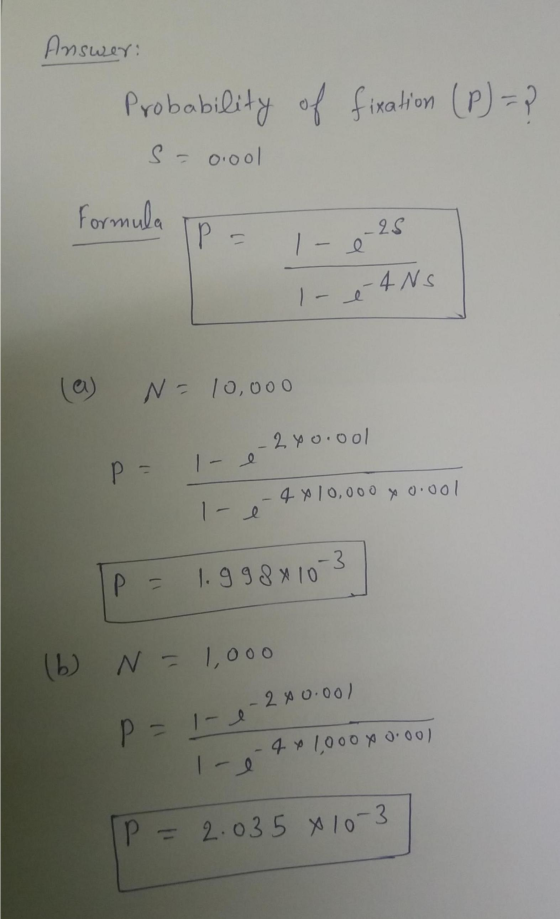
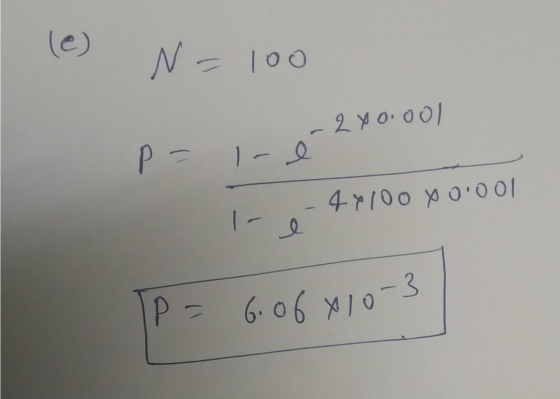
For a deleterious mutation with s = −0.001, what is the probability of fixation in a...
For a deleterious mutation with s = −0.001, what is the probability of fixation in a population of size (a) Ne = 10, 000, (b) Ne = 1, 000, and (c) Ne = 100.
Homework Answers
Add Answer to:
For a deleterious mutation with s = −0.001, what is the
probability of fixation in a...
Imagine there is a co-dominant deleterious new mutation that arises in a population of size 1,000 diploid individuals. T...
Imagine there is a co-dominant deleterious new mutation that arises in a population of size 1,000 diploid individuals. This mutation reduces fitness by 0.001 (s=0.001) in the heterozygous state. What is the probability that this mutation will become fixed in the population?
In a population of 50,000 diploid individuals, what is the probability that a new neutral mutation...
In a population of 50,000 diploid individuals, what is the probability that a new neutral mutation will ultimately reach fixation? Yes, that's correct! a. 0.001 b. 0.0001 c. 0.00001 d. 0.000001 e. 0.0000001
Genetics - Question 3 Defining heterozygosity, H, as the probability that two sequences randomly sampled from a populati...
Genetics - Question 3 Defining heterozygosity, H, as the probability that two sequences randomly sampled from a population are different, for a diploid species with a population size of N = 1000 individuals and initial heterozygosity H0 = 0.5 ; a neutral mutation rate of u = 10-9, What is the rate of substitution with the above mutation rate? Explain. [5 marks] If, for beneficial mutation A1 the selection coefficient is s = 0.01, what is the probability of substitution...
Question 3 [20 marks] Defining heterozygosity, H, as the probability that two sequences randomly sampled from a populati...
Question 3 [20 marks] Defining heterozygosity, H, as the probability that two sequences randomly sampled from a population are different, for a diploid species with a population size of N = 1000 individuals and initial heterozygosity H0 = 0.5 What will the heterozygosity be after 100 generations? [3 marks] How many generations will it take to reduce the heterozygosity by half? [3 marks] With a neutral mutation rate of u = 10-9, what is the equilibrium value of heterozygosity? [3...
Assume h = 0.7 for a mildly deleterious mutation when homozygous (s = 0.05). In this...
Assume h = 0.7 for a mildly deleterious mutation when homozygous (s = 0.05). In this case, the mutation rate to the deleterious form is 10−4. Assuming random mating, what is the equilibrium frequency for the mutant allele? A) 0.00286, B) 0.000314, C) 0.00116, D) 0.00222, E) 0.00346 Please explain, don't just give the answer.
Question 2 Part A [5 marks] If a new mutation for lactase persistence arises in a...
 Question 2 Part A [5 marks] If a new mutation for lactase persistence arises in a human population of size N = 10, what is the probability that the mutation will spread to fixation under each of the following scenarios? i a population with no culture of dairying, where the mutation is neutral ii a population with a culture of dairying, where the mutation has a selective advantage of s 0.1
Question 2 Part A [5 marks] If a new...
Question 2 Part A [5 marks] If a new mutation for lactase persistence arises in a human population of size N = 10, what is the probability that the mutation will spread to fixation under each of the following scenarios? i a population with no culture of dairying, where the mutation is neutral ii a population with a culture of dairying, where the mutation has a selective advantage of s 0.1
Question 2 Part A [5 marks] If a new...
Given a population size of 100,000,000 (108) and a mutation rate of 0.001% calculate the number...
Given a population size of 100,000,000 (108) and a mutation rate of 0.001% calculate the number of expected mutants. Under what circumstances will these mutations increase in the population? Decrease? Remain constant?
What would happen if an allele under positive selection was linked to a deleterious mutation?(Do not...
What would happen if an allele under positive selection was linked to a deleterious mutation?(Do not copy others answers)!!
We're considering a fully recessive, deleterious (harmful) mutation (A2) at an allele frequency of q =...
We're considering a fully recessive, deleterious (harmful) mutation (A2) at an allele frequency of q = 0.01 (one percent) in a large outbreeding population. Thus p(A1) = 0.99. 1. What is the population frequency of A2A2 homozygotes? 2. What is the population frequency of A1A2 heterozygotes? 3. Of all the A2 alleles in the population, what proportion are in heterozygotes? 4. And what proportion are in homozygotes? 5. Now, your country starts a policy of sterilizing all the affected individuals...
1. We're considering a fully recessive, deleterious (harmful) mutation (A2) at an allele frequency of q...
1. We're considering a fully recessive, deleterious (harmful) mutation (A2) at an allele frequency of q = 0.01 (one percent) in a large outbreeding population. Thus p(A1) = 0.99.1. What is the population frequency of A2A2 homozygotes? 2. What is the population frequency of A1A2 heterozygotes? 3. Of all the A2 alleles in the population, what proportion are in heterozygotes? 4. And what proportion are in homozygotes? 5. Now, your country starts a policy of sterilizing all the affected individuals...
 Question 2 Part A [5 marks] If a new mutation for lactase persistence arises in a human population of size N = 10, what is the probability that the mutation will spread to fixation under each of the following scenarios? i a population with no culture of dairying, where the mutation is neutral ii a population with a culture of dairying, where the mutation has a selective advantage of s 0.1
Question 2 Part A [5 marks] If a new...
Question 2 Part A [5 marks] If a new mutation for lactase persistence arises in a human population of size N = 10, what is the probability that the mutation will spread to fixation under each of the following scenarios? i a population with no culture of dairying, where the mutation is neutral ii a population with a culture of dairying, where the mutation has a selective advantage of s 0.1
Question 2 Part A [5 marks] If a new...
Most questions answered within 3 hours.
-
Where is the error in this code sequence?
String s1 = "Hello";
String s2 = "ello";...
asked 10 months ago -
Financial data for Joel de Paris, Inc., for last year
follow:
Joel de Paris, Inc.
Balance...
asked 10 months ago -
Consider this reaction:
Al2(SO4)3 (aq)+ BaCl3
(aq) Al2Cl6 (aq)- +
3BaSO4(s) . What is the...
asked 10 months ago -
Suppose that Savneet is considering increasing her
recent random sample from 20 car rentals to 40...
asked 10 months ago -
Trucks arrive at an unloading terminal at an average rate of 120
per hour.
Trucks arrive...
asked 10 months ago -
Why are methanol and ethanol completely soluble in water while
octanol is not very little soluble....
asked 10 months ago -
A facilities manager at a university reads in a research report
that the mean amount of...
asked 10 months ago -
When the CuSO4 is rehydrated by adding water to the anhydrous
compound, is this an endothermic...
asked 10 months ago -
A ray of sunlight is passing from diamond into crown glass; the
angle of incidence is...
asked 10 months ago -
A block of mass 0.249 kg is placed on top of a light, vertical
spring of...
asked 10 months ago -
how do the kidneys compensate in the presences of acidosis
a) trigger hyperventilate
b) reserve acid...
asked 10 months ago -
Question 501 pts
The rental rate of capital to the firm increases. Which of the
following...
asked 10 months ago