1) Explain these symptoms of cyanide poisoning a) Rapid breathing b) Rapid heart rate c) Weakness...
1) Explain these symptoms of cyanide poisoning
a) Rapid breathing
b) Rapid heart rate
c) Weakness
2) During ETC, the hydrogen carriers are (reduced, oxidized, or synthesized)?
3) During ETC, oxygen is (reduced, oxidized, or synthesized) into water?
4) What are the reactants and the number of them of ETC during aerobic cellular respiration?
Homework Answers
Answer :
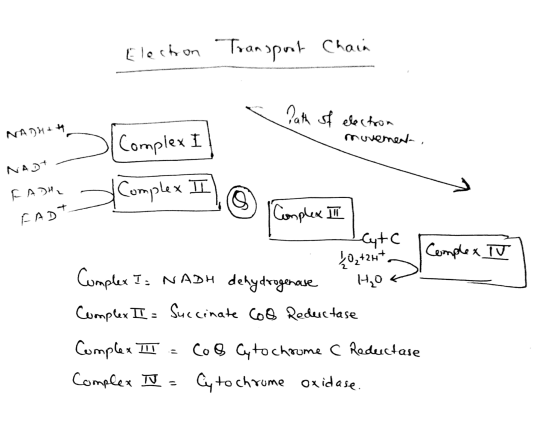
1) Cyanide inhibits cytochrome oxidase and thus prevents cellular oxygen utilisation inhibiting electron transport chain (ETC) .This creates functional tissue hypoxia leading to metabolic acidosis .
Tissue hypoxia and metabolic acidosis lead to tachypnea (increased respiratory rate ) and tachycardia ( increased heart rate ) in an urge to compensate for metabolic needs of the body.
Since ETC is inhibited hence ATP production is hampered leading to weakness ( ATP are energy packets) .
2) During ETC hydrogen carriers like NADH are oxidised
3) Oxygen acts as final electron acceptor to produce water, thus oxygen is reduced.
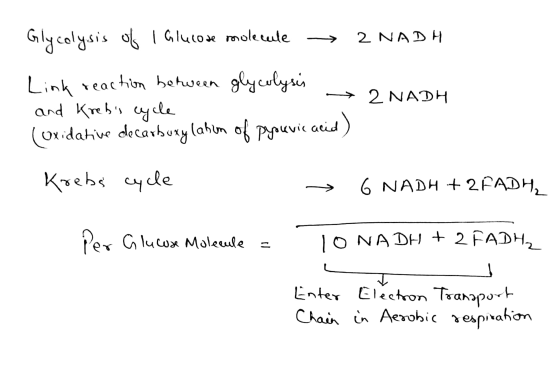
4) NADH, FADH2 are reactants. Usually 10 NADH and 2 FADH2 enter ETC per molecule of glucose utilised by aerobic respiration.
Add Answer to:
1) Explain these symptoms of cyanide poisoning
a) Rapid breathing
b) Rapid heart rate
c) Weakness...
1) Regarding the products and reactants in glycolysis (Choose All) A) although 4 ATPs are synthesized...
1) Regarding the products and reactants in glycolysis (Choose All) A) although 4 ATPs are synthesized for every glucose molecule, there is a net gain of only 2 ATPs/glucose B) ATP is both a reactant and a product C) NAD+ is a product; NADH is a reactant D) glucose is a reactant that is converted to 2 pyruvate products 2) Glycolysis...(Choose All) A) is anaerobic; no oxygen is required B) is probably the most widespread metabolic pathway among organisms C)...
The Mystery of the Seven Deaths: A Case Study in Cellular Respiration by Michaela A. Gazdik...
The Mystery of the Seven Deaths: A Case Study in Cellular Respiration by Michaela A. Gazdik Biology Department Ferrum College, Ferrum VA Part I – The Symptoms Imagine that you work at the medical examiner’s office for a major metropolitan city. As Chief Medical Officer, you investigate suspicious deaths and provide toxicology services for the county. Unfortunately, it’s been a busy week. In the past five days, seven people have died, all with similar symptoms. It is your job to...
Create graphs for Figures 1-4 (circled on pages 111 & 114) based on the data given in Tables ...
 Create graphs for Figures 1-4 (circled on pages 111 & 114)
based on the data given in Tables 2 & 4.
Lab # 8 Cellular Respiration and Fermentation I. Goals and Objectives At the completion of this laboratory exercise, students will be able to: A Differentiate between the intermediates and products of fermentation versus acrobic cellular respiration in yeast. Relate rates of fermentation with sugar availability in yeast. Utilize a reduction-oxidation dye to determine the effect of varying yeast concentration...
Create graphs for Figures 1-4 (circled on pages 111 & 114)
based on the data given in Tables 2 & 4.
Lab # 8 Cellular Respiration and Fermentation I. Goals and Objectives At the completion of this laboratory exercise, students will be able to: A Differentiate between the intermediates and products of fermentation versus acrobic cellular respiration in yeast. Relate rates of fermentation with sugar availability in yeast. Utilize a reduction-oxidation dye to determine the effect of varying yeast concentration...
just the prelab worksheet, no data yet Lab Six: Fermentation Learning Objectives: • Explain the biochemistry...
 just the prelab worksheet, no data yet
Lab Six: Fermentation Learning Objectives: • Explain the biochemistry of fermentation, substrates and products, conditions, and purpose for cells • Describe alcoholic fermentation of yeast, naming reactants and products Perform a pre-designed experiment to measure the rate of yeast fermentation of glucose under two different conditions. Propose hypotheses and make predictions based on them. Design and perform a novel experiment to test additional substrates for yeast fermentation using findings of the pre-designed experiment....
just the prelab worksheet, no data yet
Lab Six: Fermentation Learning Objectives: • Explain the biochemistry of fermentation, substrates and products, conditions, and purpose for cells • Describe alcoholic fermentation of yeast, naming reactants and products Perform a pre-designed experiment to measure the rate of yeast fermentation of glucose under two different conditions. Propose hypotheses and make predictions based on them. Design and perform a novel experiment to test additional substrates for yeast fermentation using findings of the pre-designed experiment....
bio 211 1) B Yeast cells produce carbon dioxide and alcohola ruko A) photosynthesis commentation O...
 bio 211
1) B Yeast cells produce carbon dioxide and alcohola ruko A) photosynthesis commentation O robie respiration D dehydration synthes pered of 12 hours 2) The diagram below shows investigation performed over Bubbles of gas -Rubber stopper Glass tube Water Test Tube - Elodea heels A к не The gas released in this investigation can be used in cellular respiration to form an energy storing compound known as D A co, CH,0 B) deoxyribonucleic acid Di adenosine triphosphate 3)...
bio 211
1) B Yeast cells produce carbon dioxide and alcohola ruko A) photosynthesis commentation O robie respiration D dehydration synthes pered of 12 hours 2) The diagram below shows investigation performed over Bubbles of gas -Rubber stopper Glass tube Water Test Tube - Elodea heels A к не The gas released in this investigation can be used in cellular respiration to form an energy storing compound known as D A co, CH,0 B) deoxyribonucleic acid Di adenosine triphosphate 3)...
I'd like to ask the answers for all of the uestions Question 1. A reaction in...
 I'd
like to ask the answers for all of the uestions
Question 1. A reaction in an anabolic pathway in a cell has a AG of +2.5 kcal/mol. Which of the following is true regarding this reaction? A. It will occur spontaneously. B. The product of the reaction has a lower free energy than the reactants. C. It can occur if it is coupled to ATP hydrolysis. D. It is an exergonic reaction. E. It is breaking a polymer into...
I'd
like to ask the answers for all of the uestions
Question 1. A reaction in an anabolic pathway in a cell has a AG of +2.5 kcal/mol. Which of the following is true regarding this reaction? A. It will occur spontaneously. B. The product of the reaction has a lower free energy than the reactants. C. It can occur if it is coupled to ATP hydrolysis. D. It is an exergonic reaction. E. It is breaking a polymer into...
Vitals Assignment (Read this assignment to answer the questions below) Pulse Rate: • Palpate (feel) the...
 Vitals Assignment (Read this assignment to answer the questions below) Pulse Rate: • Palpate (feel) the pulse for 20-30 seconds to just make sure the pulse feels balanced / steady Age Newborn 0-5 months 6-12 months Normal heart rate (beats per minute) Range 29 Typical example 100-1601311 1 30 90-150 120 80-140 110 80-130 80-120 70-110 60-105 80 60-100 80 Normal respiratory rate (breaths per minute) Range 30 Typical example 30-50 25-40 20-30 20-30 20-30 15-30 12-20 12-30 citation needed...
Based on the data of Respirstion of Peas at Room Temperature and Colder Temperature answer the...
 Based on the data of Respirstion of Peas at Room Temperature and
Colder Temperature answer the following questions:
1. Write two hypothesis that this experiment is designed to
test
2. Using the general gas law (V= nRT/p) give the variables
that had to be controlled for your data to be valid. State the
controls used for each variable and any means used to correct for
the influence of a variable.
3. Why does respirometer 3 serve as a negative control?...
Based on the data of Respirstion of Peas at Room Temperature and
Colder Temperature answer the following questions:
1. Write two hypothesis that this experiment is designed to
test
2. Using the general gas law (V= nRT/p) give the variables
that had to be controlled for your data to be valid. State the
controls used for each variable and any means used to correct for
the influence of a variable.
3. Why does respirometer 3 serve as a negative control?...
During the aerobic metabolism of glucose, glucose is ____________. Reduced to form water Oxidized to form...
During the aerobic metabolism of glucose, glucose is ____________. Reduced to form water Oxidized to form water Reduced to form CO2 Oxidized to form CO2 Which of the following describes the equation: FAD + XH2 à FADH2 + X. FAD is reduced to FADH2 It is a coupled reduction – oxidation reaction XH2 is oxidized to X All of the above Which of the following is FALSE about glycolysis? The initial steps of glycolysis requires energy derived from the splitting...
A deficiency of the B vitamin niacin can result in which of the following? A beriberi B Wernicke encephalopathy c pellagra D scurvy 1. Which organ contributes to the homeostasis of riboflavin...
 A deficiency of the B vitamin niacin can result in which of the following? A beriberi B Wernicke encephalopathy c pellagra D scurvy 1. Which organ contributes to the homeostasis of riboflavin by removing the excess? A kidney B liver C stomach D duodenum 2. 3. How does smoking seem to affect biotin catabolism in women? A increases it decreases it B C changes it into a toxic substance D there is no effect on biotin from smoking The primary...
 Create graphs for Figures 1-4 (circled on pages 111 & 114)
based on the data given in Tables 2 & 4.
Lab # 8 Cellular Respiration and Fermentation I. Goals and Objectives At the completion of this laboratory exercise, students will be able to: A Differentiate between the intermediates and products of fermentation versus acrobic cellular respiration in yeast. Relate rates of fermentation with sugar availability in yeast. Utilize a reduction-oxidation dye to determine the effect of varying yeast concentration...
Create graphs for Figures 1-4 (circled on pages 111 & 114)
based on the data given in Tables 2 & 4.
Lab # 8 Cellular Respiration and Fermentation I. Goals and Objectives At the completion of this laboratory exercise, students will be able to: A Differentiate between the intermediates and products of fermentation versus acrobic cellular respiration in yeast. Relate rates of fermentation with sugar availability in yeast. Utilize a reduction-oxidation dye to determine the effect of varying yeast concentration...
 just the prelab worksheet, no data yet
Lab Six: Fermentation Learning Objectives: • Explain the biochemistry of fermentation, substrates and products, conditions, and purpose for cells • Describe alcoholic fermentation of yeast, naming reactants and products Perform a pre-designed experiment to measure the rate of yeast fermentation of glucose under two different conditions. Propose hypotheses and make predictions based on them. Design and perform a novel experiment to test additional substrates for yeast fermentation using findings of the pre-designed experiment....
just the prelab worksheet, no data yet
Lab Six: Fermentation Learning Objectives: • Explain the biochemistry of fermentation, substrates and products, conditions, and purpose for cells • Describe alcoholic fermentation of yeast, naming reactants and products Perform a pre-designed experiment to measure the rate of yeast fermentation of glucose under two different conditions. Propose hypotheses and make predictions based on them. Design and perform a novel experiment to test additional substrates for yeast fermentation using findings of the pre-designed experiment....
 bio 211
1) B Yeast cells produce carbon dioxide and alcohola ruko A) photosynthesis commentation O robie respiration D dehydration synthes pered of 12 hours 2) The diagram below shows investigation performed over Bubbles of gas -Rubber stopper Glass tube Water Test Tube - Elodea heels A к не The gas released in this investigation can be used in cellular respiration to form an energy storing compound known as D A co, CH,0 B) deoxyribonucleic acid Di adenosine triphosphate 3)...
bio 211
1) B Yeast cells produce carbon dioxide and alcohola ruko A) photosynthesis commentation O robie respiration D dehydration synthes pered of 12 hours 2) The diagram below shows investigation performed over Bubbles of gas -Rubber stopper Glass tube Water Test Tube - Elodea heels A к не The gas released in this investigation can be used in cellular respiration to form an energy storing compound known as D A co, CH,0 B) deoxyribonucleic acid Di adenosine triphosphate 3)...
 I'd
like to ask the answers for all of the uestions
Question 1. A reaction in an anabolic pathway in a cell has a AG of +2.5 kcal/mol. Which of the following is true regarding this reaction? A. It will occur spontaneously. B. The product of the reaction has a lower free energy than the reactants. C. It can occur if it is coupled to ATP hydrolysis. D. It is an exergonic reaction. E. It is breaking a polymer into...
I'd
like to ask the answers for all of the uestions
Question 1. A reaction in an anabolic pathway in a cell has a AG of +2.5 kcal/mol. Which of the following is true regarding this reaction? A. It will occur spontaneously. B. The product of the reaction has a lower free energy than the reactants. C. It can occur if it is coupled to ATP hydrolysis. D. It is an exergonic reaction. E. It is breaking a polymer into...
 Vitals Assignment (Read this assignment to answer the questions below) Pulse Rate: • Palpate (feel) the pulse for 20-30 seconds to just make sure the pulse feels balanced / steady Age Newborn 0-5 months 6-12 months Normal heart rate (beats per minute) Range 29 Typical example 100-1601311 1 30 90-150 120 80-140 110 80-130 80-120 70-110 60-105 80 60-100 80 Normal respiratory rate (breaths per minute) Range 30 Typical example 30-50 25-40 20-30 20-30 20-30 15-30 12-20 12-30 citation needed...
 Based on the data of Respirstion of Peas at Room Temperature and
Colder Temperature answer the following questions:
1. Write two hypothesis that this experiment is designed to
test
2. Using the general gas law (V= nRT/p) give the variables
that had to be controlled for your data to be valid. State the
controls used for each variable and any means used to correct for
the influence of a variable.
3. Why does respirometer 3 serve as a negative control?...
Based on the data of Respirstion of Peas at Room Temperature and
Colder Temperature answer the following questions:
1. Write two hypothesis that this experiment is designed to
test
2. Using the general gas law (V= nRT/p) give the variables
that had to be controlled for your data to be valid. State the
controls used for each variable and any means used to correct for
the influence of a variable.
3. Why does respirometer 3 serve as a negative control?...
 A deficiency of the B vitamin niacin can result in which of the following? A beriberi B Wernicke encephalopathy c pellagra D scurvy 1. Which organ contributes to the homeostasis of riboflavin by removing the excess? A kidney B liver C stomach D duodenum 2. 3. How does smoking seem to affect biotin catabolism in women? A increases it decreases it B C changes it into a toxic substance D there is no effect on biotin from smoking The primary...
Most questions answered within 3 hours.
-
Where is the error in this code sequence?
String s1 = "Hello";
String s2 = "ello";...
asked 11 months ago -
Financial data for Joel de Paris, Inc., for last year
follow:
Joel de Paris, Inc.
Balance...
asked 11 months ago -
Consider this reaction:
Al2(SO4)3 (aq)+ BaCl3
(aq) Al2Cl6 (aq)- +
3BaSO4(s) . What is the...
asked 11 months ago -
Suppose that Savneet is considering increasing her
recent random sample from 20 car rentals to 40...
asked 11 months ago -
Trucks arrive at an unloading terminal at an average rate of 120
per hour.
Trucks arrive...
asked 11 months ago -
Why are methanol and ethanol completely soluble in water while
octanol is not very little soluble....
asked 11 months ago -
A facilities manager at a university reads in a research report
that the mean amount of...
asked 11 months ago -
When the CuSO4 is rehydrated by adding water to the anhydrous
compound, is this an endothermic...
asked 11 months ago -
A ray of sunlight is passing from diamond into crown glass; the
angle of incidence is...
asked 11 months ago -
A block of mass 0.249 kg is placed on top of a light, vertical
spring of...
asked 11 months ago -
how do the kidneys compensate in the presences of acidosis
a) trigger hyperventilate
b) reserve acid...
asked 11 months ago -
Question 501 pts
The rental rate of capital to the firm increases. Which of the
following...
asked 11 months ago