
Homework Answers
Ans : Option D : Glucose 6-Phosphate
Please find the attachment for explanation-

Add Answer to:
il Uide bol. 4G 15:11 @ 1 19%D Chapter 14-Homework.xls 37. Which compound links glycolysis and...
..il Uide bol. 4G 16:02 @ 1 31% O Chapter 14-Homework.xls 42. la Two reactions in...
 ..il Uide bol. 4G 16:02 @ 1 31% O Chapter 14-Homework.xls 42. la Two reactions in glycolysis produce ATP. For each of these, show the name and structure of reactant and product, indicate which cofactors participate and where, and name the enzymes. 42/45 < E- T- >
...l Uide bol. 4G 13:51 @ 4 14% Касание вернет Вас к вызову 09:10 Chapter 14-Homework.xls...
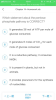 ...l Uide bol. 4G 13:51 @ 4 14% Касание вернет Вас к вызову 09:10 Chapter 14-Homework.xls Which statement about the pentose phosphate pathway is CORRECT? It generates 36 mol of ATP per mole of glucose consumed. It generates 6 moles of CO 2 for each mole of glucose consumed It is a reductive pathway; it consumes NADH. It is present in plants, but not in D animals. It provides precursors for the synthesis of nucleotides. <E- 27/45 22 T- >
..il Uide bol. 4G 15:02 1 16% Chapter 14-Homework.xls 32. ten Which amount of ATP and...
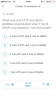 ..il Uide bol. 4G 15:02 1 16% Chapter 14-Homework.xls 32. ten Which amount of ATP and NADH identifies net production when 1 mol of DHAP is converted to 1 mol of pyruvate? A 2 mol of ATP and 2 mol of NADH (B) 2 mol of ATP and 1 mol of NADH (C 2 mol ATP and 0 mol of NADH D 1 mol ATP and 2 mol of NADH E 1 mol ATP and 0 mol of NADH 32/45...
. ..ll Uide bol. 46 13:54 @ 4 15% O Касание вернет Вас к вызову 12:15...
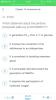 . ..ll Uide bol. 46 13:54 @ 4 15% O Касание вернет Вас к вызову 12:15 < Chapter 14-Homework.xls 28. Which statement about the pentose phosphate pathway is INCORRECT? A It generates CO 2 from C-1 of glucose. It involves the conversion of an aldohexose to an aldopentose. It is prominant in lactating mammary gland. It is principally directed toward the generation of NADPH. It requires the participation of molecular oxygen. 28/45 <E- T- >
match the following 1. Fructose 1,6-bisphosphate is converted to Fructose 6- phosphate through this enzyme _____...
match the following 1. Fructose 1,6-bisphosphate is converted to Fructose 6- phosphate through this enzyme _____ 2. Synthesis of glucose from noncarbohydrate precursors _____ 3. Stage in which two molecules of ATP are consumed _____ 4. This is formed from pyruvate in yeast and several other microorganisms through fermentation _____ 5. The isomerization of glucose 6-phosphate to fructose 6-phosphate is a coversion of an aldose into a …._____ 6. Pyruvate is converted by pyruvate carboxylase into this intermediate _____ 7....
Can someone please check my answers and aid in #12? 1. The amide nitrogen of glutamine:...
Can someone please check my answers and aid in #12? 1. The amide nitrogen of glutamine: A. represents a nontoxic transport form of ammonia. B. is a major source of ammonia for urinary excretion. C. is used in the synthesis of asparagine, purines, and pynimidines. D. can be recovered as ammonia by the action of glutaminase. E. all of the above are correct. 2- Which of the following statements about glutamate is NOT true: a It can be synthesized in...
13. Describe 2 mechanisms whereby ATP is generated during cellular respiration Mechanism 1: Mechanism 2: 14....
 13. Describe 2 mechanisms whereby ATP is generated during cellular respiration Mechanism 1: Mechanism 2: 14. Indicate the MAIN molecules that enter and exit each of these processes? Molecule(s) IN Process Molecule(s) OUT Glycolysis Pyruvate Oxidation Citric Acid/Krebs Cycle ETC Photophosphorylation Calvin Cycle 15. Isocitrate is a 6 carbon molecule that is oxidized to a-ketoglutarate (a 5 carbon molecule) by the enzyme isocitrate dehydrogenase. What happens to the extra carbon atom in this reaction and in which process (listed in...
9 ) When viewed with an electron microscope, what gives the rough Endoplasmic Reticulum its rough...
9 ) When viewed with an electron microscope, what gives the rough Endoplasmic Reticulum its rough appearance? A) The nucleus B) Mitochondria C) Nucleosomes D) Ribosomes E)sugars 10 ) Which statement below describes the function of smooth endoplasmic reticulum? A) Packing and sorting of newly synthesized macromolecules B) Protein Synthesis C) Cellular Respiration D) Detoxification and hydrolysis of polysaccharide E) Photosynthesis 11 ) If a cell is in a hypotonic environment that means…….. Protein synthesis The solute concentration inside...
1. Which of the following is not considered a nutrient a Vitamin B. Water c.Carbohydrate (d)...
 1. Which of the following is not considered a nutrient a Vitamin B. Water c.Carbohydrate (d) Alcohol e Mineral 2. For which of the following causes of death does a person's diet play a part? a. Lung disease (6) Cancer Chronic lower respiratory diseases d. Infections of the blood e AIDS 3. Researchers repeatedly report that people who consume a variety of foods such as fruits, vegetables, legumes, nuts, and whole grains have reduced risks of which of the following...
1. Which of the following are the sites within the human body where carbon dioxide and...
1. Which of the following are the sites within the human body where carbon dioxide and oxygen are exchanged? A. Alveoli B. Arteries C. Synapses D. Venules 2. Which of the following describes the most important reason for repeating an experimental investigation? A. To verify the validity of the original findings B. To expand upon the original investigation C. To manipulate the independent variable D. To attempt to disprove the hypothesis 3. Lithium has an atomic number of 3 and...
 ..il Uide bol. 4G 16:02 @ 1 31% O Chapter 14-Homework.xls 42. la Two reactions in glycolysis produce ATP. For each of these, show the name and structure of reactant and product, indicate which cofactors participate and where, and name the enzymes. 42/45 < E- T- >
 ...l Uide bol. 4G 13:51 @ 4 14% Касание вернет Вас к вызову 09:10 Chapter 14-Homework.xls Which statement about the pentose phosphate pathway is CORRECT? It generates 36 mol of ATP per mole of glucose consumed. It generates 6 moles of CO 2 for each mole of glucose consumed It is a reductive pathway; it consumes NADH. It is present in plants, but not in D animals. It provides precursors for the synthesis of nucleotides. <E- 27/45 22 T- >
 ..il Uide bol. 4G 15:02 1 16% Chapter 14-Homework.xls 32. ten Which amount of ATP and NADH identifies net production when 1 mol of DHAP is converted to 1 mol of pyruvate? A 2 mol of ATP and 2 mol of NADH (B) 2 mol of ATP and 1 mol of NADH (C 2 mol ATP and 0 mol of NADH D 1 mol ATP and 2 mol of NADH E 1 mol ATP and 0 mol of NADH 32/45...
 . ..ll Uide bol. 46 13:54 @ 4 15% O Касание вернет Вас к вызову 12:15 < Chapter 14-Homework.xls 28. Which statement about the pentose phosphate pathway is INCORRECT? A It generates CO 2 from C-1 of glucose. It involves the conversion of an aldohexose to an aldopentose. It is prominant in lactating mammary gland. It is principally directed toward the generation of NADPH. It requires the participation of molecular oxygen. 28/45 <E- T- >
 13. Describe 2 mechanisms whereby ATP is generated during cellular respiration Mechanism 1: Mechanism 2: 14. Indicate the MAIN molecules that enter and exit each of these processes? Molecule(s) IN Process Molecule(s) OUT Glycolysis Pyruvate Oxidation Citric Acid/Krebs Cycle ETC Photophosphorylation Calvin Cycle 15. Isocitrate is a 6 carbon molecule that is oxidized to a-ketoglutarate (a 5 carbon molecule) by the enzyme isocitrate dehydrogenase. What happens to the extra carbon atom in this reaction and in which process (listed in...
 1. Which of the following is not considered a nutrient a Vitamin B. Water c.Carbohydrate (d) Alcohol e Mineral 2. For which of the following causes of death does a person's diet play a part? a. Lung disease (6) Cancer Chronic lower respiratory diseases d. Infections of the blood e AIDS 3. Researchers repeatedly report that people who consume a variety of foods such as fruits, vegetables, legumes, nuts, and whole grains have reduced risks of which of the following...
Most questions answered within 3 hours.
-
Where is the error in this code sequence?
String s1 = "Hello";
String s2 = "ello";...
asked 10 months ago -
Financial data for Joel de Paris, Inc., for last year
follow:
Joel de Paris, Inc.
Balance...
asked 10 months ago -
Consider this reaction:
Al2(SO4)3 (aq)+ BaCl3
(aq) Al2Cl6 (aq)- +
3BaSO4(s) . What is the...
asked 10 months ago -
Suppose that Savneet is considering increasing her
recent random sample from 20 car rentals to 40...
asked 10 months ago -
Trucks arrive at an unloading terminal at an average rate of 120
per hour.
Trucks arrive...
asked 10 months ago -
Why are methanol and ethanol completely soluble in water while
octanol is not very little soluble....
asked 10 months ago -
A facilities manager at a university reads in a research report
that the mean amount of...
asked 10 months ago -
When the CuSO4 is rehydrated by adding water to the anhydrous
compound, is this an endothermic...
asked 10 months ago -
A ray of sunlight is passing from diamond into crown glass; the
angle of incidence is...
asked 10 months ago -
A block of mass 0.249 kg is placed on top of a light, vertical
spring of...
asked 10 months ago -
how do the kidneys compensate in the presences of acidosis
a) trigger hyperventilate
b) reserve acid...
asked 10 months ago -
Question 501 pts
The rental rate of capital to the firm increases. Which of the
following...
asked 10 months ago