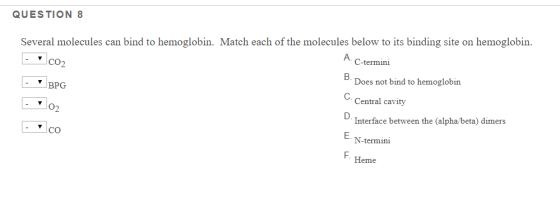
This is a biochemistry question, please take the time to answer both questions and I will like as soon as the answer is posted. Thanks in advance!

Homework Answers
To answer this question, we need to understand the nature of binding of haemoglobin to Oxygen under different conditions. An oxygen binding curve or oxygen dissociation curve shows the relationship between partial pressure of oxygen in the blood and oxygen saturation of haemoglobin. The curve is sigmoid in shape and shifts its position to right or left depending on the affinity of haemoglobin to oxygen at different conditions. If affinity increases, the curve shifts to right and if it decreases the curve shifts to left. The shift depends mainly on factors like temperature, pCO2, 2,3BPG and pH.
The partial pressure of oxygen in the blood at which the haemoglobin is 50% saturated is known as the P50 value. In normal adult haemoglobin P50 is about 26.6 mmHg. But in our question, we are asked to find the curve of HbA with a P50 of 30 Torr. It is clear from the given graph that there is only one option, option C that matches this condition. Therefore c represents HbA.
Each haemoglobin molecule has 4 oxygen binding sites and can bind to 4 oxygen molecules. The affinity of haemoglobin to Oxygen increases as the number of hemes bound to oxygen in that molecule increases. This means that a Hb molecule with a single haeme bound to oxygen have more affinity to Oxygen than a completely deoxygenated Hb molecule. This property of haemoglobin is called cooperative binding. If this property of cooperative binding is lost by mutation or any other factors, the haemoglobin will show a lesser affinity to oxygen. This will shift the Oxygen binding curve to the right. Hence, the most suitable curve for a mutated haemoglobin that has lost all the cooperativity is option d (it is the only curve in the given graph that is shifted to right than the normal). Therefore d represents mutated haemoglobin without cooperativity.
2,3-Bisphosphoglycerate or 2,3-BPG is an organophosphate formed in erythrocytes during glycolysis. The normal concentration of 2,3BPG in human blood is 5mmol/L. But the concentration of 2,3 BPG increases in conditions where the peripheral tissue oxygen availability diminishes, as in case of high altitudes. The body compensates low oxygen availability by increasing red blood cell production, decreasing the binding affinity of haemoglobin and by increasing breathing rate. The binding affinity of Hb is decreased by the increased concentration of 2,3 BPG. Option d is the best match for HbA in presence of elevated 2,3 BPG.
Fetal Hb has greater affinity to Oxygen than adult Hb. This property is attributed to the presence of 2 gamma chains in HbF in place of the 2 beta chains in HbA. 2,3BPG that diminishes oxygen binding affinity binds to the beta chains in HbA and not to the gamma chains of HbF. Therefore HbF is unaffected by the presence of 2,3BPG and shows greater affinity. Due to this structural difference the oxygen binding curve of HbF is shifted to the left relative to HbA. The normal P50 of HbF is 19 mmHg. Therefore in the given graph, option b suits HbF the best.
During vigorous exercise, oxygen binding curve of Hb shifts to right, due to the following reasons: A decrease in pH (as the muscle cells gets more acidic), an increase in muscle temperature (from muscle contraction), an increase in the partial pressure of carbon dioxide (from the working muscles) and an increase in 2,3-BPG. Therefore option d indicates HbA during intense exercise.
Hyperventilation causes a left-shift of the curve which means that it leads to stronger affinity of oxygen to hemoglobin. During hyperventilation,more CO2 is released out than what is produced in the body. This reduces pCO2 and increases the pH. This causes a leftward shift in oxygen binding curve. Option a is the best match for hyperventilation.
- HbA - c
- Mutated Hb lacking cooperativity - d
- Hb in presence of elevated 2,3BPG - d
- HbF - b
- HbA during intense exercise - d
- HbA during hyperventilation - a
Add Answer to:
This is a biochemistry question, please take the time to answer
both questions and I will...
biochemistry concept I need help with. not a hw question. on our test our professor is...
 biochemistry concept I need help with. not a hw question.
on our test our professor is going to ask us something along
the lines of these questions but I just don't understand them even
after reading the questions. I don't understand how to know when to
shift the line to the right vs left.
HEMOGLOBIN Draw the oxygen-binding curve on the graph for A-normal hemoglobin, B normal hemoglobin when BPG levels double and c-a disease that causes high blood oxygenation...
biochemistry concept I need help with. not a hw question.
on our test our professor is going to ask us something along
the lines of these questions but I just don't understand them even
after reading the questions. I don't understand how to know when to
shift the line to the right vs left.
HEMOGLOBIN Draw the oxygen-binding curve on the graph for A-normal hemoglobin, B normal hemoglobin when BPG levels double and c-a disease that causes high blood oxygenation...
biochemistry if you could please help me answer the following questions! EFT i 11) (6 pts)...
 biochemistry
if you could please help me answer the following questions!
EFT i 11) (6 pts) Which types of symmetry are possible for a protein with six (6) identical subunits? (Select all correct answers) a) cyclic C b) cyclic C3 c) dihedral D2 d) dihedral D e) octahedral o f) icosahedral ро, Yo₂ - pO₂+ Pso 12) (6 pts) What is the fractional saturation of oxygen binding to myoglobin when the partial pressure of oxygen is 1.5 torr and dissociation...
biochemistry
if you could please help me answer the following questions!
EFT i 11) (6 pts) Which types of symmetry are possible for a protein with six (6) identical subunits? (Select all correct answers) a) cyclic C b) cyclic C3 c) dihedral D2 d) dihedral D e) octahedral o f) icosahedral ро, Yo₂ - pO₂+ Pso 12) (6 pts) What is the fractional saturation of oxygen binding to myoglobin when the partial pressure of oxygen is 1.5 torr and dissociation...
This is a biochemistry question, please take the time to answer both questions and I will...
 This is a biochemistry question, please take the time to answer
both questions and I will like as soon as the answer is posted.
Thanks in advance!
QUESTION 7 Which of these molecules is NOT produced in glycolysis? Glucose-6-phosphate Fructose-6-phosphate water Inorganic phosphate ATP QUESTION 8 Glycolysis is connected to many other metabolic pathways, which can feed intermediates into glycolysis at different steps. Starting glycolysis at dihydroxyacetone phosphate will give a net yield (per DHAP molecule) of: 2 mol of...
This is a biochemistry question, please take the time to answer
both questions and I will like as soon as the answer is posted.
Thanks in advance!
QUESTION 7 Which of these molecules is NOT produced in glycolysis? Glucose-6-phosphate Fructose-6-phosphate water Inorganic phosphate ATP QUESTION 8 Glycolysis is connected to many other metabolic pathways, which can feed intermediates into glycolysis at different steps. Starting glycolysis at dihydroxyacetone phosphate will give a net yield (per DHAP molecule) of: 2 mol of...
This is a biochemistry question, please take the time to answer both questions and I will...
 This is a biochemistry question, please take the time to answer
both questions and I will like as soon as the answer is posted.
Thanks in advance!
QUESTION 9 Glycolysis is divided into two stages. Identify which of the following characteristics pertain to stage 1 or stage 2 of glycolysis. A. stage 1 - ATP is utilized B. stage 2 - ATP is synthesized - Six-carbon compounds are involved Only three-carbon compounds are involved - - NADH is produced QUESTION...
This is a biochemistry question, please take the time to answer
both questions and I will like as soon as the answer is posted.
Thanks in advance!
QUESTION 9 Glycolysis is divided into two stages. Identify which of the following characteristics pertain to stage 1 or stage 2 of glycolysis. A. stage 1 - ATP is utilized B. stage 2 - ATP is synthesized - Six-carbon compounds are involved Only three-carbon compounds are involved - - NADH is produced QUESTION...
This is a biochemistry question, please take the time to answer both questions and I will...
 This is a biochemistry question, please take the time to answer
both questions and I will like as soon as the answer is posted.
Thanks in advance!
QUESTION 5 Select all the statements that apply to enolase in glycolysis. Catalyzes a reversible reaction Is a regulated enzyme Catalyzes a dehydration Catalyzes a hydrolysis Forms a high-energy intermediate Catalyzes an oxidation Catalyzes a coupled reaction QUESTION 6 Select all the statements that apply to phosphofructokinase in glycolysis. Catalyzes the rate-limiting step...
This is a biochemistry question, please take the time to answer
both questions and I will like as soon as the answer is posted.
Thanks in advance!
QUESTION 5 Select all the statements that apply to enolase in glycolysis. Catalyzes a reversible reaction Is a regulated enzyme Catalyzes a dehydration Catalyzes a hydrolysis Forms a high-energy intermediate Catalyzes an oxidation Catalyzes a coupled reaction QUESTION 6 Select all the statements that apply to phosphofructokinase in glycolysis. Catalyzes the rate-limiting step...
 biochemistry concept I need help with. not a hw question.
on our test our professor is going to ask us something along
the lines of these questions but I just don't understand them even
after reading the questions. I don't understand how to know when to
shift the line to the right vs left.
HEMOGLOBIN Draw the oxygen-binding curve on the graph for A-normal hemoglobin, B normal hemoglobin when BPG levels double and c-a disease that causes high blood oxygenation...
biochemistry concept I need help with. not a hw question.
on our test our professor is going to ask us something along
the lines of these questions but I just don't understand them even
after reading the questions. I don't understand how to know when to
shift the line to the right vs left.
HEMOGLOBIN Draw the oxygen-binding curve on the graph for A-normal hemoglobin, B normal hemoglobin when BPG levels double and c-a disease that causes high blood oxygenation...
 biochemistry
if you could please help me answer the following questions!
EFT i 11) (6 pts) Which types of symmetry are possible for a protein with six (6) identical subunits? (Select all correct answers) a) cyclic C b) cyclic C3 c) dihedral D2 d) dihedral D e) octahedral o f) icosahedral ро, Yo₂ - pO₂+ Pso 12) (6 pts) What is the fractional saturation of oxygen binding to myoglobin when the partial pressure of oxygen is 1.5 torr and dissociation...
biochemistry
if you could please help me answer the following questions!
EFT i 11) (6 pts) Which types of symmetry are possible for a protein with six (6) identical subunits? (Select all correct answers) a) cyclic C b) cyclic C3 c) dihedral D2 d) dihedral D e) octahedral o f) icosahedral ро, Yo₂ - pO₂+ Pso 12) (6 pts) What is the fractional saturation of oxygen binding to myoglobin when the partial pressure of oxygen is 1.5 torr and dissociation...
 This is a biochemistry question, please take the time to answer
both questions and I will like as soon as the answer is posted.
Thanks in advance!
QUESTION 7 Which of these molecules is NOT produced in glycolysis? Glucose-6-phosphate Fructose-6-phosphate water Inorganic phosphate ATP QUESTION 8 Glycolysis is connected to many other metabolic pathways, which can feed intermediates into glycolysis at different steps. Starting glycolysis at dihydroxyacetone phosphate will give a net yield (per DHAP molecule) of: 2 mol of...
This is a biochemistry question, please take the time to answer
both questions and I will like as soon as the answer is posted.
Thanks in advance!
QUESTION 7 Which of these molecules is NOT produced in glycolysis? Glucose-6-phosphate Fructose-6-phosphate water Inorganic phosphate ATP QUESTION 8 Glycolysis is connected to many other metabolic pathways, which can feed intermediates into glycolysis at different steps. Starting glycolysis at dihydroxyacetone phosphate will give a net yield (per DHAP molecule) of: 2 mol of...
 This is a biochemistry question, please take the time to answer
both questions and I will like as soon as the answer is posted.
Thanks in advance!
QUESTION 9 Glycolysis is divided into two stages. Identify which of the following characteristics pertain to stage 1 or stage 2 of glycolysis. A. stage 1 - ATP is utilized B. stage 2 - ATP is synthesized - Six-carbon compounds are involved Only three-carbon compounds are involved - - NADH is produced QUESTION...
This is a biochemistry question, please take the time to answer
both questions and I will like as soon as the answer is posted.
Thanks in advance!
QUESTION 9 Glycolysis is divided into two stages. Identify which of the following characteristics pertain to stage 1 or stage 2 of glycolysis. A. stage 1 - ATP is utilized B. stage 2 - ATP is synthesized - Six-carbon compounds are involved Only three-carbon compounds are involved - - NADH is produced QUESTION...
 This is a biochemistry question, please take the time to answer
both questions and I will like as soon as the answer is posted.
Thanks in advance!
QUESTION 5 Select all the statements that apply to enolase in glycolysis. Catalyzes a reversible reaction Is a regulated enzyme Catalyzes a dehydration Catalyzes a hydrolysis Forms a high-energy intermediate Catalyzes an oxidation Catalyzes a coupled reaction QUESTION 6 Select all the statements that apply to phosphofructokinase in glycolysis. Catalyzes the rate-limiting step...
This is a biochemistry question, please take the time to answer
both questions and I will like as soon as the answer is posted.
Thanks in advance!
QUESTION 5 Select all the statements that apply to enolase in glycolysis. Catalyzes a reversible reaction Is a regulated enzyme Catalyzes a dehydration Catalyzes a hydrolysis Forms a high-energy intermediate Catalyzes an oxidation Catalyzes a coupled reaction QUESTION 6 Select all the statements that apply to phosphofructokinase in glycolysis. Catalyzes the rate-limiting step...
Most questions answered within 3 hours.
-
Where is the error in this code sequence?
String s1 = "Hello";
String s2 = "ello";...
asked 10 months ago -
Financial data for Joel de Paris, Inc., for last year
follow:
Joel de Paris, Inc.
Balance...
asked 10 months ago -
Consider this reaction:
Al2(SO4)3 (aq)+ BaCl3
(aq) Al2Cl6 (aq)- +
3BaSO4(s) . What is the...
asked 10 months ago -
Suppose that Savneet is considering increasing her
recent random sample from 20 car rentals to 40...
asked 10 months ago -
Trucks arrive at an unloading terminal at an average rate of 120
per hour.
Trucks arrive...
asked 10 months ago -
Why are methanol and ethanol completely soluble in water while
octanol is not very little soluble....
asked 10 months ago -
A facilities manager at a university reads in a research report
that the mean amount of...
asked 10 months ago -
When the CuSO4 is rehydrated by adding water to the anhydrous
compound, is this an endothermic...
asked 10 months ago -
A ray of sunlight is passing from diamond into crown glass; the
angle of incidence is...
asked 10 months ago -
A block of mass 0.249 kg is placed on top of a light, vertical
spring of...
asked 10 months ago -
how do the kidneys compensate in the presences of acidosis
a) trigger hyperventilate
b) reserve acid...
asked 10 months ago -
Question 501 pts
The rental rate of capital to the firm increases. Which of the
following...
asked 10 months ago