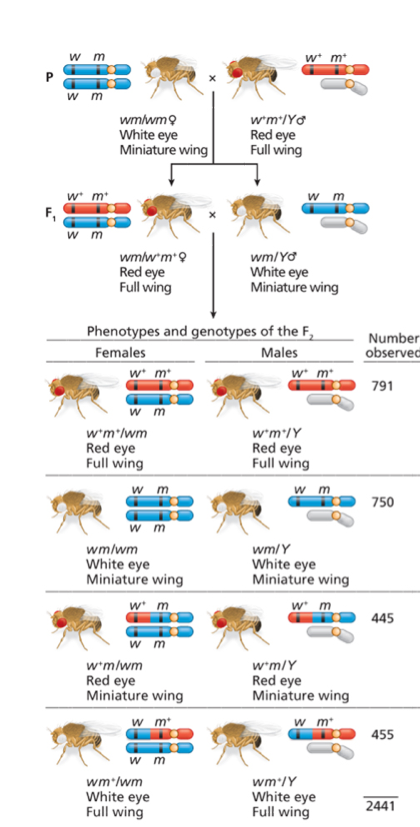
The results for the F2 progeny are shown for a F1 cross using the two X-linked markers:
w+ and m+.
As shown in the figure, the F1 cross is between the following two parents:
- a phenotypically wild-type (red eye, full wing), heterozygous female: w+m+/wm
- a double mutant male (white eye, miniature wing): wm/Y
Answer the following questions:
1) In the F1 cross, can you infer the genotype for the phenotype in the female? Why or why not?
2) Can you infer the genotype for the phenotype in the male? Why or why not?
3) ) In the F2 progeny, can you infer the genotype for the phenotype in the female? Why or why not?
3) Recombination in meiosis can modify the linkage between markers in the gametes. WHERE on the X chromosome can a recombination event occur to have such an effect for the w+ and m+ loci?
4) Can recombination modify linkage between the w+ and m+ loci in the male? Why or why not?
5) Can recombination modify linkage between the w+ and m+ loci in the female? Why or why not?
6) What is/are the parental gamete(s) for the male?
7) What is/are the parental gamete(s) for the female?
8) What is/are the recombinant gamete(s) for the male?
9) What is/are the recombinant gamete(s) for the female?
10) What is/are the parental phenotypic type(s) you predict in the F2 (progeny of the F1 cross)?
11) What is/are the recombinant type(s) you predict in the F2 (progeny of the F1 cross)?
12) Now that you can distinguish parental vs recombinant types, you can calculate the recombination between w+ and m+:
write the fraction and calculate the recombination frequency:
number of recombinant types
_______________________ = ___________ =
Total number of progeny
Now express the recombination frequency in centimorgans:
13) what would be the expected numbers for each phenotypic class in the F2, if the genes were UNLINKED? HINT: think of what would happen if w+ were on an autosome, with the same F1 parental cross.
Homework Answers
1. as the cross done b/w the Red eye full wing which is dominant trait which is present in male , and the white eye miniature wing in the female which results into the RED eye full wing female in the F1 progeny as they get the red eye dominant gene from male during cross since they follow the X-linked inheritance so genotype is RED EYE FULL WING .
2. same as we discussed above regarding the female .the Y chromosome is imp. for the male trait , which during cross came with the white eye miniature wing which is the trait present in the parental female . The reason of such shuffling is due to the linkage. the dominant w+m+/Y is absent in the male game of
3. as the crossing taken place b/w the red eye full wing female and the white eyed miniature winged male , which upon cross gave us the following female , having genotypes
w+m+/wm –red eye full wing; wm/ wm-white eye miniature wing = they are like parental ones .
w+m/wm- red eye miniature wing ; wm+ /wm – white eye miniature wing = they are recombinant one’s having linkage associated with them among genes .
4. yes the recombination modifies the linkage b/w the w+ and m+ loci in male this linkage causes the parental genes to become recombinant one which is red eye miniature wing (w+m/Y )and white eye full wing( wm+ /Y). which in absence of the linkage gives the w+m+/Y –red eye full wing; wm/ Y-white eye miniature wing gametes .
5. yes the recombination modifies the linkage b/w the w+ and m+ loci in female this linkage causes the parental genes to become recombinant one linkage b/w red eye white eyes they came together and crossed among themselves making red eye miniature wing (w+m/wm)and white eye full winged (wm+/wm). Which otherwise become red eye full wing ( w+m+/wm )and white eye miniature wing e(wm/wm).
6. w+m+/Y–red eye full wing; wm/ Y -white eye miniature wing = they are like parental gametes for male
7. w+m+/wm –red eye full wing; wm/ wm-white eye miniature wing = they are parental gametes for females
8. red eye miniature wing (w+m/Y)and white eye full winged (wm+/Y). Are recombinant gametes for the male
9. red eye miniature wing (w+m/wm)and white eye full winged (wm+/wm) re recombinant gametes in female .
10. w+m+/wm red eye full wing and wm/Y white eye miniature wing is predicted in the F2 progeny
11. red eye miniature wing (w+m/wm) and white eye full wing (wm+/wm) is predicted recombinant in the progeny
12. recombination frequency =no. of recombinant gametes /total no of gametes
=(w+m/wm) + (wm+/wm) in both male and female = (445+455 =900)
So , 900/2441=0.36 cM or 36 %
13. expected no of gametes for each phenotype is
red eye full wing= 9/16 *2441= 1373
white eye miniature wing =3/16 *2441= 457
red eye miniature wing =3/16 *2441= 457
white eye full wing =1/16 *2441= 152
since it is two point cross we use here 9:3:3:1 ratio 9/16 *2441
Add Answer to:
The results for the F2 progeny are shown for a F1 cross using
the two X-linked...
wmlwm White eye Miniature wing w m/YO Red eye Full wing W W m wmlwm Red...
 wmlwm White eye Miniature wing w m/YO Red eye Full wing W W m wmlwm Red eye Full wing wm/Yd White eye Miniature wing Phenotypes and genotypes of the F Females Males Number observed w m w*m/wm Red eye Full wing w m /Y Red eye Full wing W m wm GP 750 W m wmlwm White eye Miniature wing wm/Y White eye Miniature wing W m w mlwm Red eye Miniature wing w m/Y Red eye Miniature wing W...
10) What is/are the parental phenotypic type(s) you predict in the F2 (progeny of the F1...
 10) What is/are the parental phenotypic type(s) you predict in
the F2 (progeny of the F1 cross)?
11) What is/are the recombinant type(s) you predict in the F2
(progeny of the F1 cross)?
12) Now that you can distinguish parental vs recombinant types,
you can calculate the recombination between w+ and m+:
write the fraction and calculate the recombination
frequency:
number of recombinant
types
_______________________ = ___________ =
Total number of
progeny
Now express the recombination frequency in centimorgans:
13)...
10) What is/are the parental phenotypic type(s) you predict in
the F2 (progeny of the F1 cross)?
11) What is/are the recombinant type(s) you predict in the F2
(progeny of the F1 cross)?
12) Now that you can distinguish parental vs recombinant types,
you can calculate the recombination between w+ and m+:
write the fraction and calculate the recombination
frequency:
number of recombinant
types
_______________________ = ___________ =
Total number of
progeny
Now express the recombination frequency in centimorgans:
13)...
6) What is/are the parental gamete(s) for the male? 7) What is/are the parental gamete(s) for...
 6) What is/are the parental gamete(s) for the
male?
7) What is/are the parental gamete(s) for the female?
8) What is/are the recombinant gamete(s) for the male?
9) What is/are the recombinant gamete(s) for the female?
wmlwm White eye Miniature wing w m/YO Red eye Full wing W W m wmlwm Red eye Full wing wm/Yd White eye Miniature wing Phenotypes and genotypes of the F Females Males Number observed w m w*m/wm Red eye Full wing w m /Y...
6) What is/are the parental gamete(s) for the
male?
7) What is/are the parental gamete(s) for the female?
8) What is/are the recombinant gamete(s) for the male?
9) What is/are the recombinant gamete(s) for the female?
wmlwm White eye Miniature wing w m/YO Red eye Full wing W W m wmlwm Red eye Full wing wm/Yd White eye Miniature wing Phenotypes and genotypes of the F Females Males Number observed w m w*m/wm Red eye Full wing w m /Y...
can someone verify this? In Drosophila, alternate alleles of an X chromosome gene, white, determine red...
 can someone verify this?
In Drosophila, alternate alleles of an X chromosome gene, white, determine red eyes (w') and white eyes (w). Alternate alleles of a second X chromosome gene, yellow, determine brown body ) and yellow body (). In cross series A and B, the F1 females are heterozygous for both genes, but the arrangement of alleles in the parental generation is different in each case. Study the genotypes and phenotypes of the P, F1, and F2 flies in...
can someone verify this?
In Drosophila, alternate alleles of an X chromosome gene, white, determine red eyes (w') and white eyes (w). Alternate alleles of a second X chromosome gene, yellow, determine brown body ) and yellow body (). In cross series A and B, the F1 females are heterozygous for both genes, but the arrangement of alleles in the parental generation is different in each case. Study the genotypes and phenotypes of the P, F1, and F2 flies in...
Dehybrid cross of F1 and F2 generation what is the Phenotype and genotype Ratio: 1). White...
Dehybrid cross of F1 and F2 generation what is the Phenotype and genotype Ratio: 1). White Male (w/y) X Vestigial Female(vg).
You are working with recessive mutations at two genes in Drosophila: the fused mutation fu causes...
You are working with recessive mutations at two genes in Drosophila: the fused mutation fu causes fused wings and the garnet mutation g causes bright red eyes. You cross a true-breeding strain of wild-type flies with a true-breeding strain with garnet eyes and fused wings. You then cross an F1 female to a true-breeding male with fused wings and garnet eyes. #1) Choose which phenotype(s) in the F2 progeny result from recombination: A) fused wing, wild-type eye B) wild-type wing,...
Question 3 Two true-breeding Drosophila are crossed: a normal-winged, red-eyed female and a miniature- winged, vermillion-eyed...
 Question 3 Two true-breeding Drosophila are crossed: a normal-winged, red-eyed female and a miniature- winged, vermillion-eyed male. The Fl generation all have normal wings and red eyes. The FI offspring are crossed with miniature-winged, vermillion-eyes flies. The following offspring of that cross were counted. 233 normal wing, red eye 247 miniature wing, vermilion eye 7 normal wing, vermilion eye 13 miniature, red eye a) Explain what a testcross is (1 point). b) What is the expected phenotypic ratio from a...
In Drosophila melanogaster, the recessive X-linked alleles white (w), miniature (m) and forked (f) give the...
In Drosophila melanogaster, the recessive X-linked alleles white (w), miniature (m) and forked (f) give the phenotypes white eyes, miniature wings and forked brushes. The recombination between the w and m loci is 35%, and between the m and f loci, 20%. Wild-type males were crossed with females from a strain that was homozygous recessive for the three alleles, then the F1 flies were sibling mated. What phenotype frequencies are expected in F2 a) if there is no interference, and...
FInd F1 and parental based off of F2 data Phenotype Delivered Counts: Male Red Eyes &...
FInd F1 and parental based off of F2 data Phenotype Delivered Counts: Male Red Eyes & Normal Wings 269 Male Red Eyes & Vestigial Wings 90 Male White Eyes & Normal Wings 252 Male White Eyes & Vestigial Wings 77 Female Red Eyes & Normal Wings 545 Female Red Eyes & Vestigial Wings 183 Female White Eyes & Normal Wings 11 Female White Eyes & Vestigial Wings 1
Miniature wings in Drosophila melanogaster result from an X-linked gene (Xm) that is recessive to an...
Miniature wings in Drosophila melanogaster result from an X-linked gene (Xm) that is recessive to an allele for long wings (X+). Sepia eyes (s) are produced by an autosomal gene that is recessive to an allele for red eyes (s+). A female fly that is true-breeding for long wings and sepia eyes is crossed with a male that is true-breeding for miniature wings and red eyes. The F1 are intercrossed to produce the F2. 1) What are the expected genotypic...
 wmlwm White eye Miniature wing w m/YO Red eye Full wing W W m wmlwm Red eye Full wing wm/Yd White eye Miniature wing Phenotypes and genotypes of the F Females Males Number observed w m w*m/wm Red eye Full wing w m /Y Red eye Full wing W m wm GP 750 W m wmlwm White eye Miniature wing wm/Y White eye Miniature wing W m w mlwm Red eye Miniature wing w m/Y Red eye Miniature wing W...
 10) What is/are the parental phenotypic type(s) you predict in
the F2 (progeny of the F1 cross)?
11) What is/are the recombinant type(s) you predict in the F2
(progeny of the F1 cross)?
12) Now that you can distinguish parental vs recombinant types,
you can calculate the recombination between w+ and m+:
write the fraction and calculate the recombination
frequency:
number of recombinant
types
_______________________ = ___________ =
Total number of
progeny
Now express the recombination frequency in centimorgans:
13)...
10) What is/are the parental phenotypic type(s) you predict in
the F2 (progeny of the F1 cross)?
11) What is/are the recombinant type(s) you predict in the F2
(progeny of the F1 cross)?
12) Now that you can distinguish parental vs recombinant types,
you can calculate the recombination between w+ and m+:
write the fraction and calculate the recombination
frequency:
number of recombinant
types
_______________________ = ___________ =
Total number of
progeny
Now express the recombination frequency in centimorgans:
13)...
 6) What is/are the parental gamete(s) for the
male?
7) What is/are the parental gamete(s) for the female?
8) What is/are the recombinant gamete(s) for the male?
9) What is/are the recombinant gamete(s) for the female?
wmlwm White eye Miniature wing w m/YO Red eye Full wing W W m wmlwm Red eye Full wing wm/Yd White eye Miniature wing Phenotypes and genotypes of the F Females Males Number observed w m w*m/wm Red eye Full wing w m /Y...
6) What is/are the parental gamete(s) for the
male?
7) What is/are the parental gamete(s) for the female?
8) What is/are the recombinant gamete(s) for the male?
9) What is/are the recombinant gamete(s) for the female?
wmlwm White eye Miniature wing w m/YO Red eye Full wing W W m wmlwm Red eye Full wing wm/Yd White eye Miniature wing Phenotypes and genotypes of the F Females Males Number observed w m w*m/wm Red eye Full wing w m /Y...
 can someone verify this?
In Drosophila, alternate alleles of an X chromosome gene, white, determine red eyes (w') and white eyes (w). Alternate alleles of a second X chromosome gene, yellow, determine brown body ) and yellow body (). In cross series A and B, the F1 females are heterozygous for both genes, but the arrangement of alleles in the parental generation is different in each case. Study the genotypes and phenotypes of the P, F1, and F2 flies in...
can someone verify this?
In Drosophila, alternate alleles of an X chromosome gene, white, determine red eyes (w') and white eyes (w). Alternate alleles of a second X chromosome gene, yellow, determine brown body ) and yellow body (). In cross series A and B, the F1 females are heterozygous for both genes, but the arrangement of alleles in the parental generation is different in each case. Study the genotypes and phenotypes of the P, F1, and F2 flies in...
 Question 3 Two true-breeding Drosophila are crossed: a normal-winged, red-eyed female and a miniature- winged, vermillion-eyed male. The Fl generation all have normal wings and red eyes. The FI offspring are crossed with miniature-winged, vermillion-eyes flies. The following offspring of that cross were counted. 233 normal wing, red eye 247 miniature wing, vermilion eye 7 normal wing, vermilion eye 13 miniature, red eye a) Explain what a testcross is (1 point). b) What is the expected phenotypic ratio from a...
Most questions answered within 3 hours.
-
Where is the error in this code sequence?
String s1 = "Hello";
String s2 = "ello";...
asked 11 months ago -
Financial data for Joel de Paris, Inc., for last year
follow:
Joel de Paris, Inc.
Balance...
asked 11 months ago -
Consider this reaction:
Al2(SO4)3 (aq)+ BaCl3
(aq) Al2Cl6 (aq)- +
3BaSO4(s) . What is the...
asked 11 months ago -
Suppose that Savneet is considering increasing her
recent random sample from 20 car rentals to 40...
asked 11 months ago -
Trucks arrive at an unloading terminal at an average rate of 120
per hour.
Trucks arrive...
asked 11 months ago -
Why are methanol and ethanol completely soluble in water while
octanol is not very little soluble....
asked 11 months ago -
A facilities manager at a university reads in a research report
that the mean amount of...
asked 11 months ago -
When the CuSO4 is rehydrated by adding water to the anhydrous
compound, is this an endothermic...
asked 11 months ago -
A ray of sunlight is passing from diamond into crown glass; the
angle of incidence is...
asked 11 months ago -
A block of mass 0.249 kg is placed on top of a light, vertical
spring of...
asked 11 months ago -
how do the kidneys compensate in the presences of acidosis
a) trigger hyperventilate
b) reserve acid...
asked 11 months ago -
Question 501 pts
The rental rate of capital to the firm increases. Which of the
following...
asked 11 months ago