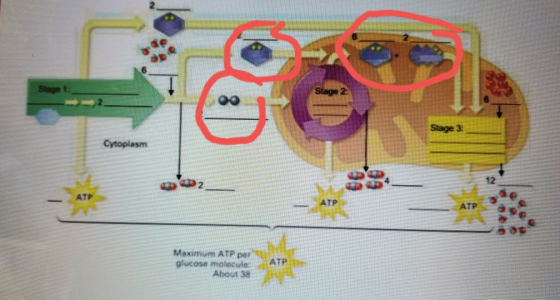
What are the names of the four circled chemicals in the cellular respiration diagram?
Homework Answers
stage 1 - glycolysis ( one is pyruvate goes to krebs cycle and another one name is NADH goes to electron taransport chain)
Stage 2 - krebs cycle
Stage 3 - electron transport chain( one molecule of NADH from krebs and another one is glycolysis)
In glycolysis, glucose—a six-carbon sugar—undergoes a series of chemical transformations. In the end, it gets converted into two molecules of pyruvate, a three-carbon organic molecule. In these reactions, ATP is made, and NAD+ is converted into NADH
pyruvate oxidation. Each pyruvate from glycolysis goes into the mitochondrial matrix—the innermost compartment of mitochondria. There, it’s converted into a two-carbon molecule bound to Coenzyme A, known as acetyl CoA. Carbon dioxide is released and NADH is generated.
Citric acid cycle. The acetyl CoA made in the last step combines with a four-carbon molecule and goes through a cycle of reactions, ultimately regenerating the four-carbon starting molecule. ATP, NADH and 2FADH2 are produced, and carbon dioxide is released.
Oxidative phosphorylation. The NADH and FADH2 made in other steps deposit their electrons in the electron transport chain, turning back into their "empty" forms. As electrons move down the chain, energy is released and used to pump protons out of the matrix, forming a gradient. Protons flow back into the matrix through an enzyme called ATP synthase, making ATP. At the end of the electron transport chain, oxygen accepts electrons and takes up protons to form water.
Add Answer to:
What are the names of the four circled chemicals in
the cellular respiration diagram?
Stage 1...
1. What is the importance of NAD+/NADH to cellular respiration? 2. Be able to write out...
1. What is the importance of NAD+/NADH to cellular respiration? 2. Be able to write out the biochemical equations for glucose respiration and photosynthesis AND label the oxidizing and reducing agents in each reaction. 3. What are the three stages of cellular respiration and where does each occur in the cell? 4. During cellular respiration, what is the role of each of these molecules: glucose, pyruvate, ATP, NAD+, FAD, NADH, FADH2, acetyl CoA, CO2, H2O, and O2? 5. For each...
Chapter 5 (Cellular Respiration) With the aid of your notes and/or textbook, write the terms that...
 Chapter 5 (Cellular Respiration) With the aid of your notes and/or textbook, write the terms that correspond to the following definitions and descriptions Oxygen-requiring process that produces CO., H,0 and ATP. A series of enzyme catalyzed reactions that form pyruvate molecules from splitting glucose. Second stage of aerobic cellular respiration that produces CO, and electron camer molecules, and takes place in the mitochondrion. Type of cellular respiration that does not use oxygen in the production of ATP. Produces lactic acid...
BIOL200, Exercise 11+12 Fill in the table below for cellular respiration and each stage of cellular...
 BIOL200, Exercise 11+12 Fill in the table below for cellular respiration and each stage of cellular respiration Stage Products Where Does it Occur Starting Molecules Co, released? (Y/N) 0, Used? (Y/N) Cellular Respiration Glycolysis Pyruvate Processing/Oxidation Krebs Cycle Oxidative Phosphorylation Electron Transport Chemiosmosis 1. What would happen if you stopped cellular respiration in an animal? Briefly explain your answer 4. What would happen to each of the following if we add a chemical that destroys the H+ gradient across the...
The phases of cellular respiration Place each phase of cellular respiration into the box that corresponds...
 The phases of cellular respiration Place each phase of cellular respiration into the box that corresponds to the location of that particular phase. Not all choices will be used: You must distinguish the four phases of cellular respiration from the choices given. Krebs cycle glycolysis production of most ATP preparatory (prep) reaction oxidation of glucose electron transport chain (ETC) Cytoplasm Mitochondrial matrix Cristae of mitochondria glycolysis preparatory (prep) reaction electron transport chain (ETC) Krebs cycle
Draw a diagram of cellular respiration. Use closed arrows ( to trace the carbon atoms, and...
 Draw a diagram of cellular respiration. Use closed arrows ( to trace the carbon atoms, and open arrows (=) to trace ATP / ADP and electron carriers (and their oxidized counterparts) through glycolysis, pyruvate oxidation, and the Krebs cycle. Draw a box around the stage(s) that take place in the cytosol and a circle around the stage(s) that take place in the mitochondrion. For full credit indicate the number of each of the inputs and outputs for each stage of...
What is the theoretical TOTAL yield of ATP per glucose molecule in the entire Cellular Respiration...
What is the theoretical TOTAL yield of ATP per glucose molecule in the entire Cellular Respiration process?
What is the overall purpose of cellular respiration? to produce ATP by using the electrons from...
 What is the overall purpose of cellular respiration? to produce ATP by using the electrons from glucose to build the ATP molecule to produce ATP by using oxygen to build the ATP molecule to break down glucose and convert it into ATP to produce ATP using the energy from the oxidation of a glucose molecule
Question 25 1 pts In which step of cellular respiration is most of the energy harvested...
 Question 25 1 pts In which step of cellular respiration is most of the energy harvested from the glucose molecule? Glycolysis ETC Citric Acid Cycle Pyruvate Oxidation Question 26 1 pts In which step of cellular respiration is most of the energy that was harvested from glucose transformed into an energy source that can be used to do cellular work? ETC ATP Synthase Citric Acid Cycle Question 27 1 pts At the end of all 3 steps of cellular respiration,...
Ch. 9 11) What are the four steps of cellular respiration? What are the initial reactants...
 Ch. 9 11) What are the four steps of cellular respiration? What are the initial reactants and final products from each of these steps (include NADH and FADH2)? Where do they occur in the cell/mitochondria? 12) Why is the pyruvate processing step necessary? Why not go straight to the citric acid cycle? 13) What is homeostasis? How does cellular respiration play a role in anabolic reactions (think intermediates)? 14) How are the first three steps of cellular respiration regulated? 15)...
Stages of aerobic cellular respiration? Most ATP is made at what stage? What is the terminal...
Stages of aerobic cellular respiration? Most ATP is made at what stage? What is the terminal electron acceptor?
 Chapter 5 (Cellular Respiration) With the aid of your notes and/or textbook, write the terms that correspond to the following definitions and descriptions Oxygen-requiring process that produces CO., H,0 and ATP. A series of enzyme catalyzed reactions that form pyruvate molecules from splitting glucose. Second stage of aerobic cellular respiration that produces CO, and electron camer molecules, and takes place in the mitochondrion. Type of cellular respiration that does not use oxygen in the production of ATP. Produces lactic acid...
 BIOL200, Exercise 11+12 Fill in the table below for cellular respiration and each stage of cellular respiration Stage Products Where Does it Occur Starting Molecules Co, released? (Y/N) 0, Used? (Y/N) Cellular Respiration Glycolysis Pyruvate Processing/Oxidation Krebs Cycle Oxidative Phosphorylation Electron Transport Chemiosmosis 1. What would happen if you stopped cellular respiration in an animal? Briefly explain your answer 4. What would happen to each of the following if we add a chemical that destroys the H+ gradient across the...
 The phases of cellular respiration Place each phase of cellular respiration into the box that corresponds to the location of that particular phase. Not all choices will be used: You must distinguish the four phases of cellular respiration from the choices given. Krebs cycle glycolysis production of most ATP preparatory (prep) reaction oxidation of glucose electron transport chain (ETC) Cytoplasm Mitochondrial matrix Cristae of mitochondria glycolysis preparatory (prep) reaction electron transport chain (ETC) Krebs cycle
 Draw a diagram of cellular respiration. Use closed arrows ( to trace the carbon atoms, and open arrows (=) to trace ATP / ADP and electron carriers (and their oxidized counterparts) through glycolysis, pyruvate oxidation, and the Krebs cycle. Draw a box around the stage(s) that take place in the cytosol and a circle around the stage(s) that take place in the mitochondrion. For full credit indicate the number of each of the inputs and outputs for each stage of...
 What is the overall purpose of cellular respiration? to produce ATP by using the electrons from glucose to build the ATP molecule to produce ATP by using oxygen to build the ATP molecule to break down glucose and convert it into ATP to produce ATP using the energy from the oxidation of a glucose molecule
 Question 25 1 pts In which step of cellular respiration is most of the energy harvested from the glucose molecule? Glycolysis ETC Citric Acid Cycle Pyruvate Oxidation Question 26 1 pts In which step of cellular respiration is most of the energy that was harvested from glucose transformed into an energy source that can be used to do cellular work? ETC ATP Synthase Citric Acid Cycle Question 27 1 pts At the end of all 3 steps of cellular respiration,...
 Ch. 9 11) What are the four steps of cellular respiration? What are the initial reactants and final products from each of these steps (include NADH and FADH2)? Where do they occur in the cell/mitochondria? 12) Why is the pyruvate processing step necessary? Why not go straight to the citric acid cycle? 13) What is homeostasis? How does cellular respiration play a role in anabolic reactions (think intermediates)? 14) How are the first three steps of cellular respiration regulated? 15)...
Most questions answered within 3 hours.
-
Where is the error in this code sequence?
String s1 = "Hello";
String s2 = "ello";...
asked 11 months ago -
Financial data for Joel de Paris, Inc., for last year
follow:
Joel de Paris, Inc.
Balance...
asked 11 months ago -
Consider this reaction:
Al2(SO4)3 (aq)+ BaCl3
(aq) Al2Cl6 (aq)- +
3BaSO4(s) . What is the...
asked 11 months ago -
Suppose that Savneet is considering increasing her
recent random sample from 20 car rentals to 40...
asked 11 months ago -
Trucks arrive at an unloading terminal at an average rate of 120
per hour.
Trucks arrive...
asked 11 months ago -
Why are methanol and ethanol completely soluble in water while
octanol is not very little soluble....
asked 11 months ago -
A facilities manager at a university reads in a research report
that the mean amount of...
asked 11 months ago -
When the CuSO4 is rehydrated by adding water to the anhydrous
compound, is this an endothermic...
asked 11 months ago -
A ray of sunlight is passing from diamond into crown glass; the
angle of incidence is...
asked 11 months ago -
A block of mass 0.249 kg is placed on top of a light, vertical
spring of...
asked 11 months ago -
how do the kidneys compensate in the presences of acidosis
a) trigger hyperventilate
b) reserve acid...
asked 11 months ago -
Question 501 pts
The rental rate of capital to the firm increases. Which of the
following...
asked 11 months ago