
Homework Answers
A) introduce stop codon at 121th position of nucleotide sequence at 3' end of DNA strand
B) this stop codon can be easily used by site directed mutatgenesis where a new reverse primer designed using overlapping sequence.
It will all the sequence complementary to 3' end of gene sequence except in last we introduce stop codon ATT. Doing this mchange leads to decrease of Tm value as last three Nucleotide (stop codon) will not complement or bind to DNA in 1st cycle of PCR so annealing temp should be 50-52C.
Hope it's clear ..thanks
Add Answer to:
(B) Truncated fragments (25 points) You have a nucleotide sequence coding Flis (bacterial flagellin-specific chaperone) in...
(B) Truncated fragments (25 points) You have a nucleotide sequence coding Flis (bacterial flagellin-specific chaperone) in...
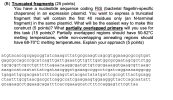 (B) Truncated fragments (25 points) You have a nucleotide sequence coding Flis (bacterial flagellin-specific chaperone) in an expression plasmid. You want to express a truncated fragment that will contain the first 40 residues only (an N-terminal fragment) in the same plasmid. What will be the easiest way to make this construct (5 points)? What partially overlapped primers will you use for this task (15 points)? Partially overlapped regions should have 50-52°C melting temperatures, while non-overlapping annealing regions should have 68-70°C...
Please help with all questions. I provided all the information that I have. The sequence below...
Please help with all questions. I provided all the information that I have. The sequence below represents the genomic DNA sequence of the first 440 bp of your gene of interest (exon 1 in blue). You want to amplify this full 440 bp region by PCR, for cloning into a plasmid vector. tgaagtccaactcctaagccagtgccagaagagccaaggacaggtacggctgtcatcacttagacctcaccctgtggagccacaccctagggttggccaatctactcccaggagcagggagggcaggagccagggctgggcataaaagtcagggcagagccatctattgcttacatttgcttctgacacaactgtgttcactagcaacctcaaacagacaccatggtgcatctgactcctgaggagaagtctgccgttactgccctgtggggcaaggtgaacgtggatgaagttggtggtgaggccctgggcaggttgctatcaaggttacaagacaggtttaaggagaccaatagaaactgggcatgtggagacagagaagactcttgggtttctgataggcactgactctctctgcctattggtctattttcccaccc 1.1 Design a 20 nucleotide forward & reverse primer set that will allow you to amplify the sequence above. (note - primers should be at the beginning...
In part A, yes you should reconstitute the full-length protein sequence from the fragments. However, you...
 In part A, yes you should reconstitute the full-length protein
sequence from the fragments. However, you do not need to write out
the amino acid sequence - you can just provide the order of the
fragment numbers (from either set of fragments). For
example (and this is not the answer), you could say:
"Using the Pro-IAPP fragment set, starting from the N-terminus, the
fragment order is '5-4-6-3-2-1' " and that would fully address the
question.
In part B, the hint...
In part A, yes you should reconstitute the full-length protein
sequence from the fragments. However, you do not need to write out
the amino acid sequence - you can just provide the order of the
fragment numbers (from either set of fragments). For
example (and this is not the answer), you could say:
"Using the Pro-IAPP fragment set, starting from the N-terminus, the
fragment order is '5-4-6-3-2-1' " and that would fully address the
question.
In part B, the hint...
 (B) Truncated fragments (25 points) You have a nucleotide sequence coding Flis (bacterial flagellin-specific chaperone) in an expression plasmid. You want to express a truncated fragment that will contain the first 40 residues only (an N-terminal fragment) in the same plasmid. What will be the easiest way to make this construct (5 points)? What partially overlapped primers will you use for this task (15 points)? Partially overlapped regions should have 50-52°C melting temperatures, while non-overlapping annealing regions should have 68-70°C...
 In part A, yes you should reconstitute the full-length protein
sequence from the fragments. However, you do not need to write out
the amino acid sequence - you can just provide the order of the
fragment numbers (from either set of fragments). For
example (and this is not the answer), you could say:
"Using the Pro-IAPP fragment set, starting from the N-terminus, the
fragment order is '5-4-6-3-2-1' " and that would fully address the
question.
In part B, the hint...
In part A, yes you should reconstitute the full-length protein
sequence from the fragments. However, you do not need to write out
the amino acid sequence - you can just provide the order of the
fragment numbers (from either set of fragments). For
example (and this is not the answer), you could say:
"Using the Pro-IAPP fragment set, starting from the N-terminus, the
fragment order is '5-4-6-3-2-1' " and that would fully address the
question.
In part B, the hint...
Most questions answered within 3 hours.
-
Where is the error in this code sequence?
String s1 = "Hello";
String s2 = "ello";...
asked 10 months ago -
Financial data for Joel de Paris, Inc., for last year
follow:
Joel de Paris, Inc.
Balance...
asked 10 months ago -
Consider this reaction:
Al2(SO4)3 (aq)+ BaCl3
(aq) Al2Cl6 (aq)- +
3BaSO4(s) . What is the...
asked 10 months ago -
Suppose that Savneet is considering increasing her
recent random sample from 20 car rentals to 40...
asked 10 months ago -
Trucks arrive at an unloading terminal at an average rate of 120
per hour.
Trucks arrive...
asked 10 months ago -
Why are methanol and ethanol completely soluble in water while
octanol is not very little soluble....
asked 10 months ago -
A facilities manager at a university reads in a research report
that the mean amount of...
asked 10 months ago -
When the CuSO4 is rehydrated by adding water to the anhydrous
compound, is this an endothermic...
asked 10 months ago -
A ray of sunlight is passing from diamond into crown glass; the
angle of incidence is...
asked 10 months ago -
A block of mass 0.249 kg is placed on top of a light, vertical
spring of...
asked 10 months ago -
how do the kidneys compensate in the presences of acidosis
a) trigger hyperventilate
b) reserve acid...
asked 10 months ago -
Question 501 pts
The rental rate of capital to the firm increases. Which of the
following...
asked 10 months ago