
Homework Answers
Add Answer to:
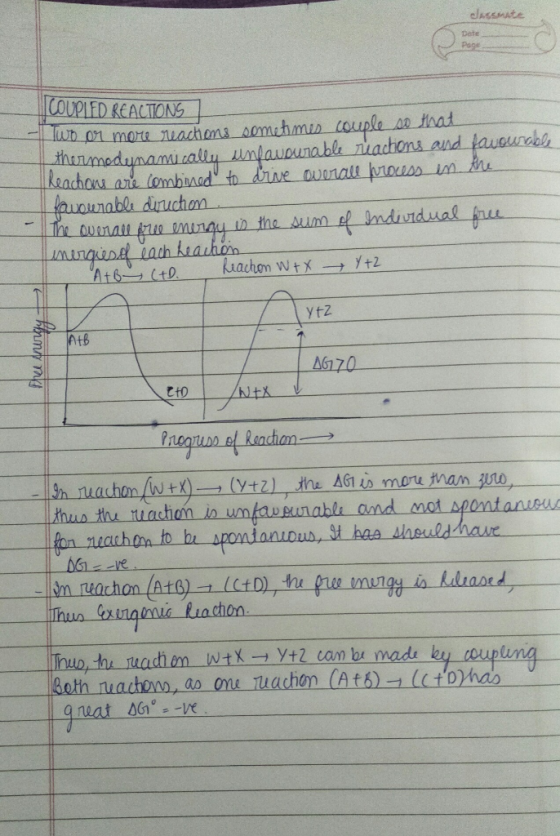
Reaction (A + B) - (C+D) Reaction (W+X) - (Y + Z) A+B --- Free Energy...
The plots show reaction energy on the y-axis and progress on the x. Which one is...
 The plots show reaction energy on the y-axis and progress on the x. Which one is the slowest reaction? A) B) in B Ос A The plots show reaction energy on the y-axis and progress on the x. Which one is thermodynamically unfavored? A) B) > B O D
Z- A+B+C+D Z:x component Z: y component W=A-B-C+D W :x component W: y component in the...
 Z- A+B+C+D Z:x component Z: y component W=A-B-C+D W :x component W: y component in the dagram tothe let Vecor A has a magnitude of 5.8 units and makes an angle of 31 degrees with respect to the positive x axis. Vector B has a magnitude of S units and makes an angle of 53.1 degrees with respect to the negative x axis. 53 319 What are the components of the resultant of: A+B
Question 4 30 pts How can a metabolic pathway contain an energetically unfavorable reaction yet still...
 Question 4 30 pts How can a metabolic pathway contain an energetically unfavorable reaction yet still occur? The free-energy changes of the individual steps in a pathway are summed to determine the overall free-energy change. [Choose] TRUE FALSE [Choose] A step in a pathway that is energetically unfavorable can be driven by coupling it to a thermodynamically favorable reaction. [Choose ] At equilibrium, very few "energetically unfavored" products might be present - but if these unfavored products are then being...
Could someone please explain these answers? Question 1: Consider the overall free energy change (AG) and...
 Could someone please explain
these answers?
Question 1: Consider the overall free energy change (AG) and the overall equilibrium constant (Keq) for a coupled reaction: (i) If the AG for the reaction A B is 'X'kJ.mole' and the AG for the reaction B-C is ‘Y' kJ.molel, what is the free energy change for the overall coupled reaction A C ? (XxY) kJ.mole" (X+Y) kJ.mole". (X+Y) kJ.mole-O (X-Y) kJ.mole- (ii) If the Keq for the reaction A B is 'X' and...
Could someone please explain
these answers?
Question 1: Consider the overall free energy change (AG) and the overall equilibrium constant (Keq) for a coupled reaction: (i) If the AG for the reaction A B is 'X'kJ.mole' and the AG for the reaction B-C is ‘Y' kJ.molel, what is the free energy change for the overall coupled reaction A C ? (XxY) kJ.mole" (X+Y) kJ.mole". (X+Y) kJ.mole-O (X-Y) kJ.mole- (ii) If the Keq for the reaction A B is 'X' and...
If A, B, Cand D are TRUE and X, Y, Z andW are FALSE, what is...
 If A, B, Cand D are TRUE and X, Y, Z andW are FALSE, what is the truth value of the following statements: T 9 "ID v (B Y)1 v [ (D v B) ( v Y) V ~[TVCF)コV [CT). CF)] LTVCE 10. (A E (W Z)) I(C v Y) (A X)1) 11. D v (Wv X)] v [(A v W) v (D X) 12. [(A X) Y] [(X A) (D W) 13. [A X) v (~C ~Z)] [(C W)...
Glycolysis is the process by which energy is harvested from glucose by living things. Several of...
 Glycolysis is the process by which energy is harvested from glucose by living things. Several of the reactions of glycolysis are thermodynamically unfavorable (nonspontaneous), but proceed when they are coupled with other reactions. Reaction A: P + glucose glucose-6-phosphate +HO AG13.8 kJ/mol Reaction B: P fructose-6-phosphate + fructose-1,6-bisphosphate +1,0 AG 16.3 kJ/mol Reaction C: ATP+H, ADP +P, AG - 30.5 kJ/mol Select every unfavorable reaction. reaction B reaction C reaction A Select every set of coupled reactions where the overall...
Free Energy (kcal/mol) CD D Reaction progress - Use the reaction energy diagram above to answer...
 Free Energy (kcal/mol) CD D Reaction progress - Use the reaction energy diagram above to answer the following questions. Calculate the activation energy, AG *, for the step B to A. kcal/mol Calculate the overall energy change, AGº, for the process A to D. kcal/mol Which step is faster, (a) B to C or (b) D to C Y Submit Answer Retry Entire Group 2 more group attempts remaining
1. Consider the three reaction energy diagrams below. Make sure you can justify your answer for...
 1. Consider the three reaction energy diagrams below. Make sure you can justify your answer for the purposes of Exam 3 – simply guessing on this multiple choice question will NOT help you when you're asked to explain your reasoning on the exam! energy energy energy reaction coordinate reaction coordinate reaction coordinate i) Which forward reaction do you expect to proceed fastest, assuming the same energy scale for each? ii) Which reaction do you expect to be the most favorable...
1. Consider the three reaction energy diagrams below. Make sure you can justify your answer for...
 1. Consider the three reaction energy diagrams below. Make sure you can justify your answer for the purposes of Exam 3 - simply guessing on this multiple choice question will NOT help you when you're asked to explain your reasoning on the exam! energy- energy- reaction coordinate reaction coordinate reaction coordinate i) Which forward reaction do you expect to proceed fastest, assuming the same energy scale for each? ii) Which reaction do you expect to be the most favorable in...
c. b. A+B e. a Free Energy d. Progress of the Reaction Given the energy diagram...
 c. b. A+B e. a Free Energy d. Progress of the Reaction Given the energy diagram for the reaction of A+B --> C above, what is represented by the arrow marked d.? Select one: O A. Activation energy of the reverse catalyzed reaction o B. Energy difference between the catalyzed and uncatalyzed reactions OC. Activation energy of the reverse uncatalyzed reaction o D. Energy difference between the reactants and products
 The plots show reaction energy on the y-axis and progress on the x. Which one is the slowest reaction? A) B) in B Ос A The plots show reaction energy on the y-axis and progress on the x. Which one is thermodynamically unfavored? A) B) > B O D
 Z- A+B+C+D Z:x component Z: y component W=A-B-C+D W :x component W: y component in the dagram tothe let Vecor A has a magnitude of 5.8 units and makes an angle of 31 degrees with respect to the positive x axis. Vector B has a magnitude of S units and makes an angle of 53.1 degrees with respect to the negative x axis. 53 319 What are the components of the resultant of: A+B
 Question 4 30 pts How can a metabolic pathway contain an energetically unfavorable reaction yet still occur? The free-energy changes of the individual steps in a pathway are summed to determine the overall free-energy change. [Choose] TRUE FALSE [Choose] A step in a pathway that is energetically unfavorable can be driven by coupling it to a thermodynamically favorable reaction. [Choose ] At equilibrium, very few "energetically unfavored" products might be present - but if these unfavored products are then being...
 Could someone please explain
these answers?
Question 1: Consider the overall free energy change (AG) and the overall equilibrium constant (Keq) for a coupled reaction: (i) If the AG for the reaction A B is 'X'kJ.mole' and the AG for the reaction B-C is ‘Y' kJ.molel, what is the free energy change for the overall coupled reaction A C ? (XxY) kJ.mole" (X+Y) kJ.mole". (X+Y) kJ.mole-O (X-Y) kJ.mole- (ii) If the Keq for the reaction A B is 'X' and...
Could someone please explain
these answers?
Question 1: Consider the overall free energy change (AG) and the overall equilibrium constant (Keq) for a coupled reaction: (i) If the AG for the reaction A B is 'X'kJ.mole' and the AG for the reaction B-C is ‘Y' kJ.molel, what is the free energy change for the overall coupled reaction A C ? (XxY) kJ.mole" (X+Y) kJ.mole". (X+Y) kJ.mole-O (X-Y) kJ.mole- (ii) If the Keq for the reaction A B is 'X' and...
 If A, B, Cand D are TRUE and X, Y, Z andW are FALSE, what is the truth value of the following statements: T 9 "ID v (B Y)1 v [ (D v B) ( v Y) V ~[TVCF)コV [CT). CF)] LTVCE 10. (A E (W Z)) I(C v Y) (A X)1) 11. D v (Wv X)] v [(A v W) v (D X) 12. [(A X) Y] [(X A) (D W) 13. [A X) v (~C ~Z)] [(C W)...
 Glycolysis is the process by which energy is harvested from glucose by living things. Several of the reactions of glycolysis are thermodynamically unfavorable (nonspontaneous), but proceed when they are coupled with other reactions. Reaction A: P + glucose glucose-6-phosphate +HO AG13.8 kJ/mol Reaction B: P fructose-6-phosphate + fructose-1,6-bisphosphate +1,0 AG 16.3 kJ/mol Reaction C: ATP+H, ADP +P, AG - 30.5 kJ/mol Select every unfavorable reaction. reaction B reaction C reaction A Select every set of coupled reactions where the overall...
 Free Energy (kcal/mol) CD D Reaction progress - Use the reaction energy diagram above to answer the following questions. Calculate the activation energy, AG *, for the step B to A. kcal/mol Calculate the overall energy change, AGº, for the process A to D. kcal/mol Which step is faster, (a) B to C or (b) D to C Y Submit Answer Retry Entire Group 2 more group attempts remaining
 1. Consider the three reaction energy diagrams below. Make sure you can justify your answer for the purposes of Exam 3 – simply guessing on this multiple choice question will NOT help you when you're asked to explain your reasoning on the exam! energy energy energy reaction coordinate reaction coordinate reaction coordinate i) Which forward reaction do you expect to proceed fastest, assuming the same energy scale for each? ii) Which reaction do you expect to be the most favorable...
 1. Consider the three reaction energy diagrams below. Make sure you can justify your answer for the purposes of Exam 3 - simply guessing on this multiple choice question will NOT help you when you're asked to explain your reasoning on the exam! energy- energy- reaction coordinate reaction coordinate reaction coordinate i) Which forward reaction do you expect to proceed fastest, assuming the same energy scale for each? ii) Which reaction do you expect to be the most favorable in...
 c. b. A+B e. a Free Energy d. Progress of the Reaction Given the energy diagram for the reaction of A+B --> C above, what is represented by the arrow marked d.? Select one: O A. Activation energy of the reverse catalyzed reaction o B. Energy difference between the catalyzed and uncatalyzed reactions OC. Activation energy of the reverse uncatalyzed reaction o D. Energy difference between the reactants and products
Most questions answered within 3 hours.
-
Where is the error in this code sequence?
String s1 = "Hello";
String s2 = "ello";...
asked 11 months ago -
Financial data for Joel de Paris, Inc., for last year
follow:
Joel de Paris, Inc.
Balance...
asked 11 months ago -
Consider this reaction:
Al2(SO4)3 (aq)+ BaCl3
(aq) Al2Cl6 (aq)- +
3BaSO4(s) . What is the...
asked 11 months ago -
Suppose that Savneet is considering increasing her
recent random sample from 20 car rentals to 40...
asked 11 months ago -
Trucks arrive at an unloading terminal at an average rate of 120
per hour.
Trucks arrive...
asked 11 months ago -
Why are methanol and ethanol completely soluble in water while
octanol is not very little soluble....
asked 11 months ago -
A facilities manager at a university reads in a research report
that the mean amount of...
asked 11 months ago -
When the CuSO4 is rehydrated by adding water to the anhydrous
compound, is this an endothermic...
asked 11 months ago -
A ray of sunlight is passing from diamond into crown glass; the
angle of incidence is...
asked 11 months ago -
A block of mass 0.249 kg is placed on top of a light, vertical
spring of...
asked 11 months ago -
how do the kidneys compensate in the presences of acidosis
a) trigger hyperventilate
b) reserve acid...
asked 11 months ago -
Question 501 pts
The rental rate of capital to the firm increases. Which of the
following...
asked 11 months ago