
Homework Answers

Add Answer to:
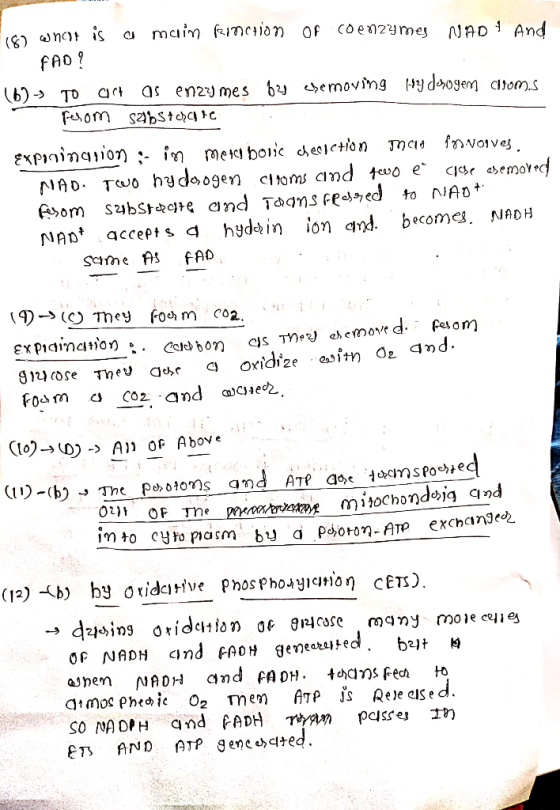
8. What is the main function of the coenzymes NAD+ and FAD? a. To form water...
During the aerobic metabolism of glucose, glucose is ____________. Reduced to form water Oxidized to form...
During the aerobic metabolism of glucose, glucose is ____________. Reduced to form water Oxidized to form water Reduced to form CO2 Oxidized to form CO2 Which of the following describes the equation: FAD + XH2 à FADH2 + X. FAD is reduced to FADH2 It is a coupled reduction – oxidation reaction XH2 is oxidized to X All of the above Which of the following is FALSE about glycolysis? The initial steps of glycolysis requires energy derived from the splitting...
the electron transport system (ETS) use molecules like FAD+ and NAD+ as electron shuttles to bring...
the electron transport system (ETS) use molecules like FAD+ and NAD+ as electron shuttles to bring electrons and protons to the ETS in order to pump protons across the Membrane. why is pumping protons important for generating energy rich molecules like ATP? A. the protons react with glucose and the ATP synthase enzyme which turns like a windmill producing ATP ADP to make ATP B. the electrons combine with oxygen to make water C. the ATP synthase is an enzyme...
NADH --> NAD+ + 2e- + H+ Question options: demonstrates that NADH can reduce to other...
NADH --> NAD+ + 2e- + H+ Question options: demonstrates that NADH can reduce to other molecules is the equation for the reduction of NADH is the equation for the oxidation of NADH demonstrates that NADH can donate e- to other molecules Glycolysis results in Question options: the synthesis of ATP via substrate-level phosphorylation the complete oxidation of glucose the reduction of electron carriers the sythesis of ATP via oxidative phosphorylation Pyruvate oxidation (which happens twice for every molecule of...
1. Where does Glycolysis occur in the cell? 2. What is the net production of ATP...
1. Where does Glycolysis occur in the cell? 2. What is the net production of ATP in Glycolysis? 3. After Glycolysis is complete and 2 pyruvate molecules are generated, what happens to pyruvate if no oxygen is present? 4. What enzyme is used in the Prep Reaction? 5. What are NAD+ and FAD+ molecules? 6. Where in the cell does the Kreb's Cycle (Citric Acid Cycle) occur? 7. How many ATP molecules are produced by the Electron Transport Chain? 8....
2. What would happen to each of the following if reduced the supply of glucose to...
 2. What would happen to each of the following if reduced the supply of glucose to cells by 50%? You may assume that the cell will NOT switch to an alternative energy source. Briefly explain why for each. A. The level of glycolysis activity. B. The level of Krebs Cycle activity. C. The level of activity in the electron transport chain in the mitochondria. D. The size of the proton gradient across the inner mitochondrial membrane. E. The rate of...
1. During the aerobic metabolism of glucose, glucose is a. Reduced to form water b. Oxidized...
 1. During the aerobic metabolism of glucose, glucose is a. Reduced to form water b. Oxidized to form water c. Reduced to form CO2 d. Oxidized to form CO2 2. Which of the following describes the equation: FAD + XH à FADH2 + X. a. FAD is reduced to FADH2 b. It is a coupled reduction - oxidation reaction c. XH, is oxidized to X d. All of the above 3. Which of the following is FALSE about glycolysis? a....
Categorize the following: Aerobic respiration, Anaerobic respiration, Fermentation, None of these .Assume in all cases that...
Categorize the following: Aerobic respiration, Anaerobic respiration, Fermentation, None of these .Assume in all cases that these processes follow breakdown of glucose by glycolysis. Results in complete oxidation of glucose to CO2 Involves regeneration of reduced co-factors (e.g. regenerating NAD+ from NADH) Generates energy by substrate level phosphorylation only Generates ATP by oxidative phosphorylation Utilizes an electron transport chain Uses molecules such as NO3 - , SO4 2- , or Fe3+ as terminal electron acceptors Products include organic acids, alcohols,...
22. Urea cycle takes place primarily in what cell types: A) Kidney cells B) Pancreatic cells...
 22. Urea cycle takes place primarily in what cell types: A) Kidney cells B) Pancreatic cells c) Liver cells D) Mitochondrial cells 23. Which of the following proteins serve as proton pumps in the Electron Transport Chain (ETC): A) NADH dehydrogenase B) Cytochrome Coxidase C) Cytochrome C D) Succinate dehydrogenase E) Coenzyme Q-10 F) All of the above G) Both A) and B) are correct H) Both B) and C) are correct 1) Both A) and D) are correct 24....
Select ALL of the statements that correctly describe the Krebs cycle. A. Pyruvic acid must be...
Select ALL of the statements that correctly describe the Krebs cycle. A. Pyruvic acid must be converted to acetyl CoA prior to entering the cycle B. The molecule oxaloacetic acid picks up the acetyl group from acetylCoA, and in the last step of the cycle, oxaloacetic acid is regenerated. C. Electrons removed during oxidation steps are picked up by NAD or FAD. D. Each turn of the cycle generates one ATP molecule for a total of two per molecule of...
4. For each of the following sentences, fill in the blanks with the best word or...
 4. For each of the following sentences, fill in the blanks with the best word or phrase selected from the list below. Not all words or phrases will be used; each word or phrase can be used more than once. (2 point each; 34 points total) ADP lysosome oxidation phosphorylation NAD pyruvate plasma membrane oxidative phosphorylation acetyl CoA cytosol carbon dioxide nucleus NADH sucrose ubiquitination GTP electrons FADH2 reduction B-sheets matrix ATP FAD kinase vacuole H* mitochondria NADH inner membrane...
 2. What would happen to each of the following if reduced the supply of glucose to cells by 50%? You may assume that the cell will NOT switch to an alternative energy source. Briefly explain why for each. A. The level of glycolysis activity. B. The level of Krebs Cycle activity. C. The level of activity in the electron transport chain in the mitochondria. D. The size of the proton gradient across the inner mitochondrial membrane. E. The rate of...
 1. During the aerobic metabolism of glucose, glucose is a. Reduced to form water b. Oxidized to form water c. Reduced to form CO2 d. Oxidized to form CO2 2. Which of the following describes the equation: FAD + XH à FADH2 + X. a. FAD is reduced to FADH2 b. It is a coupled reduction - oxidation reaction c. XH, is oxidized to X d. All of the above 3. Which of the following is FALSE about glycolysis? a....
 22. Urea cycle takes place primarily in what cell types: A) Kidney cells B) Pancreatic cells c) Liver cells D) Mitochondrial cells 23. Which of the following proteins serve as proton pumps in the Electron Transport Chain (ETC): A) NADH dehydrogenase B) Cytochrome Coxidase C) Cytochrome C D) Succinate dehydrogenase E) Coenzyme Q-10 F) All of the above G) Both A) and B) are correct H) Both B) and C) are correct 1) Both A) and D) are correct 24....
 4. For each of the following sentences, fill in the blanks with the best word or phrase selected from the list below. Not all words or phrases will be used; each word or phrase can be used more than once. (2 point each; 34 points total) ADP lysosome oxidation phosphorylation NAD pyruvate plasma membrane oxidative phosphorylation acetyl CoA cytosol carbon dioxide nucleus NADH sucrose ubiquitination GTP electrons FADH2 reduction B-sheets matrix ATP FAD kinase vacuole H* mitochondria NADH inner membrane...
Most questions answered within 3 hours.
-
Where is the error in this code sequence?
String s1 = "Hello";
String s2 = "ello";...
asked 11 months ago -
Financial data for Joel de Paris, Inc., for last year
follow:
Joel de Paris, Inc.
Balance...
asked 11 months ago -
Consider this reaction:
Al2(SO4)3 (aq)+ BaCl3
(aq) Al2Cl6 (aq)- +
3BaSO4(s) . What is the...
asked 11 months ago -
Suppose that Savneet is considering increasing her
recent random sample from 20 car rentals to 40...
asked 11 months ago -
Trucks arrive at an unloading terminal at an average rate of 120
per hour.
Trucks arrive...
asked 11 months ago -
Why are methanol and ethanol completely soluble in water while
octanol is not very little soluble....
asked 11 months ago -
A facilities manager at a university reads in a research report
that the mean amount of...
asked 11 months ago -
When the CuSO4 is rehydrated by adding water to the anhydrous
compound, is this an endothermic...
asked 11 months ago -
A ray of sunlight is passing from diamond into crown glass; the
angle of incidence is...
asked 11 months ago -
A block of mass 0.249 kg is placed on top of a light, vertical
spring of...
asked 11 months ago -
how do the kidneys compensate in the presences of acidosis
a) trigger hyperventilate
b) reserve acid...
asked 11 months ago -
Question 501 pts
The rental rate of capital to the firm increases. Which of the
following...
asked 11 months ago