
Homework Answers
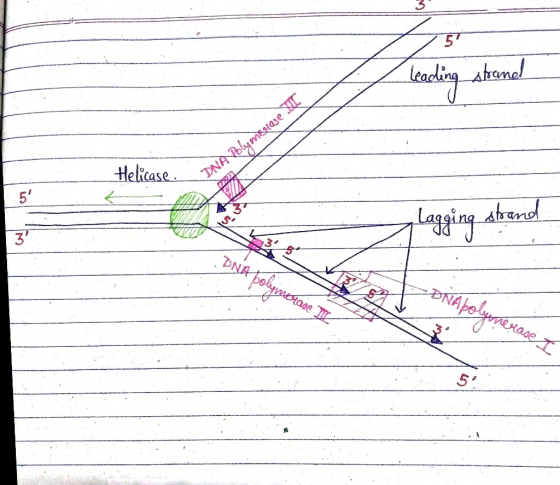
Answer- DNA polymerase only polymerizes in 5' to 3' direction. So the lagging strand is produced in small stretch called Okazaki fragments.
Please give a thumbs up!!!!!!!! Ask any doubts regarding the above question in the comment section !!!!!!!!!!! Thank you!!!!!
Add Answer to:
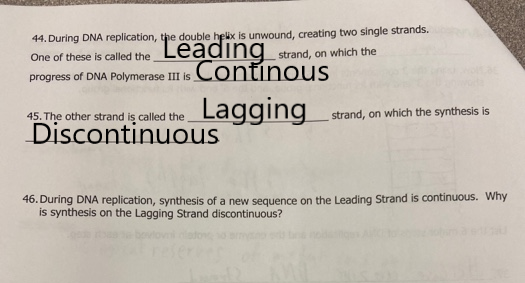
44. During DNA replication, the double helix is unwound, creating two single strands. One of these...
1. DNA is coiled around what type of proteins to form nucleosomes A. Polymerases DNA replication...
 1. DNA is coiled around what type of proteins to form nucleosomes A. Polymerases DNA replication of the lagging strand is discontinuous B. Transcription factors DNA replication of the lagging strand is continuous C. Helicases D. Histones E. DICER 2. Which of the following statements is true? A. DNA replication of the leading strand is discontinuous B. DNA replication of the lagging strand is discontinuous C. DNA replication of the leading strand is dispersive D. DNA replication of the lagging...
Vocabulary: DNA Replication
Vocabulary: DNA Replication A. Helicase B. Primase C. Single Strand Binding Protein (SSB) D. Topoisomerase E. Origin of Replication F. DNA Polymerase G. Leading Strand H. Lagging strand I. DNA Ligase J. Okazaki Fragment K. Replication Fork L. RNA Primer M. Topoisomerase .1. Site where the replication of a DNA molecule begins. 2. The new continuous complementary DNA strand synthesized in the direction for the replication fork. 3. A discontinuously synthesized DNA strand that elongates in a direction away from the replication fork 4. Relaxes...
15. The term that describes the directionality of the two strands in DNA Is A antidirectional...
 15. The term that describes the directionality of the two strands in DNA Is A antidirectional B polydirectional Csemiparallel D. antiparallel E ntisequencial 16. Which of the following enzymes synthesis new DNA during DNA replication? ADNA primase B. RNA polymerase CONA polymerase D Helicase E DNA ligase 17. Which of the following enzymes generates a covalent bond between Okazaki fragments? A DNA primase B. RNA polymerase C DNA polymerase D Helicase E. DNA ligase strand. 18. During DNA replication Okazaki...
Draw a figure of one double stranded DNA molecule that has initiated replication and produced two...
Draw a figure of one double stranded DNA molecule that has initiated replication and produced two okazaki fragment in each lagging strand. The figure must include both template strands, all newly synthesized DNA molecules on both leading and lagging strands, all RNA primers, direction of chain growth for each fragment/strand indicated with arrowheads, direction of replication forks. Each molecule must be labeled with the origin of replication on both strands, leading and lagging strands labeled, template or newly synthesized, DNA...
Place the following steps of DNA replication in order from the beginning to the end of...
 Place the following steps of DNA replication in order from the beginning to the end of the process. Your answer will be a series of numbers (1-5) in what you think is the correct order. 1. Joining of Okazaki fragments by DNA ligase 2. Priming of DNA synthesis with RNA primer 3. Opening and stabilizing the DNA strands 4.removal of primers by DNA polymerase lexonuclease 5. elongation of RNA primers by DNA polymerase III
Match the following (Total 24 pts) Enzyme responsible for joining DNA strands together The nascent DNA...
 Match the following (Total 24 pts) Enzyme responsible for joining DNA strands together The nascent DNA strand that is being synthesized in the same direction as the replication fork. Enz 39 DNA polymerase 40 DNA helicase responsible for transcribing RNA 41DNA sliding clamp 42 Single Stranded Binding Proteins DShort, newly synthesized DNA fragments 43 RNA primer 44 DNA ligase formed on the lagging template strand E Abundle or proteins that assist in the rate of transcription of DNA to mRNA....
Which enzyme lays down the signal for DNA polymerase to bind and start creating the complementary...
Which enzyme lays down the signal for DNA polymerase to bind and start creating the complementary strand of DNA? Which enzyme helps relieve tension in the DNA strand as it is pulled apart for replication? What specific structure is needed in order for DNA polymerase to start DNA replication? Select one: a. RNA primer b. DNA primer c. DNA polymerase d. nucleic acid e. nucleotide sequence Which of these is unique to the lagging strand of DNA? Select one: a....
help 7) In semiconservative DNA replication, each new double helix formed will have Atwo new strands...
 help
7) In semiconservative DNA replication, each new double helix formed will have Atwo new strands and two old strands. Bone new and one old strand in each helix C)three new strands in one helix and three old strands in the second helix D)two new and one old strand in one helix and two old and one new strand in the second helix E two new strands in one helix and two old strands in the other helix. 8) A...
help
7) In semiconservative DNA replication, each new double helix formed will have Atwo new strands and two old strands. Bone new and one old strand in each helix C)three new strands in one helix and three old strands in the second helix D)two new and one old strand in one helix and two old and one new strand in the second helix E two new strands in one helix and two old strands in the other helix. 8) A...
Where would you find histones? A. Part of the RNA polymerase complex that transcribes DNA. B....
Where would you find histones? A. Part of the RNA polymerase complex that transcribes DNA. B. In a virus, helping to "inject" foreign DNA into a cell. C. Bound to an enhancer to regulate transcription. D. Asscoiated with DNA to make chromatin. What is the role of DNA ligase during DNA replication? A. It unwinds the parental double helix. B. It synthesizes RNA nucleotides to make a primer. C. It joins lagging strand (Okazaki) fragments together. D. It stabilizes the...
What is/are the universal feature(s) of DNA replication?Choose all that apply. continuous replication of both strands...
What is/are the universal feature(s) of DNA replication?Choose all that apply. continuous replication of both strands of the double helix polymerization of a new strand in the 5' to 3' direction basepairing between nitrogenous bases semi-conservative replication release of PPi from incorporated nucleotides use of DNA primer to begin fragments Match the name of the protein/enzyme with its correct function during replication. You may use choices more than once or not at all. scan for errors in newly synthesized DNA...
 1. DNA is coiled around what type of proteins to form nucleosomes A. Polymerases DNA replication of the lagging strand is discontinuous B. Transcription factors DNA replication of the lagging strand is continuous C. Helicases D. Histones E. DICER 2. Which of the following statements is true? A. DNA replication of the leading strand is discontinuous B. DNA replication of the lagging strand is discontinuous C. DNA replication of the leading strand is dispersive D. DNA replication of the lagging...
 15. The term that describes the directionality of the two strands in DNA Is A antidirectional B polydirectional Csemiparallel D. antiparallel E ntisequencial 16. Which of the following enzymes synthesis new DNA during DNA replication? ADNA primase B. RNA polymerase CONA polymerase D Helicase E DNA ligase 17. Which of the following enzymes generates a covalent bond between Okazaki fragments? A DNA primase B. RNA polymerase C DNA polymerase D Helicase E. DNA ligase strand. 18. During DNA replication Okazaki...
 Place the following steps of DNA replication in order from the beginning to the end of the process. Your answer will be a series of numbers (1-5) in what you think is the correct order. 1. Joining of Okazaki fragments by DNA ligase 2. Priming of DNA synthesis with RNA primer 3. Opening and stabilizing the DNA strands 4.removal of primers by DNA polymerase lexonuclease 5. elongation of RNA primers by DNA polymerase III
 Match the following (Total 24 pts) Enzyme responsible for joining DNA strands together The nascent DNA strand that is being synthesized in the same direction as the replication fork. Enz 39 DNA polymerase 40 DNA helicase responsible for transcribing RNA 41DNA sliding clamp 42 Single Stranded Binding Proteins DShort, newly synthesized DNA fragments 43 RNA primer 44 DNA ligase formed on the lagging template strand E Abundle or proteins that assist in the rate of transcription of DNA to mRNA....
 help
7) In semiconservative DNA replication, each new double helix formed will have Atwo new strands and two old strands. Bone new and one old strand in each helix C)three new strands in one helix and three old strands in the second helix D)two new and one old strand in one helix and two old and one new strand in the second helix E two new strands in one helix and two old strands in the other helix. 8) A...
help
7) In semiconservative DNA replication, each new double helix formed will have Atwo new strands and two old strands. Bone new and one old strand in each helix C)three new strands in one helix and three old strands in the second helix D)two new and one old strand in one helix and two old and one new strand in the second helix E two new strands in one helix and two old strands in the other helix. 8) A...
Most questions answered within 3 hours.
-
Where is the error in this code sequence?
String s1 = "Hello";
String s2 = "ello";...
asked 10 months ago -
Financial data for Joel de Paris, Inc., for last year
follow:
Joel de Paris, Inc.
Balance...
asked 10 months ago -
Consider this reaction:
Al2(SO4)3 (aq)+ BaCl3
(aq) Al2Cl6 (aq)- +
3BaSO4(s) . What is the...
asked 10 months ago -
Suppose that Savneet is considering increasing her
recent random sample from 20 car rentals to 40...
asked 10 months ago -
Trucks arrive at an unloading terminal at an average rate of 120
per hour.
Trucks arrive...
asked 10 months ago -
Why are methanol and ethanol completely soluble in water while
octanol is not very little soluble....
asked 10 months ago -
A facilities manager at a university reads in a research report
that the mean amount of...
asked 10 months ago -
When the CuSO4 is rehydrated by adding water to the anhydrous
compound, is this an endothermic...
asked 10 months ago -
A ray of sunlight is passing from diamond into crown glass; the
angle of incidence is...
asked 10 months ago -
A block of mass 0.249 kg is placed on top of a light, vertical
spring of...
asked 10 months ago -
how do the kidneys compensate in the presences of acidosis
a) trigger hyperventilate
b) reserve acid...
asked 10 months ago -
Question 501 pts
The rental rate of capital to the firm increases. Which of the
following...
asked 10 months ago