
Homework Answers
Q.6. Answer-
1. For cloning experiments, double digest of DNA is carried out to avoid self ligation of DNA. So that for double digest restriction enzymes that has unique restriction sites are used to create cohesive ends with different sequence.
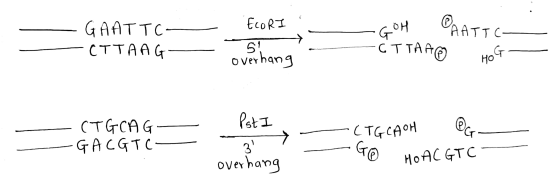
2. Here EcoRI has 5' -G*ATC -3' recognition sequence and PstI has 5'- CTGCA*G (* = cut site). EcoRI produces 5' overhang and PstI produces 3' overhang. As this two enzymes produce different cohesive ends after cleavage so that these two enzymes can be used in same reaction.
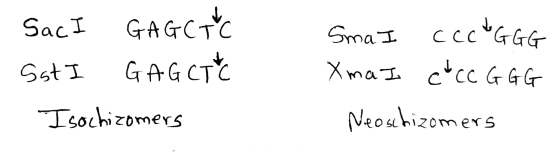
3. The restriction enzyme that recognizes different palindrome sequence and cut at its specific site so that we can use such enzymes together in double digest but some enzymes recognizes same sequence and cleave at same site are known as isoschizomers or cut at different positions in that sequence are known as neoschizomers. Such enzymes cannot use in double digest reactions.
Add Answer to:
6. Why can we combine EcoR1 and Pstl in the same reaction? Why? Could we do...
Hi! Can someone explain WHY #2 is what it is? I don't understand where those numbers...
 Hi! Can someone explain WHY #2 is what it is? I don't understand
where those numbers came from. In addition, can you explain where
the numbers came from on the bands on the gel in #4? Thanks!
The vector you use contains the lacZ gene and a kanamycin resistance cassette (KanR) BamH1 Lacz Ori EcoR1 ECOR1 Hindlll Vector 20kb Bgll 5kb Pst1 Pst1 7kb Q4. What enzyme will you use if you want to do a blue/white selection screen to...
Hi! Can someone explain WHY #2 is what it is? I don't understand
where those numbers came from. In addition, can you explain where
the numbers came from on the bands on the gel in #4? Thanks!
The vector you use contains the lacZ gene and a kanamycin resistance cassette (KanR) BamH1 Lacz Ori EcoR1 ECOR1 Hindlll Vector 20kb Bgll 5kb Pst1 Pst1 7kb Q4. What enzyme will you use if you want to do a blue/white selection screen to...
3. The pCMV-Ha vector and the DDX3 insert were cut with both EcoR1 and Sali, and...
 3. The pCMV-Ha vector and the DDX3 insert were cut with both EcoR1 and Sali, and then purified. Why do you think we chose to cut with two different restriction enzymes, rather than just one (e.g. only EcoR1)? (7 points)
please help me with these questions Lab 8 Extension Activity: Plasmid Mapping and Restriction Enzymes Mapping...
 please help me with these questions
Lab 8 Extension Activity: Plasmid Mapping and Restriction Enzymes Mapping the Plasmid The first step in mapping a plasmid is to determine how many times a restriction site is found on that plasmid. Examine the results for plasmid 55 as an example. The data given in the following table are for the double digest using EcoRI and Pstl. Also, giving are the data for single digests by the individual enzymes. The numbers in the...
please help me with these questions
Lab 8 Extension Activity: Plasmid Mapping and Restriction Enzymes Mapping the Plasmid The first step in mapping a plasmid is to determine how many times a restriction site is found on that plasmid. Examine the results for plasmid 55 as an example. The data given in the following table are for the double digest using EcoRI and Pstl. Also, giving are the data for single digests by the individual enzymes. The numbers in the...
and manipulate being little spheres. We could try to combine these spheres and learn something about...
 and manipulate being little spheres. We could try to combine these spheres and learn something about how elements combine to form compounds. PRE-LAB For a model such as the particle model of matter to be really useful, it has to offer us more than merely a convenient way of summarizing and accounting for facts we already know; a model must enable us to make predictions that can be tested 1) Here is an example of a very simple model and...
Why might we make enzymes that work on the same substrate, but with different enzyme kinetics?...
Why might we make enzymes that work on the same substrate, but with different enzyme kinetics? How do the different hexokinase isozymes of liver and muscle reflect the different roles of these organs in carbohydrate metabolism? Why is the fact how hexokinase 4 is not inhibited by glucose 6-phosphate, instead being inhibited by reversible binding of a regulatory protein specific to liver be important in its function?
Use a double for-loop to implement an OR function in python that can combine two Boolean...
Use a double for-loop to implement an OR function in python that can combine two Boolean NumPy matrices. (Do not use built-in operators such as | or +). The function should work for one-dimensional and two-dimensional matrices and it should error check to verify input matrix compatibility. Only matrices of the same size can be OR-ed together, if the input to the function is two incompatible matrices, the function should return an error message (using return, not print).
why do we need P for reaction to work? 4 we rxn WorK + PBr3 Brz...
 why do we need P for reaction to work?
4 we rxn WorK + PBr3 Brz X + 6-H Br21P
why do we need P for reaction to work?
4 we rxn WorK + PBr3 Brz X + 6-H Br21P
do you think a quantitative and qualitative study could be conducted at the same time? Why...
do you think a quantitative and qualitative study could be conducted at the same time? Why or why not.
Write down (but do not solve) equations that we could use to balance this reaction by...
 Write down (but do not solve) equations that we could use to
balance this reaction by Gaussian elimination. Specify what is
being “conserved” in front of each equation.
(a) Consider the following chemical reaction in acidic aqueous solution: aMnO2 + bH,02 +cH+ → dMn2+ +eO2 +fH,0 Write down (but do not solve) equations that we could use to balance this reaction by Gaussian elimination. Specify what is being "conserved” in front of each equation. (5 pts each) (b) (5 pts)...
Write down (but do not solve) equations that we could use to
balance this reaction by Gaussian elimination. Specify what is
being “conserved” in front of each equation.
(a) Consider the following chemical reaction in acidic aqueous solution: aMnO2 + bH,02 +cH+ → dMn2+ +eO2 +fH,0 Write down (but do not solve) equations that we could use to balance this reaction by Gaussian elimination. Specify what is being "conserved” in front of each equation. (5 pts each) (b) (5 pts)...
What does equilibrium shifting mean in terms of the direction of the reaction? Why do we...
What does equilibrium shifting mean in terms of the direction of the reaction? Why do we still have the same equilibrium after the stress is introduced to a system?
 Hi! Can someone explain WHY #2 is what it is? I don't understand
where those numbers came from. In addition, can you explain where
the numbers came from on the bands on the gel in #4? Thanks!
The vector you use contains the lacZ gene and a kanamycin resistance cassette (KanR) BamH1 Lacz Ori EcoR1 ECOR1 Hindlll Vector 20kb Bgll 5kb Pst1 Pst1 7kb Q4. What enzyme will you use if you want to do a blue/white selection screen to...
Hi! Can someone explain WHY #2 is what it is? I don't understand
where those numbers came from. In addition, can you explain where
the numbers came from on the bands on the gel in #4? Thanks!
The vector you use contains the lacZ gene and a kanamycin resistance cassette (KanR) BamH1 Lacz Ori EcoR1 ECOR1 Hindlll Vector 20kb Bgll 5kb Pst1 Pst1 7kb Q4. What enzyme will you use if you want to do a blue/white selection screen to...
 3. The pCMV-Ha vector and the DDX3 insert were cut with both EcoR1 and Sali, and then purified. Why do you think we chose to cut with two different restriction enzymes, rather than just one (e.g. only EcoR1)? (7 points)
 please help me with these questions
Lab 8 Extension Activity: Plasmid Mapping and Restriction Enzymes Mapping the Plasmid The first step in mapping a plasmid is to determine how many times a restriction site is found on that plasmid. Examine the results for plasmid 55 as an example. The data given in the following table are for the double digest using EcoRI and Pstl. Also, giving are the data for single digests by the individual enzymes. The numbers in the...
please help me with these questions
Lab 8 Extension Activity: Plasmid Mapping and Restriction Enzymes Mapping the Plasmid The first step in mapping a plasmid is to determine how many times a restriction site is found on that plasmid. Examine the results for plasmid 55 as an example. The data given in the following table are for the double digest using EcoRI and Pstl. Also, giving are the data for single digests by the individual enzymes. The numbers in the...
 and manipulate being little spheres. We could try to combine these spheres and learn something about how elements combine to form compounds. PRE-LAB For a model such as the particle model of matter to be really useful, it has to offer us more than merely a convenient way of summarizing and accounting for facts we already know; a model must enable us to make predictions that can be tested 1) Here is an example of a very simple model and...
 why do we need P for reaction to work?
4 we rxn WorK + PBr3 Brz X + 6-H Br21P
why do we need P for reaction to work?
4 we rxn WorK + PBr3 Brz X + 6-H Br21P
 Write down (but do not solve) equations that we could use to
balance this reaction by Gaussian elimination. Specify what is
being “conserved” in front of each equation.
(a) Consider the following chemical reaction in acidic aqueous solution: aMnO2 + bH,02 +cH+ → dMn2+ +eO2 +fH,0 Write down (but do not solve) equations that we could use to balance this reaction by Gaussian elimination. Specify what is being "conserved” in front of each equation. (5 pts each) (b) (5 pts)...
Write down (but do not solve) equations that we could use to
balance this reaction by Gaussian elimination. Specify what is
being “conserved” in front of each equation.
(a) Consider the following chemical reaction in acidic aqueous solution: aMnO2 + bH,02 +cH+ → dMn2+ +eO2 +fH,0 Write down (but do not solve) equations that we could use to balance this reaction by Gaussian elimination. Specify what is being "conserved” in front of each equation. (5 pts each) (b) (5 pts)...
Most questions answered within 3 hours.
-
Where is the error in this code sequence?
String s1 = "Hello";
String s2 = "ello";...
asked 10 months ago -
Financial data for Joel de Paris, Inc., for last year
follow:
Joel de Paris, Inc.
Balance...
asked 10 months ago -
Consider this reaction:
Al2(SO4)3 (aq)+ BaCl3
(aq) Al2Cl6 (aq)- +
3BaSO4(s) . What is the...
asked 10 months ago -
Suppose that Savneet is considering increasing her
recent random sample from 20 car rentals to 40...
asked 10 months ago -
Trucks arrive at an unloading terminal at an average rate of 120
per hour.
Trucks arrive...
asked 10 months ago -
Why are methanol and ethanol completely soluble in water while
octanol is not very little soluble....
asked 10 months ago -
A facilities manager at a university reads in a research report
that the mean amount of...
asked 10 months ago -
When the CuSO4 is rehydrated by adding water to the anhydrous
compound, is this an endothermic...
asked 10 months ago -
A ray of sunlight is passing from diamond into crown glass; the
angle of incidence is...
asked 10 months ago -
A block of mass 0.249 kg is placed on top of a light, vertical
spring of...
asked 10 months ago -
how do the kidneys compensate in the presences of acidosis
a) trigger hyperventilate
b) reserve acid...
asked 10 months ago -
Question 501 pts
The rental rate of capital to the firm increases. Which of the
following...
asked 10 months ago