 Please Help with simple
explanation ..
Please Help with simple
explanation ..
please answer at least the last 3 questions if can't estimate ,, please answer the first Q only
Homework Answers
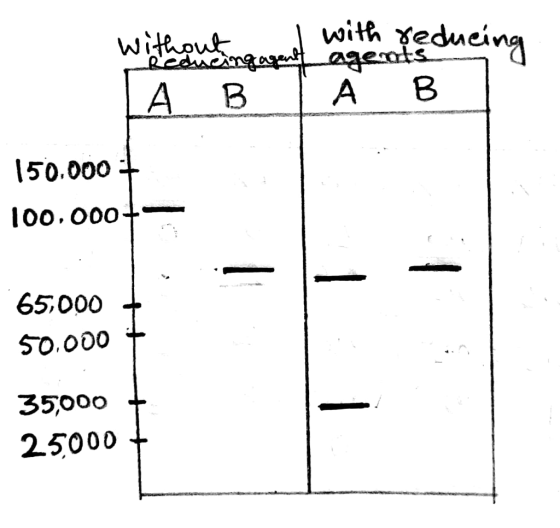
Protine A contains two polypeptide chains (70000+35000) held together by disulfide bond.
Protein B contains two polypeptide chains ( 75000+75000) held together by hydrophobic interaction and electrostatic force.
SDS PAGE is a type of gel electrophoresis. By this process larger molecules are separated by their molecular mass and charge. In SDS PAGE, sodium directly sulfate is a detergent. It can break hydrophobic interactions, hydrogen bonds but cannot break disulfide bonds.
Reducing agents can break disulfide bonds.
So when reducing agent is absent Protein A remains intact and protein B breaks into two chain of same weight . That is why protein B gives only 1 band.
When reducing agent is present, protein A splits into two polypeptide chains of different molecular weight. So they gave two different bands.
Trypsin is an proteolytic enzyme mostly found in vertebrates. It produced by pancreas and it breaks protein molecules at specific site. Trypsin mainly breaks peptides in carboxyl end of amino acid lysine or arginine. It mainly helps in protein digestion.
Lactoglobulin has a molecular weight of 18.4 kDa. It is a small protein .
BSA has molecular weight of 66.5 kDa.
SDS PAGE can separate proteins based on their mass so and charge. So, lactoglobulin traveled further than BSA.
But agarose gel electrophoresis separates proteins based on size and charge. Agarose gel can separate high molecular weight proteins perfectly. So in case of agarose gel electrophoresis both proteins traveled same distance.
Add Answer to:
Please Help with simple
explanation ..
please answer at least the last 3 questions if can't...
with reducing agents A B A B (5pts) Protein A contains 2 polypeptide chains (1 of...
 with reducing agents A B A B (5pts) Protein A contains 2 polypeptide chains (1 of 75,000, I of 25,000) held together by disulfide bonds. Protein B contains 2 polypeptide chains (each -75,000) held together by hydrophobic interactions and electrostatic forces. On the SDS-PAGE gel to the right, sketch the ideal pattern you expect for each of these proteins in the absence and presence of reducing agents. (Use your text for help if you need it.) Explain briefly your logic....
Chapter 3 Home Active and Due Dates Chapter Homework Resouros Ghve Up! Feedback PAGE A protein...
 Chapter 3 Home Active and Due Dates Chapter Homework Resouros Ghve Up! Feedback PAGE A protein sample complex consists of two proteins, a smaller protein, X, and a larger protein, Y. Protein X is composed two polypeptide chains linked by disulfide bonds. Protein Y is composed of three polypeptide chain linked by disulfide bonds The complex is analyzed by native PAGE, reducing SDS-PAGE and non-reducing SDS-PAGE Native PAGE does not include sodium dodecyl sulfate, or SDS. Reducing SDS-PAGE uses both...
A protein sample complex consists of two proteins, a smaller protein, X, and a larger protein,...
 A protein sample complex consists of two proteins, a smaller protein, X, and a larger protein, Y. Protein X is composed of two polypeptide chains linked by disulfide bonds. Protein Y is composed of three polypeptide chains linked by disulfide bonds. The complex is analyzed by native PAGE, reducing SDS-PAGE and non-reducing SDS-PAGE. Native PAGE does not include sodium dodecyl sulfate, or SDS. Reducing SDS-PAGE uses both SDS and a reducing agent in the buffer. Non-reducing SDS-PAGE uses SDS, but...
14. Recombinant MBP-, GST- or GFP- fusion proteins are expressed in bacteria not only for affinity...
14. Recombinant MBP-, GST- or GFP- fusion proteins are expressed in bacteria not only for affinity chromatography but also to ___________. A. overexpress the proteins in bacteria B. to reduce toxicity of the foreign proteins C. for proper folding and keeping the proteins soluble D. to trace the cytological location of the foreign proteins 15. You have constructed an insulin-GST fusion protein and expressed it in E. coli. You want to separate the recombinant...
SDS Page Gel: The provided standard protein sample for electrophoresis consists of 9 polypeptides with molecular...
 SDS Page Gel:
The provided standard protein sample for electrophoresis
consists of 9 polypeptides with molecular weights ranging from 250
to 15 KDa.
Sample 1: Protein A in a sample buffer with
B-Mercaptoethanol
Sample 2: Protein A in a sample buffer without
B-Mercaptoethanol
Sample 3: Protein B in a sample buffer with
B-Mercaptoethanol
Sample 4: Protein C in a sample buffer without
B-Mercaptoethanol
Use the picture below & the information about the proteins
above to answer the following questions.
1a....
SDS Page Gel:
The provided standard protein sample for electrophoresis
consists of 9 polypeptides with molecular weights ranging from 250
to 15 KDa.
Sample 1: Protein A in a sample buffer with
B-Mercaptoethanol
Sample 2: Protein A in a sample buffer without
B-Mercaptoethanol
Sample 3: Protein B in a sample buffer with
B-Mercaptoethanol
Sample 4: Protein C in a sample buffer without
B-Mercaptoethanol
Use the picture below & the information about the proteins
above to answer the following questions.
1a....
Data Analysis Problem by Marianna Pap and József Szeberényi to accompany The Cell: A Molecular Approach,...
 Data Analysis Problem by Marianna Pap and József Szeberényi to accompany The Cell: A Molecular Approach, Seventh Edition Geoffrey M. Cooper and Robert E. Hausman 2.3 The Effect of a Reducing Agent on Protein Structure Source: Janatova, J. 1986. Detection of disulphide bonds and localization of interchain linkages in the third (C3) and the fourth (C4) components of human complement. Biochem, J. 233: 819-825. Level of difficulty: Medium Corresponding chapter(s) in the textbook: Chapter 2 Review the following terms before...
1. What is the product is the product formed from the acid hydrolysis of a simple...
 1. What is the product is the product formed from the acid hydrolysis of a simple amide? a. acid & base b. aldehyde & alcohol c. acid & amine d. ester & alcohol e. amine & aldehyde B. . Insulin is a polypeptide hormone that contains two short polypeptide chains linked by two interstrand disulfide bonds. The most login he most logical order of events to perform in order to sequence this protein would be: The peptides are reduced with...
is the product formed from the acid hydrolysis of a simple amide? 1. What is the...
 is the product formed from the acid hydrolysis of a simple amide? 1. What is the product a. acid & base b. aldehyde & alcohol c. acid & amine d. ester & alcohol e. amine & aldehyde 2. Insulin Insulin is a polypeptide hormone that contains two short polypeptide chains linked by two interstrand disulfide bonds The most logical order of events to perform in order to sequence this protein would be: The peptides are reduced with mercaptoethanol. B. The...
Explanation of SDS-PAGE for Western blotting procedure, PLEASE answer the questions BELOW: 1. What does a...
Explanation of SDS-PAGE for Western blotting procedure, PLEASE answer the questions BELOW: 1. What does a gel electrophoresis allow you to do? 2. What is a gel? 3. How do you make the protein move, and why does this work? 4. Which protein fragments travel the furthest and why? 5. Name 3 materials used to make a gel. 6. What is polyacrylamide? 7. What is the purpose of the buffer? 8. What is the comb (in the gel) for? 9....
parts a,b, c please 3. Sodium dodecyl sulfate (SDS) polyacrylamide gel electrophoresis a. After pouring the...
 parts a,b, c please
3. Sodium dodecyl sulfate (SDS) polyacrylamide gel electrophoresis a. After pouring the SDS polyacrylamide gel, you realize that instead of 2 ml, you used 4 ml of 30% acrylamide/bisacrylamide solution for the preparation of the separating gel (in both cases for 5 ml, total gel volume). How would this affect the separation of your proteins during SDS PAGE? Explain your answer! b. You have to remake the gel and are now making sure just to add...
parts a,b, c please
3. Sodium dodecyl sulfate (SDS) polyacrylamide gel electrophoresis a. After pouring the SDS polyacrylamide gel, you realize that instead of 2 ml, you used 4 ml of 30% acrylamide/bisacrylamide solution for the preparation of the separating gel (in both cases for 5 ml, total gel volume). How would this affect the separation of your proteins during SDS PAGE? Explain your answer! b. You have to remake the gel and are now making sure just to add...
 with reducing agents A B A B (5pts) Protein A contains 2 polypeptide chains (1 of 75,000, I of 25,000) held together by disulfide bonds. Protein B contains 2 polypeptide chains (each -75,000) held together by hydrophobic interactions and electrostatic forces. On the SDS-PAGE gel to the right, sketch the ideal pattern you expect for each of these proteins in the absence and presence of reducing agents. (Use your text for help if you need it.) Explain briefly your logic....
 Chapter 3 Home Active and Due Dates Chapter Homework Resouros Ghve Up! Feedback PAGE A protein sample complex consists of two proteins, a smaller protein, X, and a larger protein, Y. Protein X is composed two polypeptide chains linked by disulfide bonds. Protein Y is composed of three polypeptide chain linked by disulfide bonds The complex is analyzed by native PAGE, reducing SDS-PAGE and non-reducing SDS-PAGE Native PAGE does not include sodium dodecyl sulfate, or SDS. Reducing SDS-PAGE uses both...
 A protein sample complex consists of two proteins, a smaller protein, X, and a larger protein, Y. Protein X is composed of two polypeptide chains linked by disulfide bonds. Protein Y is composed of three polypeptide chains linked by disulfide bonds. The complex is analyzed by native PAGE, reducing SDS-PAGE and non-reducing SDS-PAGE. Native PAGE does not include sodium dodecyl sulfate, or SDS. Reducing SDS-PAGE uses both SDS and a reducing agent in the buffer. Non-reducing SDS-PAGE uses SDS, but...
 SDS Page Gel:
The provided standard protein sample for electrophoresis
consists of 9 polypeptides with molecular weights ranging from 250
to 15 KDa.
Sample 1: Protein A in a sample buffer with
B-Mercaptoethanol
Sample 2: Protein A in a sample buffer without
B-Mercaptoethanol
Sample 3: Protein B in a sample buffer with
B-Mercaptoethanol
Sample 4: Protein C in a sample buffer without
B-Mercaptoethanol
Use the picture below & the information about the proteins
above to answer the following questions.
1a....
SDS Page Gel:
The provided standard protein sample for electrophoresis
consists of 9 polypeptides with molecular weights ranging from 250
to 15 KDa.
Sample 1: Protein A in a sample buffer with
B-Mercaptoethanol
Sample 2: Protein A in a sample buffer without
B-Mercaptoethanol
Sample 3: Protein B in a sample buffer with
B-Mercaptoethanol
Sample 4: Protein C in a sample buffer without
B-Mercaptoethanol
Use the picture below & the information about the proteins
above to answer the following questions.
1a....
 Data Analysis Problem by Marianna Pap and József Szeberényi to accompany The Cell: A Molecular Approach, Seventh Edition Geoffrey M. Cooper and Robert E. Hausman 2.3 The Effect of a Reducing Agent on Protein Structure Source: Janatova, J. 1986. Detection of disulphide bonds and localization of interchain linkages in the third (C3) and the fourth (C4) components of human complement. Biochem, J. 233: 819-825. Level of difficulty: Medium Corresponding chapter(s) in the textbook: Chapter 2 Review the following terms before...
 1. What is the product is the product formed from the acid hydrolysis of a simple amide? a. acid & base b. aldehyde & alcohol c. acid & amine d. ester & alcohol e. amine & aldehyde B. . Insulin is a polypeptide hormone that contains two short polypeptide chains linked by two interstrand disulfide bonds. The most login he most logical order of events to perform in order to sequence this protein would be: The peptides are reduced with...
 is the product formed from the acid hydrolysis of a simple amide? 1. What is the product a. acid & base b. aldehyde & alcohol c. acid & amine d. ester & alcohol e. amine & aldehyde 2. Insulin Insulin is a polypeptide hormone that contains two short polypeptide chains linked by two interstrand disulfide bonds The most logical order of events to perform in order to sequence this protein would be: The peptides are reduced with mercaptoethanol. B. The...
 parts a,b, c please
3. Sodium dodecyl sulfate (SDS) polyacrylamide gel electrophoresis a. After pouring the SDS polyacrylamide gel, you realize that instead of 2 ml, you used 4 ml of 30% acrylamide/bisacrylamide solution for the preparation of the separating gel (in both cases for 5 ml, total gel volume). How would this affect the separation of your proteins during SDS PAGE? Explain your answer! b. You have to remake the gel and are now making sure just to add...
parts a,b, c please
3. Sodium dodecyl sulfate (SDS) polyacrylamide gel electrophoresis a. After pouring the SDS polyacrylamide gel, you realize that instead of 2 ml, you used 4 ml of 30% acrylamide/bisacrylamide solution for the preparation of the separating gel (in both cases for 5 ml, total gel volume). How would this affect the separation of your proteins during SDS PAGE? Explain your answer! b. You have to remake the gel and are now making sure just to add...
Most questions answered within 3 hours.
-
Where is the error in this code sequence?
String s1 = "Hello";
String s2 = "ello";...
asked 11 months ago -
Financial data for Joel de Paris, Inc., for last year
follow:
Joel de Paris, Inc.
Balance...
asked 11 months ago -
Consider this reaction:
Al2(SO4)3 (aq)+ BaCl3
(aq) Al2Cl6 (aq)- +
3BaSO4(s) . What is the...
asked 11 months ago -
Suppose that Savneet is considering increasing her
recent random sample from 20 car rentals to 40...
asked 11 months ago -
Trucks arrive at an unloading terminal at an average rate of 120
per hour.
Trucks arrive...
asked 11 months ago -
Why are methanol and ethanol completely soluble in water while
octanol is not very little soluble....
asked 11 months ago -
A facilities manager at a university reads in a research report
that the mean amount of...
asked 11 months ago -
When the CuSO4 is rehydrated by adding water to the anhydrous
compound, is this an endothermic...
asked 11 months ago -
A ray of sunlight is passing from diamond into crown glass; the
angle of incidence is...
asked 11 months ago -
A block of mass 0.249 kg is placed on top of a light, vertical
spring of...
asked 11 months ago -
how do the kidneys compensate in the presences of acidosis
a) trigger hyperventilate
b) reserve acid...
asked 11 months ago -
Question 501 pts
The rental rate of capital to the firm increases. Which of the
following...
asked 11 months ago