
Homework Answers
Add Answer to:
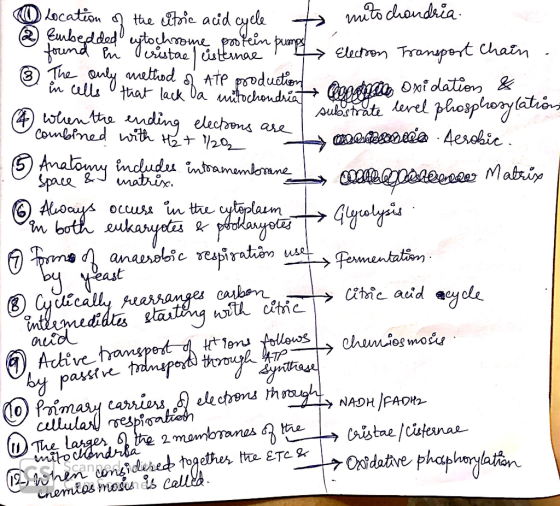
FIND THE BEST FIT PAIR AMONG THE FOLLOWING: Choose... Choose.. CITRIC ACID CYCLE ANAEROBIC MATRIX CHEMIOSMOSIS...
LOCATION OF THE CITRIC ACID CYCLE Choose... EMBEDDED CYTOCHROME PROTEIN PUMPS FOUND IN Choose... CRISTAE/CISTERNA THE...
 LOCATION OF THE CITRIC ACID CYCLE Choose... EMBEDDED CYTOCHROME PROTEIN PUMPS FOUND IN Choose... CRISTAE/CISTERNA THE ONLY METHOD OF ATP PRODUCTION IN CELLS THAT LACKA CITRIC ACID CYCLE MITOCHONDRIA ANAEROBIC WHEN THE ENDING ELECTRONS ARE COMBINED WITH H2 + MATRIX 1/202 ANATOMY INCLUDES INTRAMEMBRANE SPACE AND MATRIX. CHEMIOSMOSIS ALWAYS OCCURS IN THE CYTOPLASM IN BOTH EUKARYOTES OXIDATION AND SUBSTRATE LEVEL PHOSPHORYLATION AND PROKARYOTES CRISTAE/CISTERNA FORM OF ANAEROBIC RESPIRATION USED BY YEAST GYLCOLYSIS CYCLICALLY REARRANGES CARBON INTERMEDIATES STARTING ELECTRON TRANSPORT CHAIN...
PRE-KREBS/TRANSITION PHASE: In the absence of oxygen the luyunde molecules from glycolysis are converted to lactic...
 PRE-KREBS/TRANSITION PHASE: In the absence of oxygen the luyunde molecules from glycolysis are converted to lactic acid. If oxygen is present, they are instead converted into 2 molecules of _which then enter the mitochondria to undergo anaerob metabolism. During this transition phase, no ATP is produced but are released. and Mitochoadrial CITRIC ACID CYCLE: The citric acid cycle occurs in the matrix Both of the molecules of Adel produced after glycolysis run through the citric acid cycle reactions. At the...
Which of the following processes takes place in the inner membrane of mitochondria? Citric Acid cycle...
Which of the following processes takes place in the inner membrane of mitochondria? Citric Acid cycle Glycolysis electron transport between components of the respiratory chain ADP transport into the inter membrane space ATP hydrolysis by ATP synthase Which of the following statements is NOT correct regarding mitochondrial DNA (mtDNA)? Most proteins that function in mitochondria are encoded by mtDNA. mtDNA of mammalian cells can make up a very small portion of total cellular DNA. In some specialized eukaryotic cells, mtDNA...
1. Select the TRUE statement about the citric acid cycle. A. Isocitrate dehydrogenase is a multienzyme...
1. Select the TRUE statement about the citric acid cycle. A. Isocitrate dehydrogenase is a multienzyme complex that is very similar to the pyruvate dehydrogenase complex B. The two decarboxylation steps occur right after each other, first via oxidative alpha- decarboxylation, then via oxidative beta- decarboxylation. C. In one turn of the cycle, the two carbons that enter the cycle as acetyl CoA are the same two carbons that are released as CO2. D. A flavin containing dehydrogenase enzymes oxidizes...
27) Which one of the following best describes the electron transport chain? A) Electrons are passed...
 27) Which one of the following best describes the electron transport chain? A) Electrons are passed from one carrier to another releasing a little energy at each B) Hydrogen atoms are added to CO2 to make an energy-rich compound. C) Electrons are pumped across a membrane by active transport. D) Glucose is broken down to a three-carbon compound 28) After completion of the citric acid cycle, most of the usable energy from the one molecule is in the form of...
UCHS QUESTION 14 Which of the following is an incorrect match of process to location? preparatory...
 UCHS QUESTION 14 Which of the following is an incorrect match of process to location? preparatory reaction - cristae of mitochondria citric acid cycle - matrix of mitochondria ATP production in the electron transport chain - cristae of mitochondria H+ ion gradient-matrix of mitochondria glycolysis - cytoplasm QUESTION 15 The Calvin cycle reactions only occur in bundle sheath cells in a C4 plant so that H20 is not available to mesophyll cells. to allow O2 to enter bundle sheath cells....
MULTIPLE CHOICE. Choose the one alternative that best completes the statement or answers the question. Metabolism...
 MULTIPLE CHOICE. Choose the one alternative that best completes the statement or answers the question. Metabolism and Cellular Respiration Refer to Figure below as a guide to answer the folloaing questions Acetyt CoA Oxaloacetic acid CoA NADH Citric acid NAD Isocitric acid Malic acid Fumaric acid NAD co NADH -FADH FAD+ a-Ketoglutaric acid Succinic acid CO2NAD ATP Succinyl CoA ADP P NADH Figure above. Starting with citric acid and ending with oxaloacetic acid, how many ATP 6) Refer to molecules...
Select ALL of the statements that correctly describe the Krebs cycle. A. Pyruvic acid must be...
Select ALL of the statements that correctly describe the Krebs cycle. A. Pyruvic acid must be converted to acetyl CoA prior to entering the cycle B. The molecule oxaloacetic acid picks up the acetyl group from acetylCoA, and in the last step of the cycle, oxaloacetic acid is regenerated. C. Electrons removed during oxidation steps are picked up by NAD or FAD. D. Each turn of the cycle generates one ATP molecule for a total of two per molecule of...
Ch. 9 11) What are the four steps of cellular respiration? What are the initial reactants...
 Ch. 9 11) What are the four steps of cellular respiration? What are the initial reactants and final products from each of these steps (include NADH and FADH2)? Where do they occur in the cell/mitochondria? 12) Why is the pyruvate processing step necessary? Why not go straight to the citric acid cycle? 13) What is homeostasis? How does cellular respiration play a role in anabolic reactions (think intermediates)? 14) How are the first three steps of cellular respiration regulated? 15)...
4. For each of the following sentences, fill in the blanks with the best word or...
 4. For each of the following sentences, fill in the blanks with the best word or phrase selected from the list below. Not all words or phrases will be used; each word or phrase can be used more than once. (2 point each; 34 points total) ADP lysosome oxidation phosphorylation NAD pyruvate plasma membrane oxidative phosphorylation acetyl CoA cytosol carbon dioxide nucleus NADH sucrose ubiquitination GTP electrons FADH2 reduction B-sheets matrix ATP FAD kinase vacuole H* mitochondria NADH inner membrane...
 LOCATION OF THE CITRIC ACID CYCLE Choose... EMBEDDED CYTOCHROME PROTEIN PUMPS FOUND IN Choose... CRISTAE/CISTERNA THE ONLY METHOD OF ATP PRODUCTION IN CELLS THAT LACKA CITRIC ACID CYCLE MITOCHONDRIA ANAEROBIC WHEN THE ENDING ELECTRONS ARE COMBINED WITH H2 + MATRIX 1/202 ANATOMY INCLUDES INTRAMEMBRANE SPACE AND MATRIX. CHEMIOSMOSIS ALWAYS OCCURS IN THE CYTOPLASM IN BOTH EUKARYOTES OXIDATION AND SUBSTRATE LEVEL PHOSPHORYLATION AND PROKARYOTES CRISTAE/CISTERNA FORM OF ANAEROBIC RESPIRATION USED BY YEAST GYLCOLYSIS CYCLICALLY REARRANGES CARBON INTERMEDIATES STARTING ELECTRON TRANSPORT CHAIN...
 PRE-KREBS/TRANSITION PHASE: In the absence of oxygen the luyunde molecules from glycolysis are converted to lactic acid. If oxygen is present, they are instead converted into 2 molecules of _which then enter the mitochondria to undergo anaerob metabolism. During this transition phase, no ATP is produced but are released. and Mitochoadrial CITRIC ACID CYCLE: The citric acid cycle occurs in the matrix Both of the molecules of Adel produced after glycolysis run through the citric acid cycle reactions. At the...
 27) Which one of the following best describes the electron transport chain? A) Electrons are passed from one carrier to another releasing a little energy at each B) Hydrogen atoms are added to CO2 to make an energy-rich compound. C) Electrons are pumped across a membrane by active transport. D) Glucose is broken down to a three-carbon compound 28) After completion of the citric acid cycle, most of the usable energy from the one molecule is in the form of...
 UCHS QUESTION 14 Which of the following is an incorrect match of process to location? preparatory reaction - cristae of mitochondria citric acid cycle - matrix of mitochondria ATP production in the electron transport chain - cristae of mitochondria H+ ion gradient-matrix of mitochondria glycolysis - cytoplasm QUESTION 15 The Calvin cycle reactions only occur in bundle sheath cells in a C4 plant so that H20 is not available to mesophyll cells. to allow O2 to enter bundle sheath cells....
 MULTIPLE CHOICE. Choose the one alternative that best completes the statement or answers the question. Metabolism and Cellular Respiration Refer to Figure below as a guide to answer the folloaing questions Acetyt CoA Oxaloacetic acid CoA NADH Citric acid NAD Isocitric acid Malic acid Fumaric acid NAD co NADH -FADH FAD+ a-Ketoglutaric acid Succinic acid CO2NAD ATP Succinyl CoA ADP P NADH Figure above. Starting with citric acid and ending with oxaloacetic acid, how many ATP 6) Refer to molecules...
 Ch. 9 11) What are the four steps of cellular respiration? What are the initial reactants and final products from each of these steps (include NADH and FADH2)? Where do they occur in the cell/mitochondria? 12) Why is the pyruvate processing step necessary? Why not go straight to the citric acid cycle? 13) What is homeostasis? How does cellular respiration play a role in anabolic reactions (think intermediates)? 14) How are the first three steps of cellular respiration regulated? 15)...
 4. For each of the following sentences, fill in the blanks with the best word or phrase selected from the list below. Not all words or phrases will be used; each word or phrase can be used more than once. (2 point each; 34 points total) ADP lysosome oxidation phosphorylation NAD pyruvate plasma membrane oxidative phosphorylation acetyl CoA cytosol carbon dioxide nucleus NADH sucrose ubiquitination GTP electrons FADH2 reduction B-sheets matrix ATP FAD kinase vacuole H* mitochondria NADH inner membrane...
Most questions answered within 3 hours.
-
Where is the error in this code sequence?
String s1 = "Hello";
String s2 = "ello";...
asked 11 months ago -
Financial data for Joel de Paris, Inc., for last year
follow:
Joel de Paris, Inc.
Balance...
asked 11 months ago -
Consider this reaction:
Al2(SO4)3 (aq)+ BaCl3
(aq) Al2Cl6 (aq)- +
3BaSO4(s) . What is the...
asked 11 months ago -
Suppose that Savneet is considering increasing her
recent random sample from 20 car rentals to 40...
asked 11 months ago -
Trucks arrive at an unloading terminal at an average rate of 120
per hour.
Trucks arrive...
asked 11 months ago -
Why are methanol and ethanol completely soluble in water while
octanol is not very little soluble....
asked 11 months ago -
A facilities manager at a university reads in a research report
that the mean amount of...
asked 11 months ago -
When the CuSO4 is rehydrated by adding water to the anhydrous
compound, is this an endothermic...
asked 11 months ago -
A ray of sunlight is passing from diamond into crown glass; the
angle of incidence is...
asked 11 months ago -
A block of mass 0.249 kg is placed on top of a light, vertical
spring of...
asked 11 months ago -
how do the kidneys compensate in the presences of acidosis
a) trigger hyperventilate
b) reserve acid...
asked 11 months ago -
Question 501 pts
The rental rate of capital to the firm increases. Which of the
following...
asked 11 months ago