
Homework Answers
Answer =
Except that affect agglutination is
d.Agarose concentration
Explanation = agarose concentration is not a part of agglutination reaction. agglutination reactions are the reactions that are between antigen & antibody.
except agarose concentration, other factors that is temperature, antibody isotype ,ionic strength of buffer all are affetcs the agglutination.
a.Temperature = the temperature affects agglutination as it can alter in the equilibrium constant of the antibdy as well as temperature will alter the rate of encounter.
If temperature is higher that is antibodies are warm, the equilibrium constant is not changed.
with decreased temperature there is increase in the equilibrium constant.
b.Antibody isotype -agglutination reactions involves particulate antigens capable of binding antibody molecules.Since antibody molecules are multivalent ,suspended with particulate antigens form large aggregates or clumps.
c.Ionic strength of buffer - In saline buffer, that when ionic strength is normal , the ionized groups of both antigen & antibody are partially neutralized by oppositely charged ions in the medium.
when ionic strength is low then ions become exposed & there is increase in attaraction.
======================================================================================================
10.Immunofixation is best used in :
b.The workup of a monoclonal gammopathy such as multiple myeloma.
Explanation - Immunofixation is used for the detection and typing of monoclonal antibodies or immunoglobulins in serum or urine.
it is used to confirm the presence of a monoclonal antibodies & to identify the heavy chain type & light chain.
In this technique ,electrophoresis of one specimen from a patient suspected of monoclonal gammopathy is performed.then each sample is overlaid with different monoclonal antibodies
anti  = to detect
heavy chain
= to detect
heavy chain
anti  = to detect
chain
= to detect
chain
anti  = to detect
chain
= to detect
chain
anti  = to detect
chain
= to detect
chain
anti K = to detect K chain.
antigen antibody reaction takes place.
Add Answer to:
help please. thank you!
9. All of the following affect agglutination EXCEPT: a. temperature b. antibody...
help thank you! 28. All of the following would be considered good quality control protocols except:...
 help thank you!
28. All of the following would be considered good quality control protocols except: a. storing reagents properly b. allowing the reaction to go as long as possible. c. checking temperatures of water baths, etc. d. running positive and negative controls. 29. What would best characterize an indirect immunofluorescent assay when testing for the presence of a specific antibody in the patient's specimen. a. The anti-human immunoglobulin has a fluorescent label. b. The patient's serum is tagged with...
help thank you!
28. All of the following would be considered good quality control protocols except: a. storing reagents properly b. allowing the reaction to go as long as possible. c. checking temperatures of water baths, etc. d. running positive and negative controls. 29. What would best characterize an indirect immunofluorescent assay when testing for the presence of a specific antibody in the patient's specimen. a. The anti-human immunoglobulin has a fluorescent label. b. The patient's serum is tagged with...
Answer as much as you can please 1. Deficiency of this molecule results in angioedema: ?...
 Answer as much as you can please
1. Deficiency of this molecule results in angioedema: ? a. IL-2 b. CI INH c . properdind . decay accelerating factor 2. Which is a biologic function of complement? a. promotes antigen presentation to CD4+ cells b. opsonin-mediated phagocytosis c. retention of immune complexes d. inhibition of histamine release 3. Which method quantifies antigen: a. Ouchterlony technique b.radial immunodiffusion c. Westem blot d. SDS-PAGE 4. IgG antibodies are predominant in causing? a negative...
Answer as much as you can please
1. Deficiency of this molecule results in angioedema: ? a. IL-2 b. CI INH c . properdind . decay accelerating factor 2. Which is a biologic function of complement? a. promotes antigen presentation to CD4+ cells b. opsonin-mediated phagocytosis c. retention of immune complexes d. inhibition of histamine release 3. Which method quantifies antigen: a. Ouchterlony technique b.radial immunodiffusion c. Westem blot d. SDS-PAGE 4. IgG antibodies are predominant in causing? a negative...
help please thank you! 15. Safety precautions used in the laboratory include all of the following...
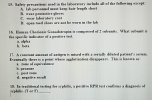 help please thank you!
15. Safety precautions used in the laboratory include all of the following except: A. lab personnel must keep hair length short B. wear protective gloves C. wear laboratory coat D. open toed shoes are not be worn in the lab 16. Human Chorionic Gonadotropin is comprised of 2 subunits. What subunit is the specific indicator of a positive test. a. alpha b. beta 17. A constant amount of antigen is mixed with a serially diluted patient's...
help please thank you!
15. Safety precautions used in the laboratory include all of the following except: A. lab personnel must keep hair length short B. wear protective gloves C. wear laboratory coat D. open toed shoes are not be worn in the lab 16. Human Chorionic Gonadotropin is comprised of 2 subunits. What subunit is the specific indicator of a positive test. a. alpha b. beta 17. A constant amount of antigen is mixed with a serially diluted patient's...
 help thank you!
28. All of the following would be considered good quality control protocols except: a. storing reagents properly b. allowing the reaction to go as long as possible. c. checking temperatures of water baths, etc. d. running positive and negative controls. 29. What would best characterize an indirect immunofluorescent assay when testing for the presence of a specific antibody in the patient's specimen. a. The anti-human immunoglobulin has a fluorescent label. b. The patient's serum is tagged with...
help thank you!
28. All of the following would be considered good quality control protocols except: a. storing reagents properly b. allowing the reaction to go as long as possible. c. checking temperatures of water baths, etc. d. running positive and negative controls. 29. What would best characterize an indirect immunofluorescent assay when testing for the presence of a specific antibody in the patient's specimen. a. The anti-human immunoglobulin has a fluorescent label. b. The patient's serum is tagged with...
 Answer as much as you can please
1. Deficiency of this molecule results in angioedema: ? a. IL-2 b. CI INH c . properdind . decay accelerating factor 2. Which is a biologic function of complement? a. promotes antigen presentation to CD4+ cells b. opsonin-mediated phagocytosis c. retention of immune complexes d. inhibition of histamine release 3. Which method quantifies antigen: a. Ouchterlony technique b.radial immunodiffusion c. Westem blot d. SDS-PAGE 4. IgG antibodies are predominant in causing? a negative...
Answer as much as you can please
1. Deficiency of this molecule results in angioedema: ? a. IL-2 b. CI INH c . properdind . decay accelerating factor 2. Which is a biologic function of complement? a. promotes antigen presentation to CD4+ cells b. opsonin-mediated phagocytosis c. retention of immune complexes d. inhibition of histamine release 3. Which method quantifies antigen: a. Ouchterlony technique b.radial immunodiffusion c. Westem blot d. SDS-PAGE 4. IgG antibodies are predominant in causing? a negative...
 help please thank you!
15. Safety precautions used in the laboratory include all of the following except: A. lab personnel must keep hair length short B. wear protective gloves C. wear laboratory coat D. open toed shoes are not be worn in the lab 16. Human Chorionic Gonadotropin is comprised of 2 subunits. What subunit is the specific indicator of a positive test. a. alpha b. beta 17. A constant amount of antigen is mixed with a serially diluted patient's...
help please thank you!
15. Safety precautions used in the laboratory include all of the following except: A. lab personnel must keep hair length short B. wear protective gloves C. wear laboratory coat D. open toed shoes are not be worn in the lab 16. Human Chorionic Gonadotropin is comprised of 2 subunits. What subunit is the specific indicator of a positive test. a. alpha b. beta 17. A constant amount of antigen is mixed with a serially diluted patient's...
Most questions answered within 3 hours.
-
Where is the error in this code sequence?
String s1 = "Hello";
String s2 = "ello";...
asked 11 months ago -
Financial data for Joel de Paris, Inc., for last year
follow:
Joel de Paris, Inc.
Balance...
asked 11 months ago -
Consider this reaction:
Al2(SO4)3 (aq)+ BaCl3
(aq) Al2Cl6 (aq)- +
3BaSO4(s) . What is the...
asked 11 months ago -
Suppose that Savneet is considering increasing her
recent random sample from 20 car rentals to 40...
asked 11 months ago -
Trucks arrive at an unloading terminal at an average rate of 120
per hour.
Trucks arrive...
asked 11 months ago -
Why are methanol and ethanol completely soluble in water while
octanol is not very little soluble....
asked 11 months ago -
A facilities manager at a university reads in a research report
that the mean amount of...
asked 11 months ago -
When the CuSO4 is rehydrated by adding water to the anhydrous
compound, is this an endothermic...
asked 11 months ago -
A ray of sunlight is passing from diamond into crown glass; the
angle of incidence is...
asked 11 months ago -
A block of mass 0.249 kg is placed on top of a light, vertical
spring of...
asked 11 months ago -
how do the kidneys compensate in the presences of acidosis
a) trigger hyperventilate
b) reserve acid...
asked 11 months ago -
Question 501 pts
The rental rate of capital to the firm increases. Which of the
following...
asked 11 months ago