For each pedigree below determine the most likely mode of inheritance and label each individual with a genotype. If you know they have a dominant phenotype, but don’t know the genotype, then label them with both possibilities. Please use the alleles A and a. Modes of inheritance for these pedigrees are autosomal dominant or autosomal recessive. For each pedigree determine if the alternative mode (not the one you chose) is also possible.
![to100 0 KEY Affected Male Affected Female Unaffected Male Unaffected] Female](http://img.homeworklib.com/questions/a54480c0-e523-11eb-9ef3-eb20e27a9f02.png?x-oss-process=image/resize,w_560)
Homework Answers
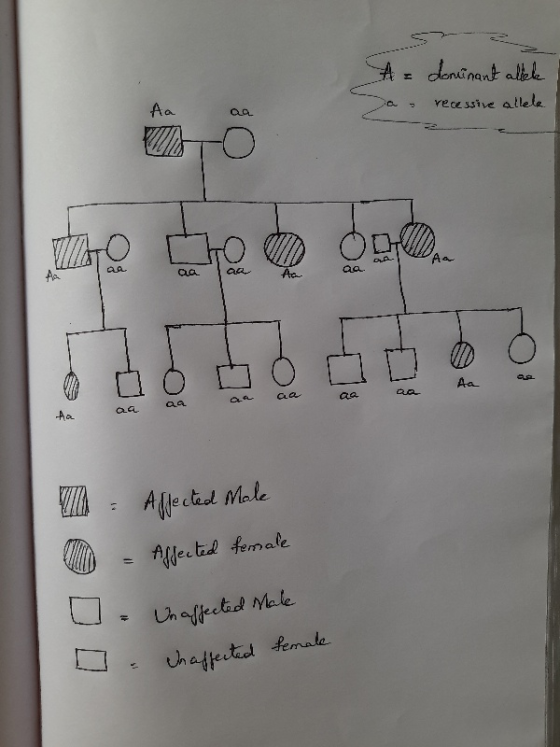
I don't think there is any other possibility even sex linked inheritance is not possible.
Add Answer to:
For each pedigree below determine the most likely mode of
inheritance and label each individual with...
For each pedigree below determine the most likely mode of inheritance and label each individual with...
 For each pedigree below determine the most likely mode of
inheritance and label each individual with a genotype. If you know
they have a dominant phenotype, but don’t know the genotype, then
label them with both possibilities. Please use the alleles A and a.
Modes of inheritance for these pedigrees are autosomal dominant or
autosomal recessive. For each pedigree determine if the alternative
mode (not the one you chose) is also possible.
female = male = III 4 6 IV...
For each pedigree below determine the most likely mode of
inheritance and label each individual with a genotype. If you know
they have a dominant phenotype, but don’t know the genotype, then
label them with both possibilities. Please use the alleles A and a.
Modes of inheritance for these pedigrees are autosomal dominant or
autosomal recessive. For each pedigree determine if the alternative
mode (not the one you chose) is also possible.
female = male = III 4 6 IV...
Pedigree Exercise For each pedigree below determine the most likely mode of inheritance and label each...
 Pedigree Exercise For each pedigree below determine the most likely mode of inheritance and label each individual with a genotype. If you know they have a dominant phenotype, but don't know the genotype, then label them with both possibilities. Please use the alleles A and a. Modes of inheritance for these pedigrees are autosomal dominant or autosomal recessive. For each pedigree determine if the alternative mode (not the one you chose) is also possible. = female = male 2 3...
For each pedigree below determine the most likely mode of inheritance and label each individual with...
 For each pedigree below determine the most likely mode of
inheritance and label each individual with a genotype. If you know
they have a dominant phenotype, but don’t know the genotype, then
label them with both possibilities. Please use the alleles A and a
for autosomal modes of inheritance and XA, Xa and Ya for any types
of sex-linkage (note: an “a” is only on the Y if the trait is
Y-linked). Modes of inheritance are autosomal dominant, autosomal
recessive,...
For each pedigree below determine the most likely mode of
inheritance and label each individual with a genotype. If you know
they have a dominant phenotype, but don’t know the genotype, then
label them with both possibilities. Please use the alleles A and a
for autosomal modes of inheritance and XA, Xa and Ya for any types
of sex-linkage (note: an “a” is only on the Y if the trait is
Y-linked). Modes of inheritance are autosomal dominant, autosomal
recessive,...
Web Genotypes and phenotypes for some common single gene inheritance patterns. Inheritance Pattern Genotype Phenotype Affected...
 Web Genotypes and phenotypes for some common single gene inheritance patterns. Inheritance Pattern Genotype Phenotype Affected Affected Not affected AA Autosomal Dominant Aa aa NN Not affected Not affected Affected Autosomal Recessive Nn nn XXN XNX Normal female Normal female Affected female Normal male Affected male Sex-linked Recessive X"X xNY X"Y Pedigree Analys is Instructions: 1. Examine the following three pedigrees. 2. Determine the most probable pattern of inheritance for each pedigree and record it in the space provided at...
Part B Determining genotypes in pedigrees of X-linked conditions The pedigree from Part A is shown...
 Part B Determining genotypes in pedigrees of X-linked
conditions
The pedigree from Part A is shown below. Fill in the most likely
genotypes of the indicated individuals in the pedigree. Note that a
dominant allele followed by an underscore (_) indicates that either
the dominant or the recessive allele may be present at the second
position. Drag one pink label (for condition A, autosomal
recessive) to each pink target. Drag one blue label (for condition
B, X-linked recessive) to each...
Part B Determining genotypes in pedigrees of X-linked
conditions
The pedigree from Part A is shown below. Fill in the most likely
genotypes of the indicated individuals in the pedigree. Note that a
dominant allele followed by an underscore (_) indicates that either
the dominant or the recessive allele may be present at the second
position. Drag one pink label (for condition A, autosomal
recessive) to each pink target. Drag one blue label (for condition
B, X-linked recessive) to each...
QUESTION 11 In this human pedigree, what is the most likely mode of inheritance of the...
 QUESTION 11 In this human pedigree, what is the most likely mode of inheritance of the trait? Autosomal dominant. Autosomal recessive. Sex-linked recessive. Sex-linked dominant.
11. (8 m) Refer to the following pedigree, which traces the inheritance of a biochemical disorder....
 11. (8 m) Refer to the following pedigree, which traces the inheritance of a biochemical disorder. female not affected female affected 0 male not affected male affected a. (2 m) Does this disorder appear to be caused by an autosomal or sex-linked gene? Does this disorder appear to be caused by a dominant allele or by a recessive allele? Explain how you know this. b. (2 m) Fill in the genotypes of all affected individuals. Use A and a to...
(a) For each pedigree, indicate the most likely mode of inheritance (6 pts) (2 pts) (b)...
 (a) For each pedigree, indicate the most likely mode of inheritance (6 pts) (2 pts) (b) In pedigree B, circle all individuals who are heterozygous. or to 0 0 - 이 SSO | 호 co | or - TTT Choices: A. Y-linked, B. X-linked dominant C. recessive, D. Autosomal dominant, E. Autosomal recessive.
6. For the given pedigree. determine what the possible modes of inheritance may be. Be sure...
 6. For the given pedigree. determine what the possible modes of inheritance may be. Be sure to include maternal inheritance and maternal effects in your analysis. Be sure to cite specific patterns in the pedigree that falsify each impossible mode. Autosomal Recessive: Autosomal Dominant: X-linked Recessive: X-linked Dominant: V-linked: Maternal Inheritance Maternal Effect:
(a) For each pedigree, indicate the most likely mode of inheritance (6 pts) B. (b) In...
 (a) For each pedigree, indicate the most likely mode of inheritance (6 pts) B. (b) In pedigree B, circle all individuals who are heterozygous. (2 pts) OG 0 0 0 0 0 호 c GO GO CD p. | 8 日 ITE | ODDC D Choices: A. Y-linked, B. X-linked dominant C. recessive, D. Autosomal dominant, E. Autosomal recessive.
 For each pedigree below determine the most likely mode of
inheritance and label each individual with a genotype. If you know
they have a dominant phenotype, but don’t know the genotype, then
label them with both possibilities. Please use the alleles A and a.
Modes of inheritance for these pedigrees are autosomal dominant or
autosomal recessive. For each pedigree determine if the alternative
mode (not the one you chose) is also possible.
female = male = III 4 6 IV...
For each pedigree below determine the most likely mode of
inheritance and label each individual with a genotype. If you know
they have a dominant phenotype, but don’t know the genotype, then
label them with both possibilities. Please use the alleles A and a.
Modes of inheritance for these pedigrees are autosomal dominant or
autosomal recessive. For each pedigree determine if the alternative
mode (not the one you chose) is also possible.
female = male = III 4 6 IV...
 Pedigree Exercise For each pedigree below determine the most likely mode of inheritance and label each individual with a genotype. If you know they have a dominant phenotype, but don't know the genotype, then label them with both possibilities. Please use the alleles A and a. Modes of inheritance for these pedigrees are autosomal dominant or autosomal recessive. For each pedigree determine if the alternative mode (not the one you chose) is also possible. = female = male 2 3...
 For each pedigree below determine the most likely mode of
inheritance and label each individual with a genotype. If you know
they have a dominant phenotype, but don’t know the genotype, then
label them with both possibilities. Please use the alleles A and a
for autosomal modes of inheritance and XA, Xa and Ya for any types
of sex-linkage (note: an “a” is only on the Y if the trait is
Y-linked). Modes of inheritance are autosomal dominant, autosomal
recessive,...
For each pedigree below determine the most likely mode of
inheritance and label each individual with a genotype. If you know
they have a dominant phenotype, but don’t know the genotype, then
label them with both possibilities. Please use the alleles A and a
for autosomal modes of inheritance and XA, Xa and Ya for any types
of sex-linkage (note: an “a” is only on the Y if the trait is
Y-linked). Modes of inheritance are autosomal dominant, autosomal
recessive,...
 Web Genotypes and phenotypes for some common single gene inheritance patterns. Inheritance Pattern Genotype Phenotype Affected Affected Not affected AA Autosomal Dominant Aa aa NN Not affected Not affected Affected Autosomal Recessive Nn nn XXN XNX Normal female Normal female Affected female Normal male Affected male Sex-linked Recessive X"X xNY X"Y Pedigree Analys is Instructions: 1. Examine the following three pedigrees. 2. Determine the most probable pattern of inheritance for each pedigree and record it in the space provided at...
 Part B Determining genotypes in pedigrees of X-linked
conditions
The pedigree from Part A is shown below. Fill in the most likely
genotypes of the indicated individuals in the pedigree. Note that a
dominant allele followed by an underscore (_) indicates that either
the dominant or the recessive allele may be present at the second
position. Drag one pink label (for condition A, autosomal
recessive) to each pink target. Drag one blue label (for condition
B, X-linked recessive) to each...
Part B Determining genotypes in pedigrees of X-linked
conditions
The pedigree from Part A is shown below. Fill in the most likely
genotypes of the indicated individuals in the pedigree. Note that a
dominant allele followed by an underscore (_) indicates that either
the dominant or the recessive allele may be present at the second
position. Drag one pink label (for condition A, autosomal
recessive) to each pink target. Drag one blue label (for condition
B, X-linked recessive) to each...
 QUESTION 11 In this human pedigree, what is the most likely mode of inheritance of the trait? Autosomal dominant. Autosomal recessive. Sex-linked recessive. Sex-linked dominant.
 11. (8 m) Refer to the following pedigree, which traces the inheritance of a biochemical disorder. female not affected female affected 0 male not affected male affected a. (2 m) Does this disorder appear to be caused by an autosomal or sex-linked gene? Does this disorder appear to be caused by a dominant allele or by a recessive allele? Explain how you know this. b. (2 m) Fill in the genotypes of all affected individuals. Use A and a to...
 (a) For each pedigree, indicate the most likely mode of inheritance (6 pts) (2 pts) (b) In pedigree B, circle all individuals who are heterozygous. or to 0 0 - 이 SSO | 호 co | or - TTT Choices: A. Y-linked, B. X-linked dominant C. recessive, D. Autosomal dominant, E. Autosomal recessive.
 6. For the given pedigree. determine what the possible modes of inheritance may be. Be sure to include maternal inheritance and maternal effects in your analysis. Be sure to cite specific patterns in the pedigree that falsify each impossible mode. Autosomal Recessive: Autosomal Dominant: X-linked Recessive: X-linked Dominant: V-linked: Maternal Inheritance Maternal Effect:
 (a) For each pedigree, indicate the most likely mode of inheritance (6 pts) B. (b) In pedigree B, circle all individuals who are heterozygous. (2 pts) OG 0 0 0 0 0 호 c GO GO CD p. | 8 日 ITE | ODDC D Choices: A. Y-linked, B. X-linked dominant C. recessive, D. Autosomal dominant, E. Autosomal recessive.
Most questions answered within 3 hours.
-
Where is the error in this code sequence?
String s1 = "Hello";
String s2 = "ello";...
asked 10 months ago -
Financial data for Joel de Paris, Inc., for last year
follow:
Joel de Paris, Inc.
Balance...
asked 10 months ago -
Consider this reaction:
Al2(SO4)3 (aq)+ BaCl3
(aq) Al2Cl6 (aq)- +
3BaSO4(s) . What is the...
asked 10 months ago -
Suppose that Savneet is considering increasing her
recent random sample from 20 car rentals to 40...
asked 10 months ago -
Trucks arrive at an unloading terminal at an average rate of 120
per hour.
Trucks arrive...
asked 10 months ago -
Why are methanol and ethanol completely soluble in water while
octanol is not very little soluble....
asked 10 months ago -
A facilities manager at a university reads in a research report
that the mean amount of...
asked 10 months ago -
When the CuSO4 is rehydrated by adding water to the anhydrous
compound, is this an endothermic...
asked 10 months ago -
A ray of sunlight is passing from diamond into crown glass; the
angle of incidence is...
asked 10 months ago -
A block of mass 0.249 kg is placed on top of a light, vertical
spring of...
asked 10 months ago -
how do the kidneys compensate in the presences of acidosis
a) trigger hyperventilate
b) reserve acid...
asked 10 months ago -
Question 501 pts
The rental rate of capital to the firm increases. Which of the
following...
asked 10 months ago