In one paragraph, discuss the structure of Polypeptides and Nucleic acids
Homework Answers

Add Answer to:
In one paragraph, discuss the structure of Polypeptides and
Nucleic acids
BRCA1 and BRCA2 Genes Discuss how the primary structure of nucleic acids is the order of bases i...
BRCA1 and BRCA2 Genes Discuss how the primary structure of nucleic acids is the order of bases in the polynucleotide sequence, and the secondary structure is the three-dimensional conformation of the backbone. Discuss the monomers of nucleic acids are nucleotides. Discuss how the bases are bonded to the sugars, forming nucleosides. Summarize how nucleosides are linked by ester bonds to phosphoric acid to form the phosphodiester backbone. Specific proteins called single-strand binding proteins bind to the single-stranded regions and protect...
Ribose is an important pentose sugar in the structure of nucleic acids. The linear structure for...
 Ribose is an important pentose sugar in the structure of nucleic acids. The linear structure for D-ribose is shown below. Use the methods we discussed in class (also in Timberlake) to convert the linear form below into the corresponding. Haworth structure for the beta anomer of D-ribose. Is the cyclic structure an acetal or a hemiacetal?
Proteins have many diverse functions. Carbohydrates, nucleic acids and lipids do not have diverse functions in...
Proteins have many diverse functions. Carbohydrates, nucleic acids and lipids do not have diverse functions in a cell. Proteins are polymers of amino acids. Discuss how the structure of amino acids allows proteins to perform so many functions.
Compare the structure of the four major biological macromolecules (carbohydrates, lipids, proteins, and nucleic acids) and...
Compare the structure of the four major biological macromolecules (carbohydrates, lipids, proteins, and nucleic acids) and explain how the distinct structure of each type of molecule enables it to carry out its particular function.
Why is CD Spectroscopy a useful tool for characterizing nucleic acid structures? Why are nucleic acids...
Why is CD Spectroscopy a useful tool for characterizing nucleic acid structures? Why are nucleic acids perfectly applicable for CD analyses? Name and describe another instrumental method for charactering the structure of DNA and RNA?
Nucleic Acids List the two types of nucleic acid polymers. Describe how information flows from DNA...
Nucleic Acids List the two types of nucleic acid polymers. Describe how information flows from DNA >> RNA >> proteins List the 3 major components of a nucleotide. Describe how these monomers are linked to form a nucleic acid. Distinguish between DNA and RNA. Briefly describe the three-dimensional structure of DNA.
Which facts about nucleic acids are true? 1. Nucleic acids are homopolymers. 2. Every polymerized monomer...
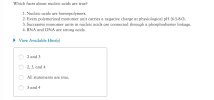 Which facts about nucleic acids are true? 1. Nucleic acids are homopolymers. 2. Every polymerized monomer unit carries a negative charge at physiological pH (6.5-8.0). 3. Successive monomer units in nucleic acids are connected through a phosphodiester linkage. 4. RNA and DNA are strong acids. ► View Available Hint(s) 2 and 3 O 2, 3, and 4 O All statements are true. 3 and 4
There are two types of nucleic acids, DNA and RNA. Nearly all organisms use DNA, not...
There are two types of nucleic acids, DNA and RNA. Nearly all organisms use DNA, not RNA, as the central repository for genetic information. Choose the statements that explain this phenomenon. DNA contains adenine as one of its nitrogenous bases. DNA has a double‑stranded structure that ensures an accurate mechanism of duplication. DNA contains an −OH−OH group at the 2′2′ carbon. DNA is flexible and forms complex catalytic structures. DNA is more resistant against enzymes that break down nucleic acids.
Most polypeptides are rather large. They contain at least __________ amino acids.
Most polypeptides are rather large. They contain at least __________ amino acids.
60) Lipids are composed of: c) fatty acids and glycerol amino acids and glycerol nucleic acids...
 60) Lipids are composed of: c) fatty acids and glycerol amino acids and glycerol nucleic acids and glycerol fatty acids and water fatty acids and sugar e) 61) The bond between two amino acids is a: a) hydrogen bond b) covalent bond c) peptide bond d) b and c e) none of the above 62) Hemoglobin has which tertiary structure: a) fibrous b) globular c) four subunits--two alpha chains, two beta chains d) alpha helix e) none of the above...
 Ribose is an important pentose sugar in the structure of nucleic acids. The linear structure for D-ribose is shown below. Use the methods we discussed in class (also in Timberlake) to convert the linear form below into the corresponding. Haworth structure for the beta anomer of D-ribose. Is the cyclic structure an acetal or a hemiacetal?
 Which facts about nucleic acids are true? 1. Nucleic acids are homopolymers. 2. Every polymerized monomer unit carries a negative charge at physiological pH (6.5-8.0). 3. Successive monomer units in nucleic acids are connected through a phosphodiester linkage. 4. RNA and DNA are strong acids. ► View Available Hint(s) 2 and 3 O 2, 3, and 4 O All statements are true. 3 and 4
 60) Lipids are composed of: c) fatty acids and glycerol amino acids and glycerol nucleic acids and glycerol fatty acids and water fatty acids and sugar e) 61) The bond between two amino acids is a: a) hydrogen bond b) covalent bond c) peptide bond d) b and c e) none of the above 62) Hemoglobin has which tertiary structure: a) fibrous b) globular c) four subunits--two alpha chains, two beta chains d) alpha helix e) none of the above...
Most questions answered within 3 hours.
-
Where is the error in this code sequence?
String s1 = "Hello";
String s2 = "ello";...
asked 10 months ago -
Financial data for Joel de Paris, Inc., for last year
follow:
Joel de Paris, Inc.
Balance...
asked 10 months ago -
Consider this reaction:
Al2(SO4)3 (aq)+ BaCl3
(aq) Al2Cl6 (aq)- +
3BaSO4(s) . What is the...
asked 10 months ago -
Suppose that Savneet is considering increasing her
recent random sample from 20 car rentals to 40...
asked 10 months ago -
Trucks arrive at an unloading terminal at an average rate of 120
per hour.
Trucks arrive...
asked 10 months ago -
Why are methanol and ethanol completely soluble in water while
octanol is not very little soluble....
asked 10 months ago -
A facilities manager at a university reads in a research report
that the mean amount of...
asked 10 months ago -
When the CuSO4 is rehydrated by adding water to the anhydrous
compound, is this an endothermic...
asked 10 months ago -
A ray of sunlight is passing from diamond into crown glass; the
angle of incidence is...
asked 10 months ago -
A block of mass 0.249 kg is placed on top of a light, vertical
spring of...
asked 10 months ago -
how do the kidneys compensate in the presences of acidosis
a) trigger hyperventilate
b) reserve acid...
asked 10 months ago -
Question 501 pts
The rental rate of capital to the firm increases. Which of the
following...
asked 10 months ago