
Homework Answers
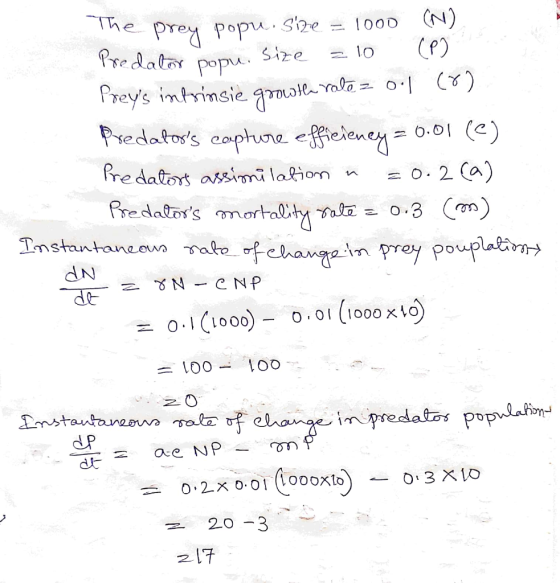
Qn a.
b.
If all parameters (r,c,a,m) remains stable, prey population will decline overtime.
c.
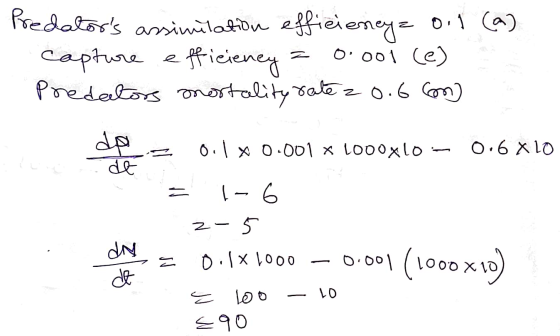
Predator population would expected to decline overtime.
Add Answer to:
I need help with parts a-c if possible, thank you!
5. Assume a predator and its...
Assume a predator and its prey are interacting according to the basic Lotka-Volterra model. The prey...
Assume a predator and its prey are interacting according to the basic Lotka-Volterra model. The prey population size is 1000, the predator population size is 10, the prey population’s intrinsic rate of growth is 0.1, the predator’s capture efficiency is 0.01, the predator’s assimilation efficiency is 0.2, and the predator’s mortality rate is 0.3. a. Under these conditions, what are the instantaneous growth rates of the prey and predator populations? b. If r, c, a, and m remain stable, which...
have I solved these correctly? (Lotka-Volterra model) Numbered Suppose that porcupines are the only prey and...
 have I solved these correctly? (Lotka-Volterra model)
Numbered Suppose that porcupines are the only prey and available food source for fisher, and that the predator-prey interaction follows Lotka-Volterra dynamics. The mortality rate of fisher in the absence of porcupines is 0.2 per week, and the intrinsic growth rate of porcupine is 0.3 per week. The capture efficiency of porcupine by fisher is 0.002, and the efficiency at which porcupine biomass is converted to fisher offspring is 0.1. 3a. If there...
have I solved these correctly? (Lotka-Volterra model)
Numbered Suppose that porcupines are the only prey and available food source for fisher, and that the predator-prey interaction follows Lotka-Volterra dynamics. The mortality rate of fisher in the absence of porcupines is 0.2 per week, and the intrinsic growth rate of porcupine is 0.3 per week. The capture efficiency of porcupine by fisher is 0.002, and the efficiency at which porcupine biomass is converted to fisher offspring is 0.1. 3a. If there...
Suppose that a lizard species eats only one type of insect and the populations follow Lotka–Volterra dynamics. The intrinsic growth rate of insects in the absence of predators is 0.2 per week, and the...
Suppose that a lizard species eats only one type of insect and the populations follow Lotka–Volterra dynamics. The intrinsic growth rate of insects in the absence of predators is 0.2 per week, and the mortality rate of the lizards in the absence of insects is 0.05 per week. The capture efficiency rate is 0.002, and the efficiency at which insect biomass is converted into predator biomass is 0.2. The lizard population will increase only if the number of insects is...
3. The graph below has axes to show the population sizes of a predator and its...
 3. The graph below has axes to show the population sizes of a predator and its prey. The dashed lines are the predator and prey isoclines. Prey Population Starting at the circle, draw in what will happen to the two populations if they are following the pattern in the Lotka-Volterra model of predation. (Remember that BOTH predator and prey numbers are represented by a point on the graph.) Use a series of arrows to show what happens. 2. Imagine two...
 have I solved these correctly? (Lotka-Volterra model)
Numbered Suppose that porcupines are the only prey and available food source for fisher, and that the predator-prey interaction follows Lotka-Volterra dynamics. The mortality rate of fisher in the absence of porcupines is 0.2 per week, and the intrinsic growth rate of porcupine is 0.3 per week. The capture efficiency of porcupine by fisher is 0.002, and the efficiency at which porcupine biomass is converted to fisher offspring is 0.1. 3a. If there...
have I solved these correctly? (Lotka-Volterra model)
Numbered Suppose that porcupines are the only prey and available food source for fisher, and that the predator-prey interaction follows Lotka-Volterra dynamics. The mortality rate of fisher in the absence of porcupines is 0.2 per week, and the intrinsic growth rate of porcupine is 0.3 per week. The capture efficiency of porcupine by fisher is 0.002, and the efficiency at which porcupine biomass is converted to fisher offspring is 0.1. 3a. If there...
 3. The graph below has axes to show the population sizes of a predator and its prey. The dashed lines are the predator and prey isoclines. Prey Population Starting at the circle, draw in what will happen to the two populations if they are following the pattern in the Lotka-Volterra model of predation. (Remember that BOTH predator and prey numbers are represented by a point on the graph.) Use a series of arrows to show what happens. 2. Imagine two...
Most questions answered within 3 hours.
-
Where is the error in this code sequence?
String s1 = "Hello";
String s2 = "ello";...
asked 11 months ago -
Financial data for Joel de Paris, Inc., for last year
follow:
Joel de Paris, Inc.
Balance...
asked 11 months ago -
Consider this reaction:
Al2(SO4)3 (aq)+ BaCl3
(aq) Al2Cl6 (aq)- +
3BaSO4(s) . What is the...
asked 11 months ago -
Suppose that Savneet is considering increasing her
recent random sample from 20 car rentals to 40...
asked 11 months ago -
Trucks arrive at an unloading terminal at an average rate of 120
per hour.
Trucks arrive...
asked 11 months ago -
Why are methanol and ethanol completely soluble in water while
octanol is not very little soluble....
asked 11 months ago -
A facilities manager at a university reads in a research report
that the mean amount of...
asked 11 months ago -
When the CuSO4 is rehydrated by adding water to the anhydrous
compound, is this an endothermic...
asked 11 months ago -
A ray of sunlight is passing from diamond into crown glass; the
angle of incidence is...
asked 11 months ago -
A block of mass 0.249 kg is placed on top of a light, vertical
spring of...
asked 11 months ago -
how do the kidneys compensate in the presences of acidosis
a) trigger hyperventilate
b) reserve acid...
asked 11 months ago -
Question 501 pts
The rental rate of capital to the firm increases. Which of the
following...
asked 11 months ago