
Homework Answers

Add Answer to:
no explaination is needed
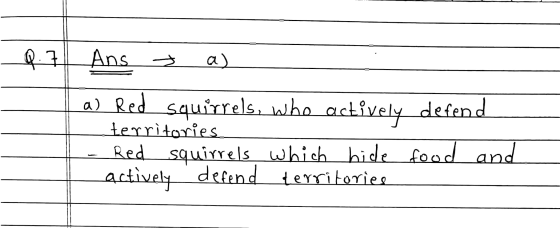
7. Which of the following groups would be most likely to exhibit...
no explaination is needed 7. Which of the following is not a term used to describe...
 no explaination is needed
7. Which of the following is not a term used to describe animal dispersion? a) Long distance b) Uniform c) Random d) Clumped 8. Population growth may be affected by a) predation but not competition. b) competition but not predation. c) competition and predation. d) neither competition nor predation 9. Batesian mimicry is when a) a harmless species imitates a harmful species b) two or more unpalatable species mimic cach other. c) a harmful species imitates...
no explaination is needed
7. Which of the following is not a term used to describe animal dispersion? a) Long distance b) Uniform c) Random d) Clumped 8. Population growth may be affected by a) predation but not competition. b) competition but not predation. c) competition and predation. d) neither competition nor predation 9. Batesian mimicry is when a) a harmless species imitates a harmful species b) two or more unpalatable species mimic cach other. c) a harmful species imitates...
no explaination is needed 8. In ecology, density independent population growth a) results from decreased fecundity....
 no explaination is needed
8. In ecology, density independent population growth a) results from decreased fecundity. b) is associated with crowded populations. ch results from competition for resources. d) may be associated with stochastic events. 9. Which of the following groups would be most likely to exhibit uniform dispersion? a) Red squirrels, who actively defend territories b) Cattails, which grow primarily at edges of lakes and streams. c) Moths, in a city at night. d) Lake trout, which seek out...
no explaination is needed
8. In ecology, density independent population growth a) results from decreased fecundity. b) is associated with crowded populations. ch results from competition for resources. d) may be associated with stochastic events. 9. Which of the following groups would be most likely to exhibit uniform dispersion? a) Red squirrels, who actively defend territories b) Cattails, which grow primarily at edges of lakes and streams. c) Moths, in a city at night. d) Lake trout, which seek out...
5. The animals of which phylum use a water vascular system in locomotion, feeding and gas...
5. The animals of which phylum use a water vascular system in locomotion, feeding and gas exchange? a) Echinodermata b) Mollusca c) Arthropoda d) Chordata 6. As N (population size) approaches K (carrying capacity) for a certain population, which of the following is predicted by the logistic equation? a) The growth rate will not change. b) The growth rate will approach zero. c) The population will increase exponentially. d) The carrying capacity of the environment will increase. 7. A type...
no explaination is needed 1. At which developmental stage should one be able to first distinguish...
 no explaination is needed
1. At which developmental stage should one be able to first distinguish a protostome embryo from a deuterostome embryo? a) Fertilization b) Cleavage c) Gastrulation d) Coelom formation Which of the following is a diploblastic phylum of aquatic predators? a) Mollusca b) Annelida c) Arthropoda d) Cnidaria 3. Arthropods are animals with a) a segmented body, hard exoskeleton and jointed appendages. b) a limbless body composed of a series of fused rings. c) soft non-segmented bodies,...
no explaination is needed
1. At which developmental stage should one be able to first distinguish a protostome embryo from a deuterostome embryo? a) Fertilization b) Cleavage c) Gastrulation d) Coelom formation Which of the following is a diploblastic phylum of aquatic predators? a) Mollusca b) Annelida c) Arthropoda d) Cnidaria 3. Arthropods are animals with a) a segmented body, hard exoskeleton and jointed appendages. b) a limbless body composed of a series of fused rings. c) soft non-segmented bodies,...
no explaination is needed SECTION A (approx. 1 hour). Answer on the special MCQ answer sheet...
 no explaination is needed
SECTION A (approx. 1 hour). Answer on the special MCQ answer sheet provided. Follow the instructions carefully on how to fill this in. Answer ALL questions. ERRE 1. Which germ layer is found in triploblastic animals but not diploblastic animals? a) Ectoderm b) Endoderm c) Mesoderme d d) Mesoglea er 2. At which developmental stage should one be able to first distinguish a protostome embryo from a deuterostome embryo? a) Fertilization b) Cleavage c) Gastrulation d)...
no explaination is needed
SECTION A (approx. 1 hour). Answer on the special MCQ answer sheet provided. Follow the instructions carefully on how to fill this in. Answer ALL questions. ERRE 1. Which germ layer is found in triploblastic animals but not diploblastic animals? a) Ectoderm b) Endoderm c) Mesoderme d d) Mesoglea er 2. At which developmental stage should one be able to first distinguish a protostome embryo from a deuterostome embryo? a) Fertilization b) Cleavage c) Gastrulation d)...
no need explaination, I will give a thumb thanks. 16. Which of the following does NOT...
 no need explaination, I will give a thumb thanks.
16. Which of the following does NOT have a gastrovascular cavity? a) earthworm b) flatworm c) hydra d) jellyfish 26. Sexual reproduction is the creation of a zygote by a) development of an unfertilised egg. b) fusion of male gamete (sperm) and female gamete (egg). c) fusion of a sperm from one species and an egg from another species. d) fusion of female gamete (sperm) and male gamete (egg). 22. The...
no need explaination, I will give a thumb thanks.
16. Which of the following does NOT have a gastrovascular cavity? a) earthworm b) flatworm c) hydra d) jellyfish 26. Sexual reproduction is the creation of a zygote by a) development of an unfertilised egg. b) fusion of male gamete (sperm) and female gamete (egg). c) fusion of a sperm from one species and an egg from another species. d) fusion of female gamete (sperm) and male gamete (egg). 22. The...
re most likely to survive and the average weight 14) Which of the following is an...
 re most likely to survive and the average weight 14) Which of the following is an example of stabilizing selection? A) The birth weight at which newborn humans are most likely to survive and of newborn humans are about the same. B) There is an increase in antibiotic resistant strains of bacteria C) There is an increase in the number of different breeds of dog. D) Garter snakes with different coloration patterns behave differently when threatened. 15) Which of the...
no explaination is needed 14. If two species of seed-eating finch colonized an island on which...
 no explaination is needed
14. If two species of seed-eating finch colonized an island on which there were seeds of only one size, what would Gause's principle of competitive exclusion predict? a) The finches would hybridize and become one species. b) One finch would evolve smaller beaks and the other would evolve larger beaks. c) One of the finch species would probably disappear from the island. d) The plants would evolve seeds of different sizes. 15. Which of the following...
no explaination is needed
14. If two species of seed-eating finch colonized an island on which there were seeds of only one size, what would Gause's principle of competitive exclusion predict? a) The finches would hybridize and become one species. b) One finch would evolve smaller beaks and the other would evolve larger beaks. c) One of the finch species would probably disappear from the island. d) The plants would evolve seeds of different sizes. 15. Which of the following...
no explaination is needed, I will give a thumb, thanks' 16. In close comparisons, external fertilization...
 no explaination is needed, I will give a thumb, thanks'
16. In close comparisons, external fertilization often yields more offspring than does Internal fertilization, but Internal fertilization offers the advantage that a) It is the only way to ensure the survival of the species b) It requires less time and energy to be devoted to reproduction. d the smaller number of offspring produced often receive a greater amount of parental investment. d) It permits the most rapid population increase 17....
no explaination is needed, I will give a thumb, thanks'
16. In close comparisons, external fertilization often yields more offspring than does Internal fertilization, but Internal fertilization offers the advantage that a) It is the only way to ensure the survival of the species b) It requires less time and energy to be devoted to reproduction. d the smaller number of offspring produced often receive a greater amount of parental investment. d) It permits the most rapid population increase 17....
Which of the following would most likely be true in the presence of an uncoupling agent?...
Which of the following would most likely be true in the presence of an uncoupling agent? A) Electron transport at the inner mitochondrial membrane would cease. B) The energy from the proton-motive force would likely be dissipated as heat rather than in producing ATP from ADP. C) H+ ions would flow through the inner membrane into the intermembrane space. D) There would be an increase in biosynthesis.
 no explaination is needed
7. Which of the following is not a term used to describe animal dispersion? a) Long distance b) Uniform c) Random d) Clumped 8. Population growth may be affected by a) predation but not competition. b) competition but not predation. c) competition and predation. d) neither competition nor predation 9. Batesian mimicry is when a) a harmless species imitates a harmful species b) two or more unpalatable species mimic cach other. c) a harmful species imitates...
no explaination is needed
7. Which of the following is not a term used to describe animal dispersion? a) Long distance b) Uniform c) Random d) Clumped 8. Population growth may be affected by a) predation but not competition. b) competition but not predation. c) competition and predation. d) neither competition nor predation 9. Batesian mimicry is when a) a harmless species imitates a harmful species b) two or more unpalatable species mimic cach other. c) a harmful species imitates...
 no explaination is needed
8. In ecology, density independent population growth a) results from decreased fecundity. b) is associated with crowded populations. ch results from competition for resources. d) may be associated with stochastic events. 9. Which of the following groups would be most likely to exhibit uniform dispersion? a) Red squirrels, who actively defend territories b) Cattails, which grow primarily at edges of lakes and streams. c) Moths, in a city at night. d) Lake trout, which seek out...
no explaination is needed
8. In ecology, density independent population growth a) results from decreased fecundity. b) is associated with crowded populations. ch results from competition for resources. d) may be associated with stochastic events. 9. Which of the following groups would be most likely to exhibit uniform dispersion? a) Red squirrels, who actively defend territories b) Cattails, which grow primarily at edges of lakes and streams. c) Moths, in a city at night. d) Lake trout, which seek out...
 no explaination is needed
1. At which developmental stage should one be able to first distinguish a protostome embryo from a deuterostome embryo? a) Fertilization b) Cleavage c) Gastrulation d) Coelom formation Which of the following is a diploblastic phylum of aquatic predators? a) Mollusca b) Annelida c) Arthropoda d) Cnidaria 3. Arthropods are animals with a) a segmented body, hard exoskeleton and jointed appendages. b) a limbless body composed of a series of fused rings. c) soft non-segmented bodies,...
no explaination is needed
1. At which developmental stage should one be able to first distinguish a protostome embryo from a deuterostome embryo? a) Fertilization b) Cleavage c) Gastrulation d) Coelom formation Which of the following is a diploblastic phylum of aquatic predators? a) Mollusca b) Annelida c) Arthropoda d) Cnidaria 3. Arthropods are animals with a) a segmented body, hard exoskeleton and jointed appendages. b) a limbless body composed of a series of fused rings. c) soft non-segmented bodies,...
 no explaination is needed
SECTION A (approx. 1 hour). Answer on the special MCQ answer sheet provided. Follow the instructions carefully on how to fill this in. Answer ALL questions. ERRE 1. Which germ layer is found in triploblastic animals but not diploblastic animals? a) Ectoderm b) Endoderm c) Mesoderme d d) Mesoglea er 2. At which developmental stage should one be able to first distinguish a protostome embryo from a deuterostome embryo? a) Fertilization b) Cleavage c) Gastrulation d)...
no explaination is needed
SECTION A (approx. 1 hour). Answer on the special MCQ answer sheet provided. Follow the instructions carefully on how to fill this in. Answer ALL questions. ERRE 1. Which germ layer is found in triploblastic animals but not diploblastic animals? a) Ectoderm b) Endoderm c) Mesoderme d d) Mesoglea er 2. At which developmental stage should one be able to first distinguish a protostome embryo from a deuterostome embryo? a) Fertilization b) Cleavage c) Gastrulation d)...
 no need explaination, I will give a thumb thanks.
16. Which of the following does NOT have a gastrovascular cavity? a) earthworm b) flatworm c) hydra d) jellyfish 26. Sexual reproduction is the creation of a zygote by a) development of an unfertilised egg. b) fusion of male gamete (sperm) and female gamete (egg). c) fusion of a sperm from one species and an egg from another species. d) fusion of female gamete (sperm) and male gamete (egg). 22. The...
no need explaination, I will give a thumb thanks.
16. Which of the following does NOT have a gastrovascular cavity? a) earthworm b) flatworm c) hydra d) jellyfish 26. Sexual reproduction is the creation of a zygote by a) development of an unfertilised egg. b) fusion of male gamete (sperm) and female gamete (egg). c) fusion of a sperm from one species and an egg from another species. d) fusion of female gamete (sperm) and male gamete (egg). 22. The...
 re most likely to survive and the average weight 14) Which of the following is an example of stabilizing selection? A) The birth weight at which newborn humans are most likely to survive and of newborn humans are about the same. B) There is an increase in antibiotic resistant strains of bacteria C) There is an increase in the number of different breeds of dog. D) Garter snakes with different coloration patterns behave differently when threatened. 15) Which of the...
 no explaination is needed
14. If two species of seed-eating finch colonized an island on which there were seeds of only one size, what would Gause's principle of competitive exclusion predict? a) The finches would hybridize and become one species. b) One finch would evolve smaller beaks and the other would evolve larger beaks. c) One of the finch species would probably disappear from the island. d) The plants would evolve seeds of different sizes. 15. Which of the following...
no explaination is needed
14. If two species of seed-eating finch colonized an island on which there were seeds of only one size, what would Gause's principle of competitive exclusion predict? a) The finches would hybridize and become one species. b) One finch would evolve smaller beaks and the other would evolve larger beaks. c) One of the finch species would probably disappear from the island. d) The plants would evolve seeds of different sizes. 15. Which of the following...
 no explaination is needed, I will give a thumb, thanks'
16. In close comparisons, external fertilization often yields more offspring than does Internal fertilization, but Internal fertilization offers the advantage that a) It is the only way to ensure the survival of the species b) It requires less time and energy to be devoted to reproduction. d the smaller number of offspring produced often receive a greater amount of parental investment. d) It permits the most rapid population increase 17....
no explaination is needed, I will give a thumb, thanks'
16. In close comparisons, external fertilization often yields more offspring than does Internal fertilization, but Internal fertilization offers the advantage that a) It is the only way to ensure the survival of the species b) It requires less time and energy to be devoted to reproduction. d the smaller number of offspring produced often receive a greater amount of parental investment. d) It permits the most rapid population increase 17....
Most questions answered within 3 hours.
-
Where is the error in this code sequence?
String s1 = "Hello";
String s2 = "ello";...
asked 10 months ago -
Financial data for Joel de Paris, Inc., for last year
follow:
Joel de Paris, Inc.
Balance...
asked 10 months ago -
Consider this reaction:
Al2(SO4)3 (aq)+ BaCl3
(aq) Al2Cl6 (aq)- +
3BaSO4(s) . What is the...
asked 10 months ago -
Suppose that Savneet is considering increasing her
recent random sample from 20 car rentals to 40...
asked 10 months ago -
Trucks arrive at an unloading terminal at an average rate of 120
per hour.
Trucks arrive...
asked 10 months ago -
Why are methanol and ethanol completely soluble in water while
octanol is not very little soluble....
asked 10 months ago -
A facilities manager at a university reads in a research report
that the mean amount of...
asked 10 months ago -
When the CuSO4 is rehydrated by adding water to the anhydrous
compound, is this an endothermic...
asked 10 months ago -
A ray of sunlight is passing from diamond into crown glass; the
angle of incidence is...
asked 10 months ago -
A block of mass 0.249 kg is placed on top of a light, vertical
spring of...
asked 10 months ago -
how do the kidneys compensate in the presences of acidosis
a) trigger hyperventilate
b) reserve acid...
asked 10 months ago -
Question 501 pts
The rental rate of capital to the firm increases. Which of the
following...
asked 10 months ago