Photoreactivation is called a direct reversal of DNA damage. Mismatch repair, Nucleotide excision repair and base...
Photoreactivation is called a direct reversal of DNA damage. Mismatch repair, Nucleotide excision repair and base excision repair correct DNA mismatches and damaged bases, but these systems are not considered direct repair. what two general steps do these indirect repair systems have in common?.
Homework Answers

Add Answer to:
Photoreactivation is called a direct reversal of DNA damage.
Mismatch repair, Nucleotide excision repair and base...
Which of the examples listed is not a DNA repair mechanism? direct repair base‑excision repair nucleotide‑excision...
Which of the examples listed is not a DNA repair mechanism? direct repair base‑excision repair nucleotide‑excision repair insertion sequence repair mismatch repair
Which DNA repair process begins with N-glycosylase reaction, followed by repair enzymes that excise one or...
 Which DNA repair process begins with N-glycosylase reaction, followed by repair enzymes that excise one or more nucleotides at the abasic site? ► View Available Hint(s) mismatch repair systems O base excision repair O photoreactivation O Nucleotide excision repair Submit
Can you please explain in detail DNA repair mechanisms from a biochemical point of view (direct...
Can you please explain in detail DNA repair mechanisms from a biochemical point of view (direct reversal of damage- DNA methyltransferase, DNA photolyase, base excision repair- DNA glycosylase and nucleotide excision repair, as well as mismatch repair and SOS response and recombination repair) I really need your help. I will be forever grateful. And if I may ask you one thing if you copy from the internet please put the citations, or links. Thank you in advance!!!
Outline the processes involved in the following five major classes of DNA repair systems: 1. Direct...
Outline the processes involved in the following five major classes of DNA repair systems: 1. Direct Repair 2. Base Excision repair 3. Nucleotide Excision Repair 4. Mismatch Repair 5. Bypass repair systems
1.Which of the following DNA repair systems involving DNA N-glycosylasesrecognizes an abnormal DNA nucleotide (i.e. uracil)...
1.Which of the following DNA repair systems involving DNA N-glycosylasesrecognizes an abnormal DNA nucleotide (i.e. uracil) and cleaves the bond between it and the sugar? - Mismatch repair -Base excision repair -Non-homologous end-joining repair -Homologous recombination repair 2. self-splicing is the most common mechanism for splicing mRNA transcribed from eukaryotic, nuclear, structural genes - true or false 3. True or False, during elongation of transcription, RNA polymerase is primarily in a closed complex
Choose the repair mechanism that is best associated with the statement. Some statements may have more...
Choose the repair mechanism that is best associated with the statement. Some statements may have more than one answer. a. nucleotide excision repair b. mismatch repair c. translesion synthesis d. recombinational repair e. base excision repair _____ 1. Uses an enzyme called the DNA-N-glycosylases. _____ 2. Utilizes a group of proteins called Mut. _____ 3. The disease Xeroderma pigmentosum is caused by a defect in this system. _____ 4. This is associated with the SOS response in bacteria. _____ 5....
Which of the following is NOT a DNA repair mechanism? a. base excision in which bulky...
Which of the following is NOT a DNA repair mechanism? a. base excision in which bulky lesions are removed and replaced with the original nucleotides b. direct repair of a modified base to the original structure c. repair of mismatched bases to the original pair of nucleotides on opposite strands d. replacement of nucleotides without the use of the complementary strand as a template e. all of the above
Which are true about direct repair of DNA? O The damaged base is excised and a...
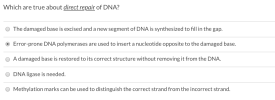 Which are true about direct repair of DNA? O The damaged base is excised and a new segment of DNA is synthesized to fill in the gap. Error-prone DNA polymerases are used to insert a nucleotide opposite to the damaged base. O A damaged base is restored to its correct structure without removing it from the DNA. O DNA ligase is needed. O Methylation marks can be used to distinguish the correct strand from the incorrect strand.
Repair of DNA damage from UV radiation DNA damage from UV radiation needs to be repaired...
 Repair of DNA damage from UV radiation
DNA damage from UV radiation needs to be repaired if
DNA replication occurs without error. the following plot shows how
cell survival is affected in the presence of UV radiation. Notice
that the wild-type cells can overcome the damaging effects of UV
radiation on DNA and show high survival even as UV increases.
However, cells deficient in certain genes display relatively much
lower survival rates.
1. the fact that the double mutant shows...
Repair of DNA damage from UV radiation
DNA damage from UV radiation needs to be repaired if
DNA replication occurs without error. the following plot shows how
cell survival is affected in the presence of UV radiation. Notice
that the wild-type cells can overcome the damaging effects of UV
radiation on DNA and show high survival even as UV increases.
However, cells deficient in certain genes display relatively much
lower survival rates.
1. the fact that the double mutant shows...
13) The number of new mutations in a given gene per cell generation is called? B)...
 13) The number of new mutations in a given gene per cell generation is called? B) mutation rate C) recombination frequeney 14) A type of spontaneous mutation that occur when a purine base is removed from the DNA is A) deamination D) alkylate bases В) apurination E) base analog C) thymine dimers 15) A type of spontaneous mutation that involves a temporary change in the base conformation because the keto group may change to an enol functional group or amino...
 Which DNA repair process begins with N-glycosylase reaction, followed by repair enzymes that excise one or more nucleotides at the abasic site? ► View Available Hint(s) mismatch repair systems O base excision repair O photoreactivation O Nucleotide excision repair Submit
 Which are true about direct repair of DNA? O The damaged base is excised and a new segment of DNA is synthesized to fill in the gap. Error-prone DNA polymerases are used to insert a nucleotide opposite to the damaged base. O A damaged base is restored to its correct structure without removing it from the DNA. O DNA ligase is needed. O Methylation marks can be used to distinguish the correct strand from the incorrect strand.
 Repair of DNA damage from UV radiation
DNA damage from UV radiation needs to be repaired if
DNA replication occurs without error. the following plot shows how
cell survival is affected in the presence of UV radiation. Notice
that the wild-type cells can overcome the damaging effects of UV
radiation on DNA and show high survival even as UV increases.
However, cells deficient in certain genes display relatively much
lower survival rates.
1. the fact that the double mutant shows...
Repair of DNA damage from UV radiation
DNA damage from UV radiation needs to be repaired if
DNA replication occurs without error. the following plot shows how
cell survival is affected in the presence of UV radiation. Notice
that the wild-type cells can overcome the damaging effects of UV
radiation on DNA and show high survival even as UV increases.
However, cells deficient in certain genes display relatively much
lower survival rates.
1. the fact that the double mutant shows...
 13) The number of new mutations in a given gene per cell generation is called? B) mutation rate C) recombination frequeney 14) A type of spontaneous mutation that occur when a purine base is removed from the DNA is A) deamination D) alkylate bases В) apurination E) base analog C) thymine dimers 15) A type of spontaneous mutation that involves a temporary change in the base conformation because the keto group may change to an enol functional group or amino...
Most questions answered within 3 hours.
-
Where is the error in this code sequence?
String s1 = "Hello";
String s2 = "ello";...
asked 10 months ago -
Financial data for Joel de Paris, Inc., for last year
follow:
Joel de Paris, Inc.
Balance...
asked 10 months ago -
Consider this reaction:
Al2(SO4)3 (aq)+ BaCl3
(aq) Al2Cl6 (aq)- +
3BaSO4(s) . What is the...
asked 10 months ago -
Suppose that Savneet is considering increasing her
recent random sample from 20 car rentals to 40...
asked 10 months ago -
Trucks arrive at an unloading terminal at an average rate of 120
per hour.
Trucks arrive...
asked 10 months ago -
Why are methanol and ethanol completely soluble in water while
octanol is not very little soluble....
asked 10 months ago -
A facilities manager at a university reads in a research report
that the mean amount of...
asked 10 months ago -
When the CuSO4 is rehydrated by adding water to the anhydrous
compound, is this an endothermic...
asked 10 months ago -
A ray of sunlight is passing from diamond into crown glass; the
angle of incidence is...
asked 10 months ago -
A block of mass 0.249 kg is placed on top of a light, vertical
spring of...
asked 10 months ago -
how do the kidneys compensate in the presences of acidosis
a) trigger hyperventilate
b) reserve acid...
asked 10 months ago -
Question 501 pts
The rental rate of capital to the firm increases. Which of the
following...
asked 10 months ago