What types of molecules can pass through a membrane without the aid of a membrane protein?...
What types of molecules can pass through a membrane without the aid of a membrane protein? What types of molecules use a membrane protein in order to cross the membrane?
Homework Answers
the plasma membrane is made of the lipid bilayer, lipid bilayer has amphipathic lipid molecules having a polar head and hydrophobic tail arranged into two layers such that the lipids of both layers face each other.
since lipid bilayer has the hydrophobic region, hydrophilic molecules cannot pass through the membrane without the help of proteins but hydrophobic lipid-soluble molecules can move through the plasma membrane into the cell.
types of molecules can pass through a membrane without the aid of a membrane protein are hydrophobic, fat-soluble molecules.
types of molecules use a membrane protein in order to cross the membrane: hydrophilic molecules ( small hydrophilic molecules can pass through the lipid bilayer at low rates)
Add Answer to:
What types of molecules can pass through a membrane without the
aid of a membrane protein?...
What molecules can pass people? through a lipid membrane? Which molecules are at 4. What technology...
 What molecules can pass people? through a lipid membrane? Which molecules are at 4. What technology was used to figure out the fluidity of cell membranesie the membrane pids are mobile? 5. Does the mobily membrane proteins der so why Look at worksheet for das 21 Compare MPL MP2 and MP3 proteins & What is the role of SRP in the rouch ER? 7. Draw apath for a n d protein from gene expression to secretion Nudes where the is...
Membrane-bound receptors are an important component facilitating some types of cellular communication; however, not all signal-receptor...
Membrane-bound receptors are an important component facilitating some types of cellular communication; however, not all signal-receptor binding occurs outside the cell membrane. Some signal molecules are able to pass through the plasma membrane, and their receptors are intracellular. In a theoretical lab study, scientists work to design a lab experiment that would inhibit some molecules’ ability to bind with their intracellular receptors. (a) Draw conclusions about the structure and function of membrane proteins. (b) Identify some molecules that are able...
Which of the below molecules would be expected to be membrane permeable and freely pass through a lipid bilayer? Select...
 Which of the below molecules would be expected to be membrane
permeable and freely pass through a lipid bilayer?
Select all that apply
Which of the below molecules would be expected to be membrane permeable and freely pass through a lipid bilayer? Select all that apply. O=C=0 Nat NEN K+ * H-C-OH Ο Ι Ι HHHHHH
Which of the below molecules would be expected to be membrane
permeable and freely pass through a lipid bilayer?
Select all that apply
Which of the below molecules would be expected to be membrane permeable and freely pass through a lipid bilayer? Select all that apply. O=C=0 Nat NEN K+ * H-C-OH Ο Ι Ι HHHHHH
what about the nucleosides? how could it cross the membrane? Q6: How would you expect nucleosides...
 what about the nucleosides? how could it cross the
membrane?
Q6: How would you expect nucleosides and steroids to cross the plasma membrane? And what are the requirements for compounds to pass through the membrane [20% Points] plasma * The el membrane is Selectively permeable; hydrophobic molecules and Small polar molecules can diffuse through the lipid Layer, but ions and Larg polar molecules Cannot. Integral membrane proteins enable ians and lary polar molecules to pass through by passive or active...
what about the nucleosides? how could it cross the
membrane?
Q6: How would you expect nucleosides and steroids to cross the plasma membrane? And what are the requirements for compounds to pass through the membrane [20% Points] plasma * The el membrane is Selectively permeable; hydrophobic molecules and Small polar molecules can diffuse through the lipid Layer, but ions and Larg polar molecules Cannot. Integral membrane proteins enable ians and lary polar molecules to pass through by passive or active...
10 > What is a membrane potential? the difference in molecular concentrations across the cell membrane...
 10 > What is a membrane potential? the difference in molecular concentrations across the cell membrane the ability of a molecule to pass through a membrane the difference in charge across the cell membrane the number of molecules that cross the membrane in an hour
QUESTION 19 The particles that can pass through a semipermeable membrane are the ones found in:...
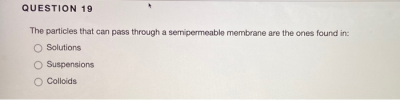 QUESTION 19 The particles that can pass through a semipermeable membrane are the ones found in: Solutions Suspensions Colloids
Describe the fluid mosaic model of membrane structure. What experimental methods support this model? With regard...
Describe the fluid mosaic model of membrane structure. What experimental methods support this model? With regard to membrane fluidity, how can molecules move within membranes? How CAN’T they move? What types of molecules increase or decrease membrane fluidity? How do alpha-helices allow proteins to pass through membranes? Describe the differences between integral membrane proteins, peripheral membrane proteins and lipid-anchored proteins with regard to how they interact with the membrane.
Match the properties described with one of the four components of a membrane. Interior protein network...
 Match the properties described with one of the four components of a membrane. Interior protein network Phospholipid bilayer Can span both layers of a membrane Often carbohydrate attached to lipid or protein Helps determine the overall shape of a cell Can form channels to allow small molecules to cross membranes Transmembrane protein Cell surface marker Forms a semipermeable barrier Can allow diffusion of gases Reset
The plasma membrane of E. coli is approximately 75% protein and 25% phospholipid by weight. It...
 The plasma membrane of E. coli is approximately 75% protein and 25% phospholipid by weight. It is known that the average membrane protein molecular weight is 50,000 Da and an average membrane phospholipid molecular weight is 750 Da. Calculate the number of membrane phospholipid molecules present per molecule of membrane protein number of membrane phospholipid molecules: 0.033 molecules Select the additional information that one would need to calculate the fraction of membrane surface covered by phospholipids. the average cross-sectional areas...
A protein diffuses from left to right through a thick biological membrane (thickness = 10 cm)...
A protein diffuses from left to right through a thick biological membrane (thickness = 10 cm) having a cross-sectional area of 6 cm2. The diffusion coefficient D for this membrane-protein system is 5.0 x 10⁻¹⁰ m2/s. A total mass of 8.0 x 10⁻¹⁴ kg of the protein is transported across the membrane in 15 sec. If the protein density on the left side of the membrane is 3.77 x 10⁻³ kg/m3, compute the protein density on the right side of...
 What molecules can pass people? through a lipid membrane? Which molecules are at 4. What technology was used to figure out the fluidity of cell membranesie the membrane pids are mobile? 5. Does the mobily membrane proteins der so why Look at worksheet for das 21 Compare MPL MP2 and MP3 proteins & What is the role of SRP in the rouch ER? 7. Draw apath for a n d protein from gene expression to secretion Nudes where the is...
 Which of the below molecules would be expected to be membrane
permeable and freely pass through a lipid bilayer?
Select all that apply
Which of the below molecules would be expected to be membrane permeable and freely pass through a lipid bilayer? Select all that apply. O=C=0 Nat NEN K+ * H-C-OH Ο Ι Ι HHHHHH
Which of the below molecules would be expected to be membrane
permeable and freely pass through a lipid bilayer?
Select all that apply
Which of the below molecules would be expected to be membrane permeable and freely pass through a lipid bilayer? Select all that apply. O=C=0 Nat NEN K+ * H-C-OH Ο Ι Ι HHHHHH
 what about the nucleosides? how could it cross the
membrane?
Q6: How would you expect nucleosides and steroids to cross the plasma membrane? And what are the requirements for compounds to pass through the membrane [20% Points] plasma * The el membrane is Selectively permeable; hydrophobic molecules and Small polar molecules can diffuse through the lipid Layer, but ions and Larg polar molecules Cannot. Integral membrane proteins enable ians and lary polar molecules to pass through by passive or active...
what about the nucleosides? how could it cross the
membrane?
Q6: How would you expect nucleosides and steroids to cross the plasma membrane? And what are the requirements for compounds to pass through the membrane [20% Points] plasma * The el membrane is Selectively permeable; hydrophobic molecules and Small polar molecules can diffuse through the lipid Layer, but ions and Larg polar molecules Cannot. Integral membrane proteins enable ians and lary polar molecules to pass through by passive or active...
 10 > What is a membrane potential? the difference in molecular concentrations across the cell membrane the ability of a molecule to pass through a membrane the difference in charge across the cell membrane the number of molecules that cross the membrane in an hour
 QUESTION 19 The particles that can pass through a semipermeable membrane are the ones found in: Solutions Suspensions Colloids
 Match the properties described with one of the four components of a membrane. Interior protein network Phospholipid bilayer Can span both layers of a membrane Often carbohydrate attached to lipid or protein Helps determine the overall shape of a cell Can form channels to allow small molecules to cross membranes Transmembrane protein Cell surface marker Forms a semipermeable barrier Can allow diffusion of gases Reset
 The plasma membrane of E. coli is approximately 75% protein and 25% phospholipid by weight. It is known that the average membrane protein molecular weight is 50,000 Da and an average membrane phospholipid molecular weight is 750 Da. Calculate the number of membrane phospholipid molecules present per molecule of membrane protein number of membrane phospholipid molecules: 0.033 molecules Select the additional information that one would need to calculate the fraction of membrane surface covered by phospholipids. the average cross-sectional areas...
Most questions answered within 3 hours.
-
Where is the error in this code sequence?
String s1 = "Hello";
String s2 = "ello";...
asked 10 months ago -
Financial data for Joel de Paris, Inc., for last year
follow:
Joel de Paris, Inc.
Balance...
asked 10 months ago -
Consider this reaction:
Al2(SO4)3 (aq)+ BaCl3
(aq) Al2Cl6 (aq)- +
3BaSO4(s) . What is the...
asked 10 months ago -
Suppose that Savneet is considering increasing her
recent random sample from 20 car rentals to 40...
asked 10 months ago -
Trucks arrive at an unloading terminal at an average rate of 120
per hour.
Trucks arrive...
asked 10 months ago -
Why are methanol and ethanol completely soluble in water while
octanol is not very little soluble....
asked 10 months ago -
A facilities manager at a university reads in a research report
that the mean amount of...
asked 10 months ago -
When the CuSO4 is rehydrated by adding water to the anhydrous
compound, is this an endothermic...
asked 10 months ago -
A ray of sunlight is passing from diamond into crown glass; the
angle of incidence is...
asked 10 months ago -
A block of mass 0.249 kg is placed on top of a light, vertical
spring of...
asked 10 months ago -
how do the kidneys compensate in the presences of acidosis
a) trigger hyperventilate
b) reserve acid...
asked 10 months ago -
Question 501 pts
The rental rate of capital to the firm increases. Which of the
following...
asked 10 months ago