a) Draw the structure of lipids present in the brain of a pig. b) What are...
a) Draw the structure of lipids present in the brain of a pig.
b) What are the types of lipids present in pig's brain based on polarity? Provide examples.
c) Discuss the principle involved in the Libermann-Burchard test. Explain the importance of each reagent used.
Homework Answers
Structure.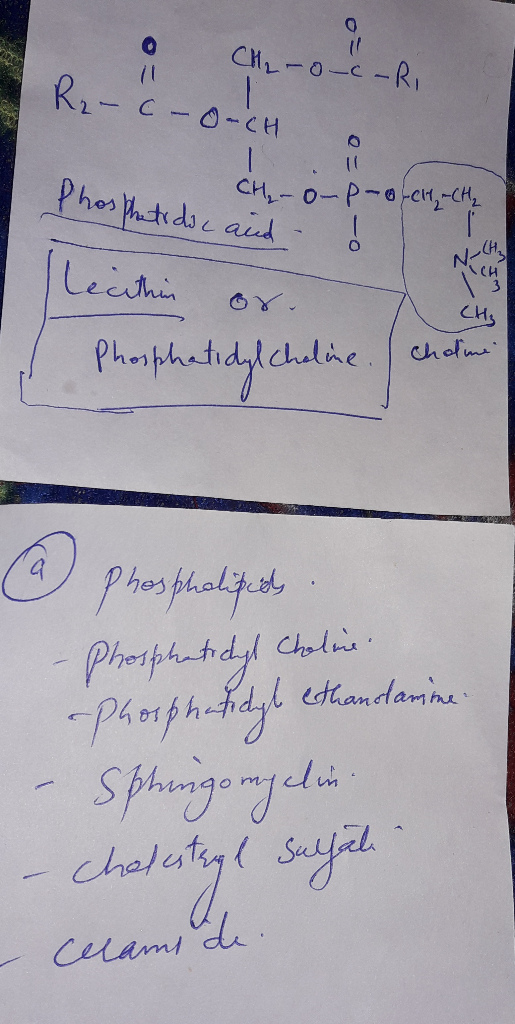
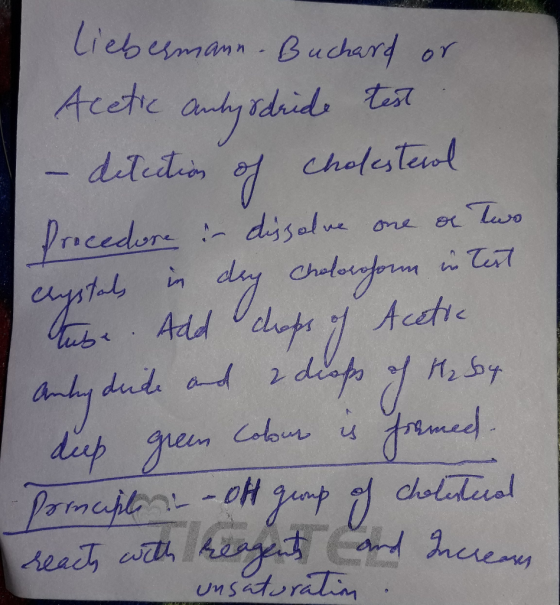
Add Answer to:
a) Draw the structure of lipids present in the brain of a
pig.
b) What are...
LIPIDS a. Draw a triglyceride containing palmitic, stearic, and oleic acids, identify each one. b. Consider...
 LIPIDS a. Draw a triglyceride containing palmitic, stearic, and oleic acids, identify each one. b. Consider a triglyceride containing three oleic acids: compare its melting point and iodine number to the triglyceride in (a); describe how hydrogenation would affect these attributes. C. Draw the chemical structures of phosphatidylcholine and sphingomyelin; explain their similarities and differences, including the types of water-labile linkages (bonds) present in each. d. What is meant by "good cholesterol" and "bad cholesterol?" e. How do manufacturers get...
3.4 Lipids List the several different classes of lipid molecules important in living organisms. Diagram the...
3.4 Lipids List the several different classes of lipid molecules important in living organisms. Diagram the structure of a triglyceride and explain how it is affected by the presence of saturated and unsaturated fatty acids. Explain why some fats are solid at room temperature, and others are liquid. Discuss how fats function as energy-storage molecules. Apply knowledge of the structure of phospholipids to the formation of cellular membranes. Describe the chemical nature of steroids and give an example of their...
PRE-LABORATORY ASSIGNMENT Carbohydrates 1. Draw the structures of fructose (ring structures) present in a solution at...
 PRE-LABORATORY ASSIGNMENT Carbohydrates 1. Draw the structures of fructose (ring structures) present in a solution at equilibrium. 2. An unknown carbohydrate showed a positive test reaction when tested with Fehling's reagent, turned red when reacted with Seliwanoff's reagent, and reacted quickly with Barfoed's reagent. What conclusions can be made about this compound? 3. What test could be used to differentiate between the compounds in each set? a. sucrose and maltose b. fructose and glucose c. lactose and glucose
b. How will you synthesize the following compounds starting from an alkene? Draw the structure of...
 b. How will you synthesize the following compounds starting from an alkene? Draw the structure of the alkene and the reagent(s) used for the synthesis. Он CH3CCH2CH2CH2CH3 CHз a. CH3 CH3CH2CHCHCH2CH3 он b. Он CH3CHCH2 C. Br 7. Draw one possible structure for the following. a. A hydrocarbon with formula CeH16, on hydrogenation, reacted with 1 molar equivalence of Hz2 (g) in presence of Pd catalyst. Draw any one possible structure. b. A hydrocarbon with formula CeH 12, on hydrogenation,...
2. Consider the molecule CS2. a. Draw the Lewis structure and label the hybridization of each ato...
 2. Consider the molecule CS2. a. Draw the Lewis structure and label the hybridization of each atom. b. Re-draw the Lewis structure and draw the hybrid orbitals of each atom on the structure What types of bonds are formed in CS, from the overlap of hybrid orbitals? Explain how you know. c. d. List all the atomic orbitals of C following hybridization in this molecule. e. List all the atomic orbitals of S following hybridization in this molecule. f. When...
Chapter 5 1. Define micro-molecules and macromolecules. Explain the differences between these molecules a, b, and c,...
 Chapter 5 1. Define micro-molecules and macromolecules. Explain the differences between these molecules a, b, and c, give an example of each. a) monosaccharides, disaccharides, and carbohydrates, and polysaccharides b) amino acids and proteins c) glycerol, fatty acids, and lipids 2. Explain the differences between complex carbohydrates, high fructose corn syrup, and nutritive sweeteners, alternative sweeteners. Explain the complicated side effects of high fructose corn syrup and nutritive sweeteners 3. Explain the differences between starch and glycogen, their function in...
1. Draw Structure of Acetylsalicylic acid and name functional groups within structure 2. Understand percent yield,...
 1. Draw Structure of Acetylsalicylic acid and name functional groups within structure 2. Understand percent yield, active ingredients and inert ingredients 3. Alcohol structure and related iso-isomer position 4. Newman projection (draw staggered, eclipsed forms) 5. Draw structure examples of: a. Alkane b. Alkene c. Alkyne d. Aromatic 6. Types of reactions (i.e. Alkene with Halogens) and classification of reaction (i.e., hydrolysis, substitution, elimination) 7. Significance of Hydrogen bonding and effects on solubility 8. Tollens' Test: describe determinants of a...
b) Is CO paramagnetic or diamagnetic? What is the bond order of CO? c) Draw a Lewis structure...
Draw an energy-level diagram for the valence molecular orbitals of CO. Include the relevant atomic orbitals in your diagram. Clearly label each molecular orbital (e.gs2s, p2p, etc.) and fill in the appropriate number of electrons. Use the same energy order as the neutral O2 molecule.b) Is CO paramagnetic or diamagnetic? What is the bond order of CO? c) Draw a Lewis structure for CO. Does this match the predicted bond order? d) CO can react withOH– to form the formate...
(a) Draw the Lewis dot structure for methanol and acetone. Identify the types of intermolecular forces...
(a) Draw the Lewis dot structure for methanol and acetone. Identify the types of intermolecular forces present in those molecules. (b) What is meant by the term "retention time"? (c) What is Gas Chromatography used for? Find an application of gas chromatography not mentioned in the background info.
Question 02 (a) i) Draw a diagram to illustrate each of the following. Clearance fit...
Question 02 (a) i) Draw a diagram to illustrate each of the following. Clearance fit Transition fit Interference fit ii) How does gaging differ from measuring? (b) i) Give an example of contact and noncontact inspection technique ii) Explain the function of the followings in inspection techniques. Tensile Test Impact Test Liquid Penetration Radiography (c) i) Name the components of Iron ore. Give four examples ii) What are the materials added to the...
 LIPIDS a. Draw a triglyceride containing palmitic, stearic, and oleic acids, identify each one. b. Consider a triglyceride containing three oleic acids: compare its melting point and iodine number to the triglyceride in (a); describe how hydrogenation would affect these attributes. C. Draw the chemical structures of phosphatidylcholine and sphingomyelin; explain their similarities and differences, including the types of water-labile linkages (bonds) present in each. d. What is meant by "good cholesterol" and "bad cholesterol?" e. How do manufacturers get...
 PRE-LABORATORY ASSIGNMENT Carbohydrates 1. Draw the structures of fructose (ring structures) present in a solution at equilibrium. 2. An unknown carbohydrate showed a positive test reaction when tested with Fehling's reagent, turned red when reacted with Seliwanoff's reagent, and reacted quickly with Barfoed's reagent. What conclusions can be made about this compound? 3. What test could be used to differentiate between the compounds in each set? a. sucrose and maltose b. fructose and glucose c. lactose and glucose
 b. How will you synthesize the following compounds starting from an alkene? Draw the structure of the alkene and the reagent(s) used for the synthesis. Он CH3CCH2CH2CH2CH3 CHз a. CH3 CH3CH2CHCHCH2CH3 он b. Он CH3CHCH2 C. Br 7. Draw one possible structure for the following. a. A hydrocarbon with formula CeH16, on hydrogenation, reacted with 1 molar equivalence of Hz2 (g) in presence of Pd catalyst. Draw any one possible structure. b. A hydrocarbon with formula CeH 12, on hydrogenation,...
 2. Consider the molecule CS2. a. Draw the Lewis structure and label the hybridization of each atom. b. Re-draw the Lewis structure and draw the hybrid orbitals of each atom on the structure What types of bonds are formed in CS, from the overlap of hybrid orbitals? Explain how you know. c. d. List all the atomic orbitals of C following hybridization in this molecule. e. List all the atomic orbitals of S following hybridization in this molecule. f. When...
 Chapter 5 1. Define micro-molecules and macromolecules. Explain the differences between these molecules a, b, and c, give an example of each. a) monosaccharides, disaccharides, and carbohydrates, and polysaccharides b) amino acids and proteins c) glycerol, fatty acids, and lipids 2. Explain the differences between complex carbohydrates, high fructose corn syrup, and nutritive sweeteners, alternative sweeteners. Explain the complicated side effects of high fructose corn syrup and nutritive sweeteners 3. Explain the differences between starch and glycogen, their function in...
 1. Draw Structure of Acetylsalicylic acid and name functional groups within structure 2. Understand percent yield, active ingredients and inert ingredients 3. Alcohol structure and related iso-isomer position 4. Newman projection (draw staggered, eclipsed forms) 5. Draw structure examples of: a. Alkane b. Alkene c. Alkyne d. Aromatic 6. Types of reactions (i.e. Alkene with Halogens) and classification of reaction (i.e., hydrolysis, substitution, elimination) 7. Significance of Hydrogen bonding and effects on solubility 8. Tollens' Test: describe determinants of a...
Most questions answered within 3 hours.
-
Where is the error in this code sequence?
String s1 = "Hello";
String s2 = "ello";...
asked 11 months ago -
Financial data for Joel de Paris, Inc., for last year
follow:
Joel de Paris, Inc.
Balance...
asked 11 months ago -
Consider this reaction:
Al2(SO4)3 (aq)+ BaCl3
(aq) Al2Cl6 (aq)- +
3BaSO4(s) . What is the...
asked 11 months ago -
Suppose that Savneet is considering increasing her
recent random sample from 20 car rentals to 40...
asked 11 months ago -
Trucks arrive at an unloading terminal at an average rate of 120
per hour.
Trucks arrive...
asked 11 months ago -
Why are methanol and ethanol completely soluble in water while
octanol is not very little soluble....
asked 11 months ago -
A facilities manager at a university reads in a research report
that the mean amount of...
asked 11 months ago -
When the CuSO4 is rehydrated by adding water to the anhydrous
compound, is this an endothermic...
asked 11 months ago -
A ray of sunlight is passing from diamond into crown glass; the
angle of incidence is...
asked 11 months ago -
A block of mass 0.249 kg is placed on top of a light, vertical
spring of...
asked 11 months ago -
how do the kidneys compensate in the presences of acidosis
a) trigger hyperventilate
b) reserve acid...
asked 11 months ago -
Question 501 pts
The rental rate of capital to the firm increases. Which of the
following...
asked 11 months ago