
Homework Answers
Water is here base and acid both because hydogen ion acts as acid while hydoxide ions acts as base.
Add Answer to:
Question 22 2 pts When water ionizes, it produces equal amounts of hydrogen and hydroxide ions,...
8) An acid (1.5pts) produces hydroxide ions when dissolved in water. donates protons in a proton...
 8) An acid (1.5pts) produces hydroxide ions when dissolved in water. donates protons in a proton transfer reaction. does none of the above. donates electrons in an electron transfer reaction. changes the color of phenolphthalein indicator from colorless to pink. 9) A base (1.5pts) produces hydrogen ions in solution. donates a proton in a proton transfer reaction. causes phenolphthalein indicator to change from colorless to pink. accepts electrons in an electron transfer reaction. does none of the above. 10) Which,...
Question 3 1 pts A substance that produces H+ ions when dissolved in water is a/an...
 Question 3 1 pts A substance that produces H+ ions when dissolved in water is a/an A substance that produces OH-ions when dissolved in water is a/an
Incorrect Question 4 0/4 pts Which of the following is the Arrhenius definition of an acid?...
 Incorrect Question 4 0/4 pts Which of the following is the Arrhenius definition of an acid? A substance that is an H* donor A substance that produces OH ions in aqueous solution. A substance that is an H* acceptor. A substance that is an OH donor. A substance that produces Htions in aqueous solution. Incorrect Question 5 0/4 pts Which of the following is the Arrhenius definition of a base? A substance that is an H* donor. A substance that...
d. 1.33 QUESTION 10 Arrhenius defined a base as a. A substance that produces OH-ions when...
 d. 1.33 QUESTION 10 Arrhenius defined a base as a. A substance that produces OH-ions when dissolved in water A hydrogen ion acceptor b. C. A substance that produces H+ ions when dissolved in water An electron donor QUESTION 11
Consider a beaker containing equal amounts of dihydrogen phosphate anhd hydrogen phosphate to which either a...
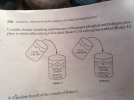 Consider a beaker containing equal amounts of dihydrogen
phosphate anhd hydrogen phosphate to which either a strong acid is
added (Beaker C) or a strong base is added (beaker D).
1) Calculate the pH of the contents of beaker C
2) Calculate the pH of the contents of beaker D.
256 Activity 51 l What Are Buffer systems in Your Body that Keep You Alive phos Consider a beaker the dilhydrogen phosphate and hydrogen containing equal amounts of strong base...
Consider a beaker containing equal amounts of dihydrogen
phosphate anhd hydrogen phosphate to which either a strong acid is
added (Beaker C) or a strong base is added (beaker D).
1) Calculate the pH of the contents of beaker C
2) Calculate the pH of the contents of beaker D.
256 Activity 51 l What Are Buffer systems in Your Body that Keep You Alive phos Consider a beaker the dilhydrogen phosphate and hydrogen containing equal amounts of strong base...
3. Vinegar (CH3COOH) is considered a weak acid because a. it releases a small percentage of...
3. Vinegar (CH3COOH) is considered a weak acid because a. it releases a small percentage of hydrogen ions in water b. it contains an OH- function group c. it releases a small percentage of OH- in water it contains four hydrogen atoms 4. an acid is a substance that___ when added to water a. produces hydroxide atoms b. raises the pH of the solution c. produces hydrogen atoms d. produces hydronium ions 5. which of the following is an acid?...
Question 1 (1 point) The reaction of metal ions with dilute NaOH (Itd.OH") produces the same...
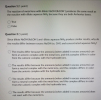 Question 1 (1 point) The reaction of metal ions with dilute NaOH (Itd.OH") produces the same result as the reaction with dilute aqueous NH3 because they are both Arrhenius bases. True False Question 2 (1 point) Since dilute NaOH (Itd.OH") and dilute aqueous NH3 produce similar results, why do the results differ between excess NaOH (xs. OH") and concentrated aqueous NH3? The results differ because the ammonia (when added in excess amounts) can form an anionic complex with the metal...
Lab 5 Buffers 1. Dissolved ions in salt solutions can act as acids or bases and...
Lab 5 Buffers 1. Dissolved ions in salt solutions can act as acids or bases and react with water to produce hydronium ions or hydroxide ions that contribute to the pH of the salt solution. Since strong acids and strong bases completely ionize in solution, the reverse reaction essentially does not occur, meaning that the resulting conjugate base of a strong acid or conjugate acid of a strong base do NOT act as acids or bases. Ions that are conjugate...
Question 15 3 pts Are there more reactants, more products, or about equal amounts when the...
 Question 15 3 pts Are there more reactants, more products, or about equal amounts when the reaction between hypochlorous acid and pyridine reaches equilibrium? HCIO(aq) + CsHsN(aq) = O about equal amounts O reactants O products
hydrogen bonds b sonpolar covalent bond c. polar covalent bonds E. van der Waals interactions d....
 hydrogen bonds b sonpolar covalent bond c. polar covalent bonds E. van der Waals interactions d. ionic bonds 43. The slige What is oegative charge at one end of one water molecule is atracted to the slight positive charge of another water molecule. What s this attraction called? a covalent bond a hydirogem bond c an ionic bond The breaking of bonds between water molecules Water molecules absorb heat from the surface in order to acquire enough energy d a...
 8) An acid (1.5pts) produces hydroxide ions when dissolved in water. donates protons in a proton transfer reaction. does none of the above. donates electrons in an electron transfer reaction. changes the color of phenolphthalein indicator from colorless to pink. 9) A base (1.5pts) produces hydrogen ions in solution. donates a proton in a proton transfer reaction. causes phenolphthalein indicator to change from colorless to pink. accepts electrons in an electron transfer reaction. does none of the above. 10) Which,...
 Question 3 1 pts A substance that produces H+ ions when dissolved in water is a/an A substance that produces OH-ions when dissolved in water is a/an
 Incorrect Question 4 0/4 pts Which of the following is the Arrhenius definition of an acid? A substance that is an H* donor A substance that produces OH ions in aqueous solution. A substance that is an H* acceptor. A substance that is an OH donor. A substance that produces Htions in aqueous solution. Incorrect Question 5 0/4 pts Which of the following is the Arrhenius definition of a base? A substance that is an H* donor. A substance that...
 d. 1.33 QUESTION 10 Arrhenius defined a base as a. A substance that produces OH-ions when dissolved in water A hydrogen ion acceptor b. C. A substance that produces H+ ions when dissolved in water An electron donor QUESTION 11
 Consider a beaker containing equal amounts of dihydrogen
phosphate anhd hydrogen phosphate to which either a strong acid is
added (Beaker C) or a strong base is added (beaker D).
1) Calculate the pH of the contents of beaker C
2) Calculate the pH of the contents of beaker D.
256 Activity 51 l What Are Buffer systems in Your Body that Keep You Alive phos Consider a beaker the dilhydrogen phosphate and hydrogen containing equal amounts of strong base...
Consider a beaker containing equal amounts of dihydrogen
phosphate anhd hydrogen phosphate to which either a strong acid is
added (Beaker C) or a strong base is added (beaker D).
1) Calculate the pH of the contents of beaker C
2) Calculate the pH of the contents of beaker D.
256 Activity 51 l What Are Buffer systems in Your Body that Keep You Alive phos Consider a beaker the dilhydrogen phosphate and hydrogen containing equal amounts of strong base...
 Question 1 (1 point) The reaction of metal ions with dilute NaOH (Itd.OH") produces the same result as the reaction with dilute aqueous NH3 because they are both Arrhenius bases. True False Question 2 (1 point) Since dilute NaOH (Itd.OH") and dilute aqueous NH3 produce similar results, why do the results differ between excess NaOH (xs. OH") and concentrated aqueous NH3? The results differ because the ammonia (when added in excess amounts) can form an anionic complex with the metal...
 Question 15 3 pts Are there more reactants, more products, or about equal amounts when the reaction between hypochlorous acid and pyridine reaches equilibrium? HCIO(aq) + CsHsN(aq) = O about equal amounts O reactants O products
 hydrogen bonds b sonpolar covalent bond c. polar covalent bonds E. van der Waals interactions d. ionic bonds 43. The slige What is oegative charge at one end of one water molecule is atracted to the slight positive charge of another water molecule. What s this attraction called? a covalent bond a hydirogem bond c an ionic bond The breaking of bonds between water molecules Water molecules absorb heat from the surface in order to acquire enough energy d a...
Most questions answered within 3 hours.
-
Where is the error in this code sequence?
String s1 = "Hello";
String s2 = "ello";...
asked 10 months ago -
Financial data for Joel de Paris, Inc., for last year
follow:
Joel de Paris, Inc.
Balance...
asked 10 months ago -
Consider this reaction:
Al2(SO4)3 (aq)+ BaCl3
(aq) Al2Cl6 (aq)- +
3BaSO4(s) . What is the...
asked 10 months ago -
Suppose that Savneet is considering increasing her
recent random sample from 20 car rentals to 40...
asked 10 months ago -
Trucks arrive at an unloading terminal at an average rate of 120
per hour.
Trucks arrive...
asked 10 months ago -
Why are methanol and ethanol completely soluble in water while
octanol is not very little soluble....
asked 10 months ago -
A facilities manager at a university reads in a research report
that the mean amount of...
asked 10 months ago -
When the CuSO4 is rehydrated by adding water to the anhydrous
compound, is this an endothermic...
asked 10 months ago -
A ray of sunlight is passing from diamond into crown glass; the
angle of incidence is...
asked 10 months ago -
A block of mass 0.249 kg is placed on top of a light, vertical
spring of...
asked 10 months ago -
how do the kidneys compensate in the presences of acidosis
a) trigger hyperventilate
b) reserve acid...
asked 10 months ago -
Question 501 pts
The rental rate of capital to the firm increases. Which of the
following...
asked 10 months ago