
Homework Answers
Add Answer to:
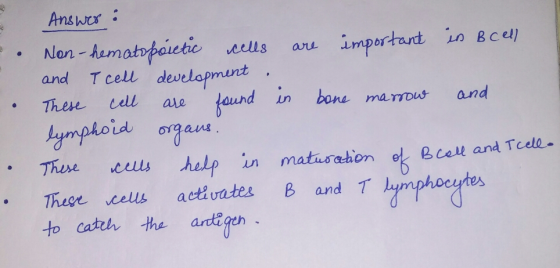
8. Non-hematopoietic cell types are crucial in B cell and T cell development. What/where are these...
Lymphocyte Development 1. B cell development in the bone marrow shares may features with T cell...
 Lymphocyte Development 1. B cell development in the bone marrow shares may features with T cell development in the thymus. A) Discuss the two major goals of lymphocyte development? B) Compare and contrast the ordered steps of receptor rearrangement in B and T cells. C) What cell surface molecules make up the pre-B cell receptor and the pre-T cell receptor and are they only required for development?
A. Match the following cells rith their meanings below: hematopoietic stem cell lymphocyte mопосyte basophil cosinophil...
 A. Match the following cells rith their meanings below: hematopoietic stem cell lymphocyte mопосyte basophil cosinophil erythyocyte neutrophil platelet 1. red blood cell white blood cell: phagocyte and precursor of a macrophage 2. 3. thrombocyte bone marrow cell; gives rise to many types of blood cells 4. 5. leukocyte formed in lymph tissue; produces antibodies 6. leukocyte with dense reddish granules; associated with allergic reactions 7. leukocyte (poly) formed in bone marrow and having neutral-staining granules 8. leukocyte whose granules...
1. At the molecular level, what drives B cell development in the bone marrow? 2. What...
1. At the molecular level, what drives B cell development in the bone marrow? 2. What is the role of stromal cells in B cell development in the bone marrow? 3. Describe the sequence of events in B cell development with respect to rearrangement of heavy and light chain Ig genes. 4. Why does Ig gene rearrangement often fail to produce a functional protein product? What mechanisms exist to overcome this problem? 5. What is “allelic exclusion” and what is...
1. How does a double positive T cell become a mature T cell? Include the selection...
 1. How does a double positive T cell become a mature T cell? Include the selection process. 2. What is the effector function of CD8+T cells? How do they cooperate with CD4+ T cell effector functions? 3. What specifically drives the formation of each subset of Th effector cells? How do these Th effector cells respond once activated (i.e. what are their effector mechanisms?) 4. Describe in detail the signals in which an APC activates a T cell, and include...
Lymphocyte Development 1. B cell development in the bone marrow shares may features with T cell...
 Lymphocyte Development 1. B cell development in the bone marrow shares may features with T cell development in the thymus. A) Discuss what you consider to be the two major goals of lymphocyte development (i.e, what is the purpose of the Bone marrow and Thymus environments). B) Describe what occurs during the Precursor B cell stage and identify/describe the analogous stage in T cells.
A. Discuss the importance of the bone marrow stroma for B-cell development. B. What would be...
A. Discuss the importance of the bone marrow stroma for B-cell development. B. What would be the effect of anti-IL-7 antibodies on the development of B cells in the bone marrow, and at which stage would development be impaired? Explain your answer. C. What is MHC restriction? How is it achieved during T-cell development? D. How is self-tolerance achieved during B- and T-cell development?
Which of the following statements is (are) true of a T cell that expresses two α chains (and thus...
Which of the following statements is (are) true of a T cell that expresses two α chains (and thus two different T-cell receptors) as a result of ineffective allelic exclusion of the α chain during rearrangement? There will be two unique TCRs on the surface of this T cell. Engaging either of the T-cell receptors on MHC molecules of the thymic epithelium will result in positive selection. If either T-cell receptor binds strongly to self-peptide presented by self-MHC molecules, the...
1. How does a double positive T cell become a mature T cell? Include the selection...
 1. How does a double positive T cell become a mature T cell? Include the selection process. 2. What is the effector function of CD8+ T cells? How do they cooperate with CD4+ T cell effector functions? 3. What specifically drives the formation of each subset of Th effector cells? How do these Th effector cells respond once activated (i.e. what are their effector mechanisms?)
D 7. Deficiency in RAG1 and/or RAG2 can affect the proper development of which of the...
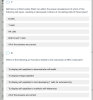 D 7. Deficiency in RAG1 and/or RAG2 can affect the proper development of which of the following cell types, resulting in decreased numbers of circulating cells of those types? B cells T cells NK cells Both B and T cells All of the answers are correct. D 8. Which of the following are functions related to the expression of MHC molecules? To display self-peptides to demonstrate cell health To display foreign peptides To display self-peptides to test developing T cells...
Explain how the adaptive immune response is able to generate the diversity of antigen receptors necessary...
Explain how the adaptive immune response is able to generate the diversity of antigen receptors necessary to recognize the multitude of foreign antigens. Explain how clonal selection contributes to the development and expansion of antigen specific lymphocytes that do not respond to self. Distinguish cytokines and chemokines and their roles in the immune response What are the 3 roles of antibody in the immune response What are the two types of T cells that contribute to cellular immunity? What are...
 Lymphocyte Development 1. B cell development in the bone marrow shares may features with T cell development in the thymus. A) Discuss the two major goals of lymphocyte development? B) Compare and contrast the ordered steps of receptor rearrangement in B and T cells. C) What cell surface molecules make up the pre-B cell receptor and the pre-T cell receptor and are they only required for development?
 A. Match the following cells rith their meanings below: hematopoietic stem cell lymphocyte mопосyte basophil cosinophil erythyocyte neutrophil platelet 1. red blood cell white blood cell: phagocyte and precursor of a macrophage 2. 3. thrombocyte bone marrow cell; gives rise to many types of blood cells 4. 5. leukocyte formed in lymph tissue; produces antibodies 6. leukocyte with dense reddish granules; associated with allergic reactions 7. leukocyte (poly) formed in bone marrow and having neutral-staining granules 8. leukocyte whose granules...
 1. How does a double positive T cell become a mature T cell? Include the selection process. 2. What is the effector function of CD8+T cells? How do they cooperate with CD4+ T cell effector functions? 3. What specifically drives the formation of each subset of Th effector cells? How do these Th effector cells respond once activated (i.e. what are their effector mechanisms?) 4. Describe in detail the signals in which an APC activates a T cell, and include...
 Lymphocyte Development 1. B cell development in the bone marrow shares may features with T cell development in the thymus. A) Discuss what you consider to be the two major goals of lymphocyte development (i.e, what is the purpose of the Bone marrow and Thymus environments). B) Describe what occurs during the Precursor B cell stage and identify/describe the analogous stage in T cells.
 1. How does a double positive T cell become a mature T cell? Include the selection process. 2. What is the effector function of CD8+ T cells? How do they cooperate with CD4+ T cell effector functions? 3. What specifically drives the formation of each subset of Th effector cells? How do these Th effector cells respond once activated (i.e. what are their effector mechanisms?)
 D 7. Deficiency in RAG1 and/or RAG2 can affect the proper development of which of the following cell types, resulting in decreased numbers of circulating cells of those types? B cells T cells NK cells Both B and T cells All of the answers are correct. D 8. Which of the following are functions related to the expression of MHC molecules? To display self-peptides to demonstrate cell health To display foreign peptides To display self-peptides to test developing T cells...
Most questions answered within 3 hours.
-
Where is the error in this code sequence?
String s1 = "Hello";
String s2 = "ello";...
asked 11 months ago -
Financial data for Joel de Paris, Inc., for last year
follow:
Joel de Paris, Inc.
Balance...
asked 11 months ago -
Consider this reaction:
Al2(SO4)3 (aq)+ BaCl3
(aq) Al2Cl6 (aq)- +
3BaSO4(s) . What is the...
asked 11 months ago -
Suppose that Savneet is considering increasing her
recent random sample from 20 car rentals to 40...
asked 11 months ago -
Trucks arrive at an unloading terminal at an average rate of 120
per hour.
Trucks arrive...
asked 11 months ago -
Why are methanol and ethanol completely soluble in water while
octanol is not very little soluble....
asked 11 months ago -
A facilities manager at a university reads in a research report
that the mean amount of...
asked 11 months ago -
When the CuSO4 is rehydrated by adding water to the anhydrous
compound, is this an endothermic...
asked 11 months ago -
A ray of sunlight is passing from diamond into crown glass; the
angle of incidence is...
asked 11 months ago -
A block of mass 0.249 kg is placed on top of a light, vertical
spring of...
asked 11 months ago -
how do the kidneys compensate in the presences of acidosis
a) trigger hyperventilate
b) reserve acid...
asked 11 months ago -
Question 501 pts
The rental rate of capital to the firm increases. Which of the
following...
asked 11 months ago