

Homework Answers
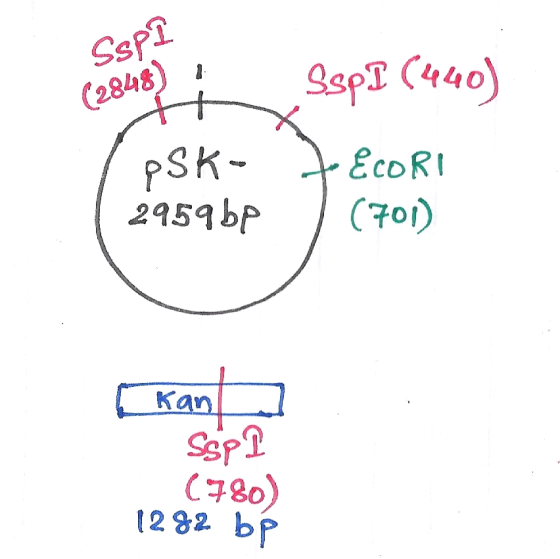
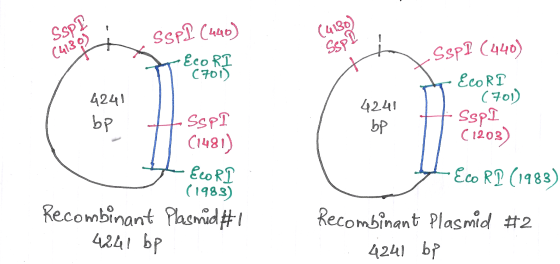
The Kanamycin Gene insert has a Ssp I site, the position of which is relative to the orientation of the insert. This position is different in the two plasmids. The position of the SspI site on the pSK- vector backbone is changed as an additional 1282 bp of DNA has been inserted. The EcoRI site on the pSK- plasmid is duplicated as either end of the 1.3 kb insert is now an EcoRI site.
Add Answer to:
2 Addendum 1 to this lab provides information on the location of the EcoRI, and Sspl...
The PCR was a success and your target region of 440 bp in length has been amplified. You ligate a short linker containing an Apal restriction enzyme site onto both ends of the PCR product, dige...
 The PCR was a success and your target region of 440 bp in length has been amplified. You ligate a short linker containing an Apal restriction enzyme site onto both ends of the PCR product, digest it with Apal, and clone it into the Apal site of the 5 kb plasmid diagrammed below amHI 300 EcoRI 5 kb 3400 1000 EcoRI 2000 Apal Draw the plasmid containing the cloned insert. Indicate clearly where the insert will be located. Include RE...
Draw the plasmkd containing the cloned insert Indicate clearty where the insert will be ocated. I...
 Please help. Every time I have posted this I have gotten a
different answer.
Draw the plasmkd containing the cloned insert Indicate clearty where the insert will be ocated. Include RE sites and distances. 300 EcoR3400 544kb 1000 2000 Cloned Insert The PCR was a success and your target region of 440 bp in length has been ampiied You igate a short linker containing an Apal restriction enzyme site onlo both ends of the PCR product, digest it with Apal...
Please help. Every time I have posted this I have gotten a
different answer.
Draw the plasmkd containing the cloned insert Indicate clearty where the insert will be ocated. Include RE sites and distances. 300 EcoR3400 544kb 1000 2000 Cloned Insert The PCR was a success and your target region of 440 bp in length has been ampiied You igate a short linker containing an Apal restriction enzyme site onlo both ends of the PCR product, digest it with Apal...
Now determine the sizes of the fragments generated after digesting the r-plasmid with each of the...
 Now determine the sizes of the fragments generated after digesting the r-plasmid with each of the restriction enzymes or combination of restriction enzymes. r-plasmid digested with Pstl r-plasmid digested with EcoRI r-plasmid digested with both Pstl and EcoRI Question 8. (3 pts.) Use this information to determine the relative placement of these restriction sites in the r-plasmid, and then draw restriction site maps of the vector and the r-plasmid on the following circular chromosome templates. The map should show the...
Question 4 C. Cloning and restriction enzyme digest Video aid 1: Plasmid cloning Video aid 2:...
 Question 4
C. Cloning and restriction enzyme digest Video aid 1: Plasmid cloning Video aid 2: Restriction enzyme digest analysis The PCR was a success and your target region of 440 bp in length has been amplified. You igate a short linker containing an Apal restriction enzyme site onto both ends of the PCR product, digest it with Apal, and clone it into the Apal site of the 5 kb plasmid diagrammed below Bamll 300 EcoRI 3400 1000 2000 5...
Question 4
C. Cloning and restriction enzyme digest Video aid 1: Plasmid cloning Video aid 2: Restriction enzyme digest analysis The PCR was a success and your target region of 440 bp in length has been amplified. You igate a short linker containing an Apal restriction enzyme site onto both ends of the PCR product, digest it with Apal, and clone it into the Apal site of the 5 kb plasmid diagrammed below Bamll 300 EcoRI 3400 1000 2000 5...
Question 2,3 and 4 aBbCcDdE AaBbCoDdE Normal No Spacing BamHI 300 EcoRI 3400 1000 2000 5 kb EcoRU Apal List three components a cloning vector must contain A cloning site A replication origin A sel...
 Question 2,3 and 4
aBbCcDdE AaBbCoDdE Normal No Spacing BamHI 300 EcoRI 3400 1000 2000 5 kb EcoRU Apal List three components a cloning vector must contain A cloning site A replication origin A selectable marker -Drug resistant gene 1. 2. Draw the end of the fragment that will be generated after digestion with the Apal enzyme. Indicate the type of ends generated by this enzyme (Blunt/Sticky, 5' or 3' overhang) (3) 3. What is the size of the plasmid...
Question 2,3 and 4
aBbCcDdE AaBbCoDdE Normal No Spacing BamHI 300 EcoRI 3400 1000 2000 5 kb EcoRU Apal List three components a cloning vector must contain A cloning site A replication origin A selectable marker -Drug resistant gene 1. 2. Draw the end of the fragment that will be generated after digestion with the Apal enzyme. Indicate the type of ends generated by this enzyme (Blunt/Sticky, 5' or 3' overhang) (3) 3. What is the size of the plasmid...
UuOU Wuuur 3. Complete the table below to show your anticipated results, when digesting the recombinant...
 UuOU Wuuur 3. Complete the table below to show your anticipated results, when digesting the recombinant plasmid containing the PCR fragment with the different restriction enzymes as listed. Recombinant plasmid Restriction enzyme No. of cuts Fragment sizes EcoRI BamHI Eael EcoRI + BamHI +Eae 1 -teamHI EcoRI 4000 EcoRI 6k6 1000 2000 es Target region of 770 bp in length has been amplified Plan to digest the DNA amplican with restrictch enzyme Egel, and clone the resulting longest fragment into...
The PCR was a success and your target region of 770 bp in length has been...
 The PCR was a success and your target region of 770 bp in length has been amplified. You now plan to digest the DNA amplicon with the restriction enzyme Eael, and clone the resulting longest fragment it into the Eael site of the 5 kb plasmid diagrammed below. 770 bp BamHI 1 200 EcoRI 800 EcoRI 4000 1000 5 kb O /1000 2000 2000 Faal You purify your recombinant plasmid from bacterial cells, and run the plasmid (uncut. or not...
HindIII 5000, 2500 SmaI 5500, 2000 EcoRI 4000, 3500 HindIII + EcoRI 3500, 2500, 1500 HindIII...
HindIII 5000, 2500 SmaI 5500, 2000 EcoRI 4000, 3500 HindIII + EcoRI 3500, 2500, 1500 HindIII + SmaI 3000, 2500, 2000 SmaI + EcoRI 4000, 2000, 1500 23. The enzyme PspN4I cleaves the sequence NNGCNN (N= any of the four bases). How many times would you expect PspN4I to digest a 10.752 kb genome? Sequence A, which contains two BstBI sites (TT/CGAA), was digested with BstBI. The resulting fragment was then ligated into the unique TaqI restriction site (T/CGA) within...
Cloning 2 Below is the restriction map of a 10 kb piece of DNA. Also shown...
 Cloning 2
Below is the restriction map of a 10 kb piece of DNA. Also shown
below is a cloning vector which has two unique restriction enzyme
recognition sites, one for EcoRI (E) and one for HindIII (H). The
location of the kanamycin (kan) and ampicillin (amp) resistance
genes is also shown. Kanamycin and ampicillin are antibiotics that
are commonly used to select transformed E. colicells (consult the
Lab Manual for more information). Note that the HindIII site is
located...
Cloning 2
Below is the restriction map of a 10 kb piece of DNA. Also shown
below is a cloning vector which has two unique restriction enzyme
recognition sites, one for EcoRI (E) and one for HindIII (H). The
location of the kanamycin (kan) and ampicillin (amp) resistance
genes is also shown. Kanamycin and ampicillin are antibiotics that
are commonly used to select transformed E. colicells (consult the
Lab Manual for more information). Note that the HindIII site is
located...
A genetics problem covering chapter 10 concepts. Could really use some help! The Notch gene, involved...
 A genetics problem covering chapter 10 concepts. Could
really use some help!
The Notch gene, involved in Drosophila development, is contained within a restriction fragment of Drosophila genomic DNA produced by cleavage with the enzyme SalI. The restriction map of this Drosophila fragment for several enzymes (Sall, PstI, and Xhol) is shown here; numbers indicate the distances between adjacent restriction sites. This fragment is cloned by sticky-end ligation into the single Sall site of a bacterial plasmid vector that is...
A genetics problem covering chapter 10 concepts. Could
really use some help!
The Notch gene, involved in Drosophila development, is contained within a restriction fragment of Drosophila genomic DNA produced by cleavage with the enzyme SalI. The restriction map of this Drosophila fragment for several enzymes (Sall, PstI, and Xhol) is shown here; numbers indicate the distances between adjacent restriction sites. This fragment is cloned by sticky-end ligation into the single Sall site of a bacterial plasmid vector that is...
 The PCR was a success and your target region of 440 bp in length has been amplified. You ligate a short linker containing an Apal restriction enzyme site onto both ends of the PCR product, digest it with Apal, and clone it into the Apal site of the 5 kb plasmid diagrammed below amHI 300 EcoRI 5 kb 3400 1000 EcoRI 2000 Apal Draw the plasmid containing the cloned insert. Indicate clearly where the insert will be located. Include RE...
 Please help. Every time I have posted this I have gotten a
different answer.
Draw the plasmkd containing the cloned insert Indicate clearty where the insert will be ocated. Include RE sites and distances. 300 EcoR3400 544kb 1000 2000 Cloned Insert The PCR was a success and your target region of 440 bp in length has been ampiied You igate a short linker containing an Apal restriction enzyme site onlo both ends of the PCR product, digest it with Apal...
Please help. Every time I have posted this I have gotten a
different answer.
Draw the plasmkd containing the cloned insert Indicate clearty where the insert will be ocated. Include RE sites and distances. 300 EcoR3400 544kb 1000 2000 Cloned Insert The PCR was a success and your target region of 440 bp in length has been ampiied You igate a short linker containing an Apal restriction enzyme site onlo both ends of the PCR product, digest it with Apal...
 Now determine the sizes of the fragments generated after digesting the r-plasmid with each of the restriction enzymes or combination of restriction enzymes. r-plasmid digested with Pstl r-plasmid digested with EcoRI r-plasmid digested with both Pstl and EcoRI Question 8. (3 pts.) Use this information to determine the relative placement of these restriction sites in the r-plasmid, and then draw restriction site maps of the vector and the r-plasmid on the following circular chromosome templates. The map should show the...
 Question 4
C. Cloning and restriction enzyme digest Video aid 1: Plasmid cloning Video aid 2: Restriction enzyme digest analysis The PCR was a success and your target region of 440 bp in length has been amplified. You igate a short linker containing an Apal restriction enzyme site onto both ends of the PCR product, digest it with Apal, and clone it into the Apal site of the 5 kb plasmid diagrammed below Bamll 300 EcoRI 3400 1000 2000 5...
Question 4
C. Cloning and restriction enzyme digest Video aid 1: Plasmid cloning Video aid 2: Restriction enzyme digest analysis The PCR was a success and your target region of 440 bp in length has been amplified. You igate a short linker containing an Apal restriction enzyme site onto both ends of the PCR product, digest it with Apal, and clone it into the Apal site of the 5 kb plasmid diagrammed below Bamll 300 EcoRI 3400 1000 2000 5...
 Question 2,3 and 4
aBbCcDdE AaBbCoDdE Normal No Spacing BamHI 300 EcoRI 3400 1000 2000 5 kb EcoRU Apal List three components a cloning vector must contain A cloning site A replication origin A selectable marker -Drug resistant gene 1. 2. Draw the end of the fragment that will be generated after digestion with the Apal enzyme. Indicate the type of ends generated by this enzyme (Blunt/Sticky, 5' or 3' overhang) (3) 3. What is the size of the plasmid...
Question 2,3 and 4
aBbCcDdE AaBbCoDdE Normal No Spacing BamHI 300 EcoRI 3400 1000 2000 5 kb EcoRU Apal List three components a cloning vector must contain A cloning site A replication origin A selectable marker -Drug resistant gene 1. 2. Draw the end of the fragment that will be generated after digestion with the Apal enzyme. Indicate the type of ends generated by this enzyme (Blunt/Sticky, 5' or 3' overhang) (3) 3. What is the size of the plasmid...
 UuOU Wuuur 3. Complete the table below to show your anticipated results, when digesting the recombinant plasmid containing the PCR fragment with the different restriction enzymes as listed. Recombinant plasmid Restriction enzyme No. of cuts Fragment sizes EcoRI BamHI Eael EcoRI + BamHI +Eae 1 -teamHI EcoRI 4000 EcoRI 6k6 1000 2000 es Target region of 770 bp in length has been amplified Plan to digest the DNA amplican with restrictch enzyme Egel, and clone the resulting longest fragment into...
 The PCR was a success and your target region of 770 bp in length has been amplified. You now plan to digest the DNA amplicon with the restriction enzyme Eael, and clone the resulting longest fragment it into the Eael site of the 5 kb plasmid diagrammed below. 770 bp BamHI 1 200 EcoRI 800 EcoRI 4000 1000 5 kb O /1000 2000 2000 Faal You purify your recombinant plasmid from bacterial cells, and run the plasmid (uncut. or not...
 Cloning 2
Below is the restriction map of a 10 kb piece of DNA. Also shown
below is a cloning vector which has two unique restriction enzyme
recognition sites, one for EcoRI (E) and one for HindIII (H). The
location of the kanamycin (kan) and ampicillin (amp) resistance
genes is also shown. Kanamycin and ampicillin are antibiotics that
are commonly used to select transformed E. colicells (consult the
Lab Manual for more information). Note that the HindIII site is
located...
Cloning 2
Below is the restriction map of a 10 kb piece of DNA. Also shown
below is a cloning vector which has two unique restriction enzyme
recognition sites, one for EcoRI (E) and one for HindIII (H). The
location of the kanamycin (kan) and ampicillin (amp) resistance
genes is also shown. Kanamycin and ampicillin are antibiotics that
are commonly used to select transformed E. colicells (consult the
Lab Manual for more information). Note that the HindIII site is
located...
 A genetics problem covering chapter 10 concepts. Could
really use some help!
The Notch gene, involved in Drosophila development, is contained within a restriction fragment of Drosophila genomic DNA produced by cleavage with the enzyme SalI. The restriction map of this Drosophila fragment for several enzymes (Sall, PstI, and Xhol) is shown here; numbers indicate the distances between adjacent restriction sites. This fragment is cloned by sticky-end ligation into the single Sall site of a bacterial plasmid vector that is...
A genetics problem covering chapter 10 concepts. Could
really use some help!
The Notch gene, involved in Drosophila development, is contained within a restriction fragment of Drosophila genomic DNA produced by cleavage with the enzyme SalI. The restriction map of this Drosophila fragment for several enzymes (Sall, PstI, and Xhol) is shown here; numbers indicate the distances between adjacent restriction sites. This fragment is cloned by sticky-end ligation into the single Sall site of a bacterial plasmid vector that is...
Most questions answered within 3 hours.
-
Where is the error in this code sequence?
String s1 = "Hello";
String s2 = "ello";...
asked 10 months ago -
Financial data for Joel de Paris, Inc., for last year
follow:
Joel de Paris, Inc.
Balance...
asked 10 months ago -
Consider this reaction:
Al2(SO4)3 (aq)+ BaCl3
(aq) Al2Cl6 (aq)- +
3BaSO4(s) . What is the...
asked 10 months ago -
Suppose that Savneet is considering increasing her
recent random sample from 20 car rentals to 40...
asked 10 months ago -
Trucks arrive at an unloading terminal at an average rate of 120
per hour.
Trucks arrive...
asked 10 months ago -
Why are methanol and ethanol completely soluble in water while
octanol is not very little soluble....
asked 10 months ago -
A facilities manager at a university reads in a research report
that the mean amount of...
asked 10 months ago -
When the CuSO4 is rehydrated by adding water to the anhydrous
compound, is this an endothermic...
asked 10 months ago -
A ray of sunlight is passing from diamond into crown glass; the
angle of incidence is...
asked 10 months ago -
A block of mass 0.249 kg is placed on top of a light, vertical
spring of...
asked 10 months ago -
how do the kidneys compensate in the presences of acidosis
a) trigger hyperventilate
b) reserve acid...
asked 10 months ago -
Question 501 pts
The rental rate of capital to the firm increases. Which of the
following...
asked 10 months ago