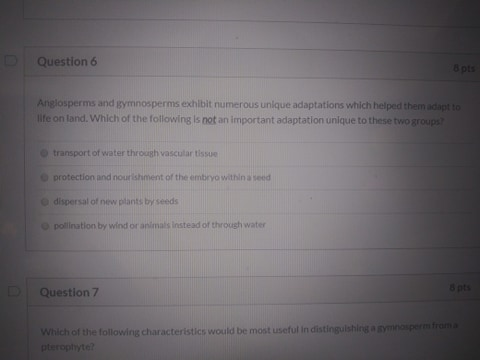
Angiosperms and gymnosperms exhibit numerous unique adaptations which helped them adapt to life on land. Which of the following is not an important adaptation unique to these two groups?
Homework Answers
Option A since angiosperm and gymnosperm are higher plants so they already have a well organised vascular tissue that is the xylem and the pholem. So this will not come under the term adaptation.
Add Answer to:
Angiosperms and gymnosperms exhibit numerous unique adaptations
which helped them adapt to life on land. Which...
The evolution of plants onto land required them to solve several problems. The first groups of...
The evolution of plants onto land required them to solve several problems. The first groups of plants to come up with an effective means of support on land was the Mosses Flowering plants Angiosperms Gymnosperms Ferns A unique characteristic of monocots is They have secondary growth They have no vascular tissue They have no netted leaf veins They have scattered vascular bundles They are flowering plants Osmosis is most important in the transport of Sugars in the phloem Sugars in...
Plantae: 1. Which of the following correctly describes an evolutionary trend that occurred as land plants...
 Plantae: 1. Which of the following correctly describes an evolutionary trend that occurred as land plants evolved? 2. Becoming seedless b. Producing one type of spole Producing nonmotile wametes d. Haploid generation becoming dominant 2. Which of the following occurs in the Ilie cycle of both masses and anglosperms? a. The sporophyte is the dominant generation b. The gametophyce is the dominant gcneration c Spores develop into sporophytes d. The sporophyte products sporcs 3. The evolution of which of the...
Chapters 29,30 Plant Diversity I, Plant Dlversity I 1. What are characteristics of the most recent common ancestor land plants 2. List plant adaptations to lifo on land. 3. What are characteristi...
 Chapters 29,30 Plant Diversity I, Plant Dlversity I 1. What are characteristics of the most recent common ancestor land plants 2. List plant adaptations to lifo on land. 3. What are characteristics of Byophytes? 4. How are plant spores produced? 5. Define the function(s) of archegonia 6. Def fine heterospory in terms of the evolution of plants. 7. Discuss the ongoing trend in the evolution of land plants. 8, what is the function of the seed coat? 9. How are...
The ancestors of plants were probably algae. True/False 2) What do plants and the green algae...
The ancestors of plants were probably algae. True/False 2) What do plants and the green algae charophytes have in common? 3) What advantages did life in land provide for plants? 4) What were the disadvantages for life on land for plants? 5) What are some differences between plants and algae? 6) How do land plants maintain moisture in their cells? 7) What structures do land plants use to obtain resources such as water, minerals, and CO2? 8) List the two...
 Plantae: 1. Which of the following correctly describes an evolutionary trend that occurred as land plants evolved? 2. Becoming seedless b. Producing one type of spole Producing nonmotile wametes d. Haploid generation becoming dominant 2. Which of the following occurs in the Ilie cycle of both masses and anglosperms? a. The sporophyte is the dominant generation b. The gametophyce is the dominant gcneration c Spores develop into sporophytes d. The sporophyte products sporcs 3. The evolution of which of the...
 Chapters 29,30 Plant Diversity I, Plant Dlversity I 1. What are characteristics of the most recent common ancestor land plants 2. List plant adaptations to lifo on land. 3. What are characteristics of Byophytes? 4. How are plant spores produced? 5. Define the function(s) of archegonia 6. Def fine heterospory in terms of the evolution of plants. 7. Discuss the ongoing trend in the evolution of land plants. 8, what is the function of the seed coat? 9. How are...
Most questions answered within 3 hours.
-
Where is the error in this code sequence?
String s1 = "Hello";
String s2 = "ello";...
asked 10 months ago -
Financial data for Joel de Paris, Inc., for last year
follow:
Joel de Paris, Inc.
Balance...
asked 10 months ago -
Consider this reaction:
Al2(SO4)3 (aq)+ BaCl3
(aq) Al2Cl6 (aq)- +
3BaSO4(s) . What is the...
asked 10 months ago -
Suppose that Savneet is considering increasing her
recent random sample from 20 car rentals to 40...
asked 10 months ago -
Trucks arrive at an unloading terminal at an average rate of 120
per hour.
Trucks arrive...
asked 10 months ago -
Why are methanol and ethanol completely soluble in water while
octanol is not very little soluble....
asked 10 months ago -
A facilities manager at a university reads in a research report
that the mean amount of...
asked 10 months ago -
When the CuSO4 is rehydrated by adding water to the anhydrous
compound, is this an endothermic...
asked 10 months ago -
A ray of sunlight is passing from diamond into crown glass; the
angle of incidence is...
asked 10 months ago -
A block of mass 0.249 kg is placed on top of a light, vertical
spring of...
asked 10 months ago -
how do the kidneys compensate in the presences of acidosis
a) trigger hyperventilate
b) reserve acid...
asked 10 months ago -
Question 501 pts
The rental rate of capital to the firm increases. Which of the
following...
asked 10 months ago