
Homework Answers
Only Glyceraldehyde 3 phosphate dehydrogenase use NAD+ as a cofactor that help in conversion of glyceraldehyde 3 phosphate to 1,3 Bisphosphoglycerate, rather all reaction uses ADP as cofactor.
Add Answer to:
Which enzymes in glycolysis use NAD+ as a cofactor? Select all that apply. O Select all...
Which enzymes in glycolysis catalyze reactions thx are irreversible in cellular conditions? Select all that apply....
 Which enzymes in glycolysis catalyze reactions thx are irreversible in cellular conditions? Select all that apply. 0 Select all that apply Hexokinase Phosphoglucoisomerase с Phosphofructokinase Aldolase Triose Phosphate Isomerase Glyceraldehyde-3-phosphate dehydrogenase Phosphoglycerate kinase H Phosphoglycerate Mutase Enolase Submit Pyruvate kinase
Magnesium was tested as a potential activator of glycolysis.
Magnesium was tested as a potential activator of glycolysis. It serves as a cofactor for which glycolytic enzymes? Check all that apply. glyceraldehyde phosphate dehydrogenase pyruvate kinase aldolase phosphofructokinase phosphoplyceromutase hexokinase triosephosphate isomerase phosphoglycerokinase phosphoglucoisomerase enolase
1. You have given all the enzymes and intermediates in glycolysis. Choose the right enzymes and...
 1. You have given all the enzymes and intermediates in glycolysis. Choose the right enzymes and intermediates and draw the glycolytic pathway. Decorate the diagram by adding ATP, ADP, H", NADH, NAD', P, and H20 where necessary. All the steps are reversible except 1, 3 and 10; draw appropriate arrow. First arrange the reactants in the correct order. Reactants/intermediates: 3-phosphoglycerate glucose Phosphoenolpyruvate dihydroxyacetone phosphate Pyruvate glucose 6-phosphate 1,3-bisphosphoglycerate fructose 6-phosophate 2-phosphoglycerate glyceraldehyde 3-phosphate fructose 1,6-bisphosphate Enzymes: Phosphoglucoisomerase phosphoglycerate kinase phosphoglycerate...
Match the enzyme to the substrate --> product reaction to which it catalyzes. O Hold and...
 Match the enzyme to the substrate --> product reaction to which it catalyzes. O Hold and drag to reorder Phosphoglycerate Mutase Glucose --> Glucose 6-phosphate Phosphohexose Isomerase 1-3- Bisphosphoglycerat e--> 3- Phosphoglycerate Hexokinase Fuctose 1-6- bisphophate --> Glyceraldehyde 3- phosphate + Dihydroxyacetone phosphate Phosphoglycerate Kinase Oxaloacetate --> Phosphoenolpyruva te Aldolase Mannose 6- phosphate -> Fructose 6- phosphate Pyruvate kinase Dihydroxyacetone phosphate -> Glyceraldehyde 3- phosphate Enolase Glyceraldehyde 3- phosp Bisph Submit Glyceraldehyde 3- phosphate Enolase Glyceraldehyde 3- phosphate -> 1-3-...
4. Which of the following enzymes catalyzed reactions in glycolysis require(s) ATP as a substrate? A)...
 4. Which of the following enzymes catalyzed reactions in glycolysis require(s) ATP as a substrate? A) Phosphoglycerate mutase E) Pyruvate kinase B) Aldolase F) Phosphofructokinase-1 C) Phosphoglycerate kinase G) Hexokinase D) Glyceraldehyde-3-phosphate dehydrogenase 5. Blood Lactate Levels during Vigorous Exercise The following graph shows the concentrations of lactate in blood plasma before, during, and after a 400 m sprint. Use your knowledge from chapter 14 to explain the causes of the rapid rise in lactate concentration? --Before-- - After Blood...
Glycolysis activity 1: Metabolic pathway puzzle Try to complete the activity without using the textbook. 1....
 Glycolysis activity 1: Metabolic pathway puzzle Try to complete the activity without using the textbook. 1. Slides 4 and 5 show the 10 reactions for glycolysis, but some of the molecules are missing. Draw the missing molecules in the proper place (on the handout). The missing molecules are shown on the next slide, you have to use the clues on the handout and your organic chemistry knowledge to figure out where each molecule belongs. 3. In the red dotted boxes...
I am confused with this glucose structure, Can you answer the question asked on the right...
 I am confused with this glucose structure, Can you answer the
question asked on the right side of the page, please?
Glucose Hexokinase ATP Glucose 6-phosphate Phosphoglucose isomerase Fructose 6-phosphate Phosphofructo- ATP kinase-1 ADP Dihydroxyacetone phosphate Fructose 1,6-bisphosphate Aldolase Triose 5 phosphate Glyceraldehyde isomerase 3-phosphate (2 molecules ) Glyceraldehyde 2 NAD+ +2P, 3-phosphate 2 NADH + 2H dehydrogenase I 1,3-Bisphosphoglycerate (2 molecules) 7 Phosphoglycerate 2ADP kinase 2 ATP 3-Phosphoglycerate (2 molecules) Phosphoglycero- mutase 2-Phosphoglycerate (2 molecules) Enolase. > 2H2O Phosphoenolpyruvate...
I am confused with this glucose structure, Can you answer the
question asked on the right side of the page, please?
Glucose Hexokinase ATP Glucose 6-phosphate Phosphoglucose isomerase Fructose 6-phosphate Phosphofructo- ATP kinase-1 ADP Dihydroxyacetone phosphate Fructose 1,6-bisphosphate Aldolase Triose 5 phosphate Glyceraldehyde isomerase 3-phosphate (2 molecules ) Glyceraldehyde 2 NAD+ +2P, 3-phosphate 2 NADH + 2H dehydrogenase I 1,3-Bisphosphoglycerate (2 molecules) 7 Phosphoglycerate 2ADP kinase 2 ATP 3-Phosphoglycerate (2 molecules) Phosphoglycero- mutase 2-Phosphoglycerate (2 molecules) Enolase. > 2H2O Phosphoenolpyruvate...
Question 7 (1 point) The first step of beta oxidation is catalyzed by the enzyme . The cofactor u...
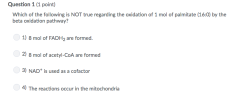 We were unable to transcribe this imageQuestion 7 (1 point) The first step of beta oxidation is catalyzed by the enzyme . The cofactor used is We were unable to transcribe this imageQuestion 15 (1 point) Which of the following glycolytic enzymes catalyses a substrate level phosphorylation? Hexokinase Phosphoglycerate kinase Phosphofructokinase-1 Glyceraldehyde 3-phosphate dehydrogenase
Question 7 (1 point) The first step of beta oxidation is catalyzed by the enzyme . The cofactor used is
Question 15 (1 point) Which of...
We were unable to transcribe this imageQuestion 7 (1 point) The first step of beta oxidation is catalyzed by the enzyme . The cofactor used is We were unable to transcribe this imageQuestion 15 (1 point) Which of the following glycolytic enzymes catalyses a substrate level phosphorylation? Hexokinase Phosphoglycerate kinase Phosphofructokinase-1 Glyceraldehyde 3-phosphate dehydrogenase
Question 7 (1 point) The first step of beta oxidation is catalyzed by the enzyme . The cofactor used is
Question 15 (1 point) Which of...
(2 of 5) Which one of the following enzymes and intermediates is not a part of...
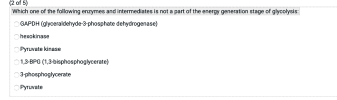 (2 of 5) Which one of the following enzymes and intermediates is not a part of the energy generation stage of glycolysis: GAPDH (glyceraldehyde-3-phosphate dehydrogenase) hexokinase Pyruvate kinase 1,3-BPG (1,3-bisphosphoglycerate) 3-phosphoglycerate Pyruvate
32. The gluconeogenic precursor thereby generated is alpha-ketoglutarate. The pathway e pathway by which it can...
 32. The gluconeogenic precursor thereby generated is alpha-ketoglutarate. The pathway e pathway by which it can be converted to glucose is: Enzyme alpha-ketoglutarate dehydrogenase succinyl-CoA synthetase succinate dehydrogenase Product succinate L-malate malate dehydrogenase phosphoenolpyruvate 3-phosphoglycerate glyceraldehyde-3-phosphate 0 enolase phosphoglycerate mutase phosphoglycerate kinase triose phosphate isomerase fructose-1,6-bisphosphate ctose bisphosphatase glucose-6-phosphate glucose-6-phosphatase
 Which enzymes in glycolysis catalyze reactions thx are irreversible in cellular conditions? Select all that apply. 0 Select all that apply Hexokinase Phosphoglucoisomerase с Phosphofructokinase Aldolase Triose Phosphate Isomerase Glyceraldehyde-3-phosphate dehydrogenase Phosphoglycerate kinase H Phosphoglycerate Mutase Enolase Submit Pyruvate kinase
 1. You have given all the enzymes and intermediates in glycolysis. Choose the right enzymes and intermediates and draw the glycolytic pathway. Decorate the diagram by adding ATP, ADP, H", NADH, NAD', P, and H20 where necessary. All the steps are reversible except 1, 3 and 10; draw appropriate arrow. First arrange the reactants in the correct order. Reactants/intermediates: 3-phosphoglycerate glucose Phosphoenolpyruvate dihydroxyacetone phosphate Pyruvate glucose 6-phosphate 1,3-bisphosphoglycerate fructose 6-phosophate 2-phosphoglycerate glyceraldehyde 3-phosphate fructose 1,6-bisphosphate Enzymes: Phosphoglucoisomerase phosphoglycerate kinase phosphoglycerate...
 Match the enzyme to the substrate --> product reaction to which it catalyzes. O Hold and drag to reorder Phosphoglycerate Mutase Glucose --> Glucose 6-phosphate Phosphohexose Isomerase 1-3- Bisphosphoglycerat e--> 3- Phosphoglycerate Hexokinase Fuctose 1-6- bisphophate --> Glyceraldehyde 3- phosphate + Dihydroxyacetone phosphate Phosphoglycerate Kinase Oxaloacetate --> Phosphoenolpyruva te Aldolase Mannose 6- phosphate -> Fructose 6- phosphate Pyruvate kinase Dihydroxyacetone phosphate -> Glyceraldehyde 3- phosphate Enolase Glyceraldehyde 3- phosp Bisph Submit Glyceraldehyde 3- phosphate Enolase Glyceraldehyde 3- phosphate -> 1-3-...
 4. Which of the following enzymes catalyzed reactions in glycolysis require(s) ATP as a substrate? A) Phosphoglycerate mutase E) Pyruvate kinase B) Aldolase F) Phosphofructokinase-1 C) Phosphoglycerate kinase G) Hexokinase D) Glyceraldehyde-3-phosphate dehydrogenase 5. Blood Lactate Levels during Vigorous Exercise The following graph shows the concentrations of lactate in blood plasma before, during, and after a 400 m sprint. Use your knowledge from chapter 14 to explain the causes of the rapid rise in lactate concentration? --Before-- - After Blood...
 Glycolysis activity 1: Metabolic pathway puzzle Try to complete the activity without using the textbook. 1. Slides 4 and 5 show the 10 reactions for glycolysis, but some of the molecules are missing. Draw the missing molecules in the proper place (on the handout). The missing molecules are shown on the next slide, you have to use the clues on the handout and your organic chemistry knowledge to figure out where each molecule belongs. 3. In the red dotted boxes...
 I am confused with this glucose structure, Can you answer the
question asked on the right side of the page, please?
Glucose Hexokinase ATP Glucose 6-phosphate Phosphoglucose isomerase Fructose 6-phosphate Phosphofructo- ATP kinase-1 ADP Dihydroxyacetone phosphate Fructose 1,6-bisphosphate Aldolase Triose 5 phosphate Glyceraldehyde isomerase 3-phosphate (2 molecules ) Glyceraldehyde 2 NAD+ +2P, 3-phosphate 2 NADH + 2H dehydrogenase I 1,3-Bisphosphoglycerate (2 molecules) 7 Phosphoglycerate 2ADP kinase 2 ATP 3-Phosphoglycerate (2 molecules) Phosphoglycero- mutase 2-Phosphoglycerate (2 molecules) Enolase. > 2H2O Phosphoenolpyruvate...
I am confused with this glucose structure, Can you answer the
question asked on the right side of the page, please?
Glucose Hexokinase ATP Glucose 6-phosphate Phosphoglucose isomerase Fructose 6-phosphate Phosphofructo- ATP kinase-1 ADP Dihydroxyacetone phosphate Fructose 1,6-bisphosphate Aldolase Triose 5 phosphate Glyceraldehyde isomerase 3-phosphate (2 molecules ) Glyceraldehyde 2 NAD+ +2P, 3-phosphate 2 NADH + 2H dehydrogenase I 1,3-Bisphosphoglycerate (2 molecules) 7 Phosphoglycerate 2ADP kinase 2 ATP 3-Phosphoglycerate (2 molecules) Phosphoglycero- mutase 2-Phosphoglycerate (2 molecules) Enolase. > 2H2O Phosphoenolpyruvate...
 We were unable to transcribe this imageQuestion 7 (1 point) The first step of beta oxidation is catalyzed by the enzyme . The cofactor used is We were unable to transcribe this imageQuestion 15 (1 point) Which of the following glycolytic enzymes catalyses a substrate level phosphorylation? Hexokinase Phosphoglycerate kinase Phosphofructokinase-1 Glyceraldehyde 3-phosphate dehydrogenase
Question 7 (1 point) The first step of beta oxidation is catalyzed by the enzyme . The cofactor used is
Question 15 (1 point) Which of...
We were unable to transcribe this imageQuestion 7 (1 point) The first step of beta oxidation is catalyzed by the enzyme . The cofactor used is We were unable to transcribe this imageQuestion 15 (1 point) Which of the following glycolytic enzymes catalyses a substrate level phosphorylation? Hexokinase Phosphoglycerate kinase Phosphofructokinase-1 Glyceraldehyde 3-phosphate dehydrogenase
Question 7 (1 point) The first step of beta oxidation is catalyzed by the enzyme . The cofactor used is
Question 15 (1 point) Which of...
 (2 of 5) Which one of the following enzymes and intermediates is not a part of the energy generation stage of glycolysis: GAPDH (glyceraldehyde-3-phosphate dehydrogenase) hexokinase Pyruvate kinase 1,3-BPG (1,3-bisphosphoglycerate) 3-phosphoglycerate Pyruvate
 32. The gluconeogenic precursor thereby generated is alpha-ketoglutarate. The pathway e pathway by which it can be converted to glucose is: Enzyme alpha-ketoglutarate dehydrogenase succinyl-CoA synthetase succinate dehydrogenase Product succinate L-malate malate dehydrogenase phosphoenolpyruvate 3-phosphoglycerate glyceraldehyde-3-phosphate 0 enolase phosphoglycerate mutase phosphoglycerate kinase triose phosphate isomerase fructose-1,6-bisphosphate ctose bisphosphatase glucose-6-phosphate glucose-6-phosphatase
Most questions answered within 3 hours.
-
Where is the error in this code sequence?
String s1 = "Hello";
String s2 = "ello";...
asked 10 months ago -
Financial data for Joel de Paris, Inc., for last year
follow:
Joel de Paris, Inc.
Balance...
asked 10 months ago -
Consider this reaction:
Al2(SO4)3 (aq)+ BaCl3
(aq) Al2Cl6 (aq)- +
3BaSO4(s) . What is the...
asked 10 months ago -
Suppose that Savneet is considering increasing her
recent random sample from 20 car rentals to 40...
asked 10 months ago -
Trucks arrive at an unloading terminal at an average rate of 120
per hour.
Trucks arrive...
asked 10 months ago -
Why are methanol and ethanol completely soluble in water while
octanol is not very little soluble....
asked 10 months ago -
A facilities manager at a university reads in a research report
that the mean amount of...
asked 10 months ago -
When the CuSO4 is rehydrated by adding water to the anhydrous
compound, is this an endothermic...
asked 10 months ago -
A ray of sunlight is passing from diamond into crown glass; the
angle of incidence is...
asked 10 months ago -
A block of mass 0.249 kg is placed on top of a light, vertical
spring of...
asked 10 months ago -
how do the kidneys compensate in the presences of acidosis
a) trigger hyperventilate
b) reserve acid...
asked 10 months ago -
Question 501 pts
The rental rate of capital to the firm increases. Which of the
following...
asked 10 months ago