1. A flower is heterozygous for the following inversion of chromosome 1 (dot=centromere) A B C ...
1. A flower is heterozygous for the following inversion of chromosome 1 (dot=centromere)
A B C ● D E F G
a b e d ● c f g
a. Is this a paracentric or pericentric inversion?
I am thinking Pericentric?
b. Draw the pairing configuration at prophase I including all 4 chromatids.
I wasnt too sure how to map the loop out for this one
c. Give the genotypes of the gametes from this meiosis if there is a single cross-over between genes D and E, and tell whether the gametes will be viable or nonviable.
Homework Answers
Answer-
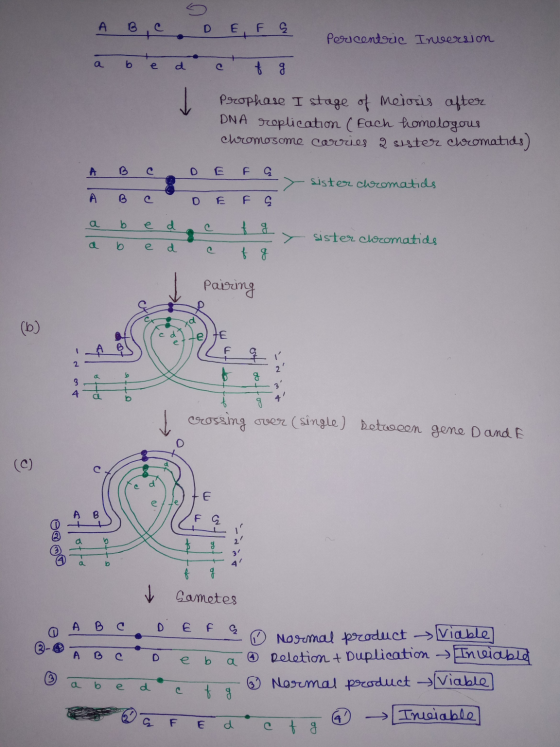
1) a) The inversion is pericentric because the inverted segment contains the centromere, i.e., it involves one break on either side of the centromere.
Crossing over in pericentric inversion results in the formation of the chromosome which have duplications for some genes anf deletions of others. The gametes receiving chromosomes with these deficiencies are inviable.
Picture is given below:
Add Answer to:
1. A flower is heterozygous for the following inversion of
chromosome 1 (dot=centromere)
A B
C ...
Practice Problems 7: Chromosome Variation in Structure 1. A petunia is heterozygous for the following inversion...
 Practice Problems 7: Chromosome Variation in Structure 1. A petunia is heterozygous for the following inversion of chromosome 1 (the dot is the centromere): A a b B C D • E C F f G g e d a. Is this a paracentric or pericentric inversion? b. Draw the pairing configuration at prophase l including all 4 chromatids. c. Give the genotypes of the gametes from this meiosis if there is a single cross-over between genes D and E,...
Inversion Problems: An individual is heterozygous for an inversion: ADCBEFG HI, and during gamete formation there...
 Inversion Problems: An individual is heterozygous for an inversion: ADCBEFG HI, and during gamete formation there is a crossing over event between C and B. Draw chromosome structure pre and post meiosis. Be sure to label the chromatids/chromosomes with the appropriate sequence of genes. Label mutant and wild type chromatids/chromosomes, viable and non-viable gametes. Circle and identify the mutations in the non-viable gametes inuerston If an individual is heterozygous for an inversion, ABC DGFEHI, and a crossing over event occurred...
Mr Crabs suffers from semi-sterility due to a pericentric inversion on chromosome #10. His normal chromosome...
Mr Crabs suffers from semi-sterility due to a pericentric inversion on chromosome #10. His normal chromosome #10 has the sequence of genes as follows (the dot represents the centromere): ABCD·EFGH. His inverted #10 has the sequence: AFE·DCBGH. a. What proportion of Mr Crab’s gametes will be viable if no crossing over occurs within the inverted segment? b. What proportion of Mr Crab’s gametes will be viable if a cross over occurs between genes F-E? c. What is the sequence of...
19. A viable inversion heterozygote is undergoing meiosis. The chromosomes are illustrated below. Compare the consequences...
 19. A viable inversion heterozygote is undergoing meiosis. The chromosomes are illustrated below. Compare the consequences of crossing over in two cases: crossing over between C and D, and crossing over between F and G ABCDEFGHIJK 2 ABCHG FEDIJK 20. Using the same inverted chromosome above: a. Two crossing over events occur among these chromatids: a crossover between genes H and G on chromatids 2 and 4, and a crossover between genes D and E on chromatids 1 and 3....
1) given the following sequence of genes on a chromosome, determine what change in chromosome structure...
1) given the following sequence of genes on a chromosome, determine what change in chromosome structure occurred. the asterisk indicates the centromere before: A B C D * E F G H after: A C D * E F G H a) inversion b) gene duplication c) terminal deletion d) interstitial deletion 2) given the following sequence of genes on a chromosome, determine what change in chromosome structure occurred. the asterisk indicates the centromere before: A B C D *...
11. A normal chromosome and its homolog carrying an inversion are given below (Y* = centromere)...
 11. A normal chromosome and its homolog carrying an inversion are given below (Y* = centromere) Normal: ABCDEFGH Inversion: a dcbe*fgh Answer the following questions about these homologs (8 points total) 11c. Suggest four gamete genotypes that could be produced during a single episode of meiosis if there is a is a crossover between B & C in the inversion heterozygote. Be sure to indicate the position of the centromere with a * Write V or I beside each gamete...
In this diagram, the top chromosome is the wild-type chromosome, while the bottom one carries an...
In this diagram, the top chromosome is the wild-type chromosome, while the bottom one carries an inversion. The star is the centromere. A B C * D E F G A B F E D * C G 1. During meiosis recombination occurs between the centromere and the region marked "D". Draw out the recombinant gametes showing the gene order and position of the centromeres in each. 2. Are either of the recombinant gametes likely to give rise to viable...
A normal chromosome and its homolog carrying an inversion are given below (* Y= centromere): Normal:...
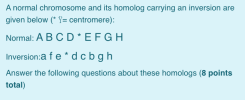 A normal chromosome and its homolog carrying an inversion are given below (* Y= centromere): Normal: A B C D * EFGH Inversion:a fe* dcbgh Answer the following questions about these homologs (8 points total) With pen and paper, diagram the alignment of these homologs during meiosis in an inversion heterozygote. Be sure to include all chromatids.
1. An inversion heterozygote has the following inverted chromosome: ABCD JIHGF.EKLM. a. Sketch how this chromosome...
 1. An inversion heterozygote has the following inverted chromosome: ABCD JIHGF.EKLM. a. Sketch how this chromosome will pair with its normal homologue (AB CDE FGHIJ K L M) in prophase I. Make sure you include all strands (remember, the chromosomes are replicated). (2 pts) b. What four gametes result when a single crossover occurs between genes F and G on one inversion and one normal chromosome? (4 pts)
1. During meiosis when crossing over occurs in a paracentric inversion loop, what percent of the...
 1. During meiosis when crossing over occurs in a paracentric inversion loop, what percent of the meiotic products will result in nonviable gametes? (0.5 points) a. 0% b. 25% c. 50% d. 75% e. 100%
 Practice Problems 7: Chromosome Variation in Structure 1. A petunia is heterozygous for the following inversion of chromosome 1 (the dot is the centromere): A a b B C D • E C F f G g e d a. Is this a paracentric or pericentric inversion? b. Draw the pairing configuration at prophase l including all 4 chromatids. c. Give the genotypes of the gametes from this meiosis if there is a single cross-over between genes D and E,...
 Inversion Problems: An individual is heterozygous for an inversion: ADCBEFG HI, and during gamete formation there is a crossing over event between C and B. Draw chromosome structure pre and post meiosis. Be sure to label the chromatids/chromosomes with the appropriate sequence of genes. Label mutant and wild type chromatids/chromosomes, viable and non-viable gametes. Circle and identify the mutations in the non-viable gametes inuerston If an individual is heterozygous for an inversion, ABC DGFEHI, and a crossing over event occurred...
 19. A viable inversion heterozygote is undergoing meiosis. The chromosomes are illustrated below. Compare the consequences of crossing over in two cases: crossing over between C and D, and crossing over between F and G ABCDEFGHIJK 2 ABCHG FEDIJK 20. Using the same inverted chromosome above: a. Two crossing over events occur among these chromatids: a crossover between genes H and G on chromatids 2 and 4, and a crossover between genes D and E on chromatids 1 and 3....
 11. A normal chromosome and its homolog carrying an inversion are given below (Y* = centromere) Normal: ABCDEFGH Inversion: a dcbe*fgh Answer the following questions about these homologs (8 points total) 11c. Suggest four gamete genotypes that could be produced during a single episode of meiosis if there is a is a crossover between B & C in the inversion heterozygote. Be sure to indicate the position of the centromere with a * Write V or I beside each gamete...
 A normal chromosome and its homolog carrying an inversion are given below (* Y= centromere): Normal: A B C D * EFGH Inversion:a fe* dcbgh Answer the following questions about these homologs (8 points total) With pen and paper, diagram the alignment of these homologs during meiosis in an inversion heterozygote. Be sure to include all chromatids.
 1. An inversion heterozygote has the following inverted chromosome: ABCD JIHGF.EKLM. a. Sketch how this chromosome will pair with its normal homologue (AB CDE FGHIJ K L M) in prophase I. Make sure you include all strands (remember, the chromosomes are replicated). (2 pts) b. What four gametes result when a single crossover occurs between genes F and G on one inversion and one normal chromosome? (4 pts)
 1. During meiosis when crossing over occurs in a paracentric inversion loop, what percent of the meiotic products will result in nonviable gametes? (0.5 points) a. 0% b. 25% c. 50% d. 75% e. 100%
Most questions answered within 3 hours.
-
Where is the error in this code sequence?
String s1 = "Hello";
String s2 = "ello";...
asked 11 months ago -
Financial data for Joel de Paris, Inc., for last year
follow:
Joel de Paris, Inc.
Balance...
asked 11 months ago -
Consider this reaction:
Al2(SO4)3 (aq)+ BaCl3
(aq) Al2Cl6 (aq)- +
3BaSO4(s) . What is the...
asked 11 months ago -
Suppose that Savneet is considering increasing her
recent random sample from 20 car rentals to 40...
asked 11 months ago -
Trucks arrive at an unloading terminal at an average rate of 120
per hour.
Trucks arrive...
asked 11 months ago -
Why are methanol and ethanol completely soluble in water while
octanol is not very little soluble....
asked 11 months ago -
A facilities manager at a university reads in a research report
that the mean amount of...
asked 11 months ago -
When the CuSO4 is rehydrated by adding water to the anhydrous
compound, is this an endothermic...
asked 11 months ago -
A ray of sunlight is passing from diamond into crown glass; the
angle of incidence is...
asked 11 months ago -
A block of mass 0.249 kg is placed on top of a light, vertical
spring of...
asked 11 months ago -
how do the kidneys compensate in the presences of acidosis
a) trigger hyperventilate
b) reserve acid...
asked 11 months ago -
Question 501 pts
The rental rate of capital to the firm increases. Which of the
following...
asked 11 months ago