In this diagram, the top chromosome is the wild-type chromosome, while the bottom one carries an...
In this diagram, the top chromosome is the wild-type chromosome, while the bottom one carries an inversion. The star is the centromere.
A B C * D E F G
A B F E D * C G
1. During meiosis recombination occurs between the centromere and the region marked "D". Draw out the recombinant gametes showing the gene order and position of the centromeres in each.
2. Are either of the recombinant gametes likely to give rise to viable offspring? Briefly explain why with reference to the chromosome you have drawn.
Homework Answers
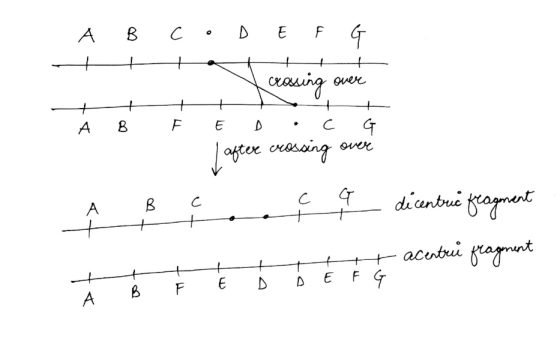
After recombination, 2 fragments will be formed, dicentric (containing 2 centromeres) and acentric (containing no centromeres). Both of these fragments are abnormal because a normal fragment has single centromere only. Therefore, both of these fragments will not give rise to a normal gamete.
Please rate.
Add Answer to:
In this diagram, the top chromosome is the wild-type chromosome,
while the bottom one carries an...
Practice Problems 7: Chromosome Variation in Structure 1. A petunia is heterozygous for the following inversion...
 Practice Problems 7: Chromosome Variation in Structure 1. A petunia is heterozygous for the following inversion of chromosome 1 (the dot is the centromere): A a b B C D • E C F f G g e d a. Is this a paracentric or pericentric inversion? b. Draw the pairing configuration at prophase l including all 4 chromatids. c. Give the genotypes of the gametes from this meiosis if there is a single cross-over between genes D and E,...
1. A flower is heterozygous for the following inversion of chromosome 1 (dot=centromere) A B C ...
1. A flower is heterozygous for the following inversion of chromosome 1 (dot=centromere) A B C ● D E F G a b e d ● c f g a. Is this a paracentric or pericentric inversion? I am thinking Pericentric? b. Draw the pairing configuration at prophase I including all 4 chromatids. I wasnt too sure how to map the loop out for this one c. Give the genotypes of the gametes from this meiosis if there is a...
19. A viable inversion heterozygote is undergoing meiosis. The chromosomes are illustrated below. Compare the consequences...
 19. A viable inversion heterozygote is undergoing meiosis. The chromosomes are illustrated below. Compare the consequences of crossing over in two cases: crossing over between C and D, and crossing over between F and G ABCDEFGHIJK 2 ABCHG FEDIJK 20. Using the same inverted chromosome above: a. Two crossing over events occur among these chromatids: a crossover between genes H and G on chromatids 2 and 4, and a crossover between genes D and E on chromatids 1 and 3....
Here are data from crossing a phenotypically wild-type female Drosophila (tly) F1 The Y and A...
 Here are data from crossing a phenotypically wild-type female Drosophila (tly) F1 The Y and A genes are dosely linked on the same chromosome. In this cross, which of the following is true about the gametes produced by the F1 progeny 2 pt YYAA X Yaa YyAa A. YA & Ya gametes will outnumber YA & ya gametes. B. YA & ya gametes will outnumber yA & Ya gametes. C.YA. Ya, YA, & xa gametes will be present in equal...
You have three genes on the same chromosome - A, B and C. Each gene has...
You have three genes on the same chromosome - A, B and C. Each gene has two alleles in a dominant/recessive relationship. For these genes the homozygous recessive has the mutant phenotype for that trait, the dominant phenotype = wild type for that trait. allele A is dominant to a; phenotype a = mutant for trait a; phenotype A = wild type for trait A allele B is dominant to b; phenotype b = mutant for trait b; phenotype B...
5.) You have discovered mutants in two new gene mutants in Drosophila. One mutant, curl, has...
 5.) You have discovered mutants in two new gene mutants in Drosophila. One mutant, curl, has small, curly, nonfunctional wings. The other mutant, big, has enormous eyes. You decide to test if these two new genes are on chromosome #2, so you perform a three-gene linkage testcross using a gene that you know is on chromosome #2, trp, a mutant that cannot make its own tryptophan (and so must get it from its food). In all three cases, these mutant...
**Please answer ALL 10 QUESTION** 1. A species of flowering plant includes plants with blooms that...
**Please answer ALL 10 QUESTION** 1. A species of flowering plant includes plants with blooms that range from bright golden yellow to very pale yellow; no flowers carrying the yellow pigment allele appear white. The allele for yellow flower color: a. must be a suppressor of another allele. b. demonstrates incomplete penetrance. c. demonstrates variable expressivity. d. must be a modifier of another allele. e. demonstrates variable penetrance. 2. Coat color in mice is determined by two alleles acting at...
(9 points) You are interested in studying recombination frequencies in wasps. You identify a queen that...
 (9 points) You are interested in studying recombination frequencies in wasps. You identify a queen that is heterozygous at three different loci on chromosome 5: G, H, and R. As queen wasps can produce haploid male offspring without fertilizing their eggs, you decide to look only at the genotypes of her male offspring in your analysis. Below is a list of the genotypes of her male offspring, and the number of individuals that fall into each genotypic class. 92 168...
Practice questions for BIO 340 (Exam 2) I need help with these questions Please. WILL GIVE...
 Practice questions for BIO 340 (Exam 2) I need help with these
questions Please. WILL GIVE GOOD RATING
1. Wild type blue-eyed mary has blue flowers. Two genes control the pathway that makes the blue pigment: The product of gene W turns a white precursor into magenta pigment. The product of gene M turns the magenta pigment into blue pigment. Each gene has a recessive loss-of-function allele: w and m, respectively. A double heterozygote (Ww Mm) is self-pollinated. What proportion...
Practice questions for BIO 340 (Exam 2) I need help with these
questions Please. WILL GIVE GOOD RATING
1. Wild type blue-eyed mary has blue flowers. Two genes control the pathway that makes the blue pigment: The product of gene W turns a white precursor into magenta pigment. The product of gene M turns the magenta pigment into blue pigment. Each gene has a recessive loss-of-function allele: w and m, respectively. A double heterozygote (Ww Mm) is self-pollinated. What proportion...
 Practice Problems 7: Chromosome Variation in Structure 1. A petunia is heterozygous for the following inversion of chromosome 1 (the dot is the centromere): A a b B C D • E C F f G g e d a. Is this a paracentric or pericentric inversion? b. Draw the pairing configuration at prophase l including all 4 chromatids. c. Give the genotypes of the gametes from this meiosis if there is a single cross-over between genes D and E,...
 19. A viable inversion heterozygote is undergoing meiosis. The chromosomes are illustrated below. Compare the consequences of crossing over in two cases: crossing over between C and D, and crossing over between F and G ABCDEFGHIJK 2 ABCHG FEDIJK 20. Using the same inverted chromosome above: a. Two crossing over events occur among these chromatids: a crossover between genes H and G on chromatids 2 and 4, and a crossover between genes D and E on chromatids 1 and 3....
 Here are data from crossing a phenotypically wild-type female Drosophila (tly) F1 The Y and A genes are dosely linked on the same chromosome. In this cross, which of the following is true about the gametes produced by the F1 progeny 2 pt YYAA X Yaa YyAa A. YA & Ya gametes will outnumber YA & ya gametes. B. YA & ya gametes will outnumber yA & Ya gametes. C.YA. Ya, YA, & xa gametes will be present in equal...
 5.) You have discovered mutants in two new gene mutants in Drosophila. One mutant, curl, has small, curly, nonfunctional wings. The other mutant, big, has enormous eyes. You decide to test if these two new genes are on chromosome #2, so you perform a three-gene linkage testcross using a gene that you know is on chromosome #2, trp, a mutant that cannot make its own tryptophan (and so must get it from its food). In all three cases, these mutant...
 (9 points) You are interested in studying recombination frequencies in wasps. You identify a queen that is heterozygous at three different loci on chromosome 5: G, H, and R. As queen wasps can produce haploid male offspring without fertilizing their eggs, you decide to look only at the genotypes of her male offspring in your analysis. Below is a list of the genotypes of her male offspring, and the number of individuals that fall into each genotypic class. 92 168...
 Practice questions for BIO 340 (Exam 2) I need help with these
questions Please. WILL GIVE GOOD RATING
1. Wild type blue-eyed mary has blue flowers. Two genes control the pathway that makes the blue pigment: The product of gene W turns a white precursor into magenta pigment. The product of gene M turns the magenta pigment into blue pigment. Each gene has a recessive loss-of-function allele: w and m, respectively. A double heterozygote (Ww Mm) is self-pollinated. What proportion...
Practice questions for BIO 340 (Exam 2) I need help with these
questions Please. WILL GIVE GOOD RATING
1. Wild type blue-eyed mary has blue flowers. Two genes control the pathway that makes the blue pigment: The product of gene W turns a white precursor into magenta pigment. The product of gene M turns the magenta pigment into blue pigment. Each gene has a recessive loss-of-function allele: w and m, respectively. A double heterozygote (Ww Mm) is self-pollinated. What proportion...
Most questions answered within 3 hours.
-
Where is the error in this code sequence?
String s1 = "Hello";
String s2 = "ello";...
asked 11 months ago -
Financial data for Joel de Paris, Inc., for last year
follow:
Joel de Paris, Inc.
Balance...
asked 11 months ago -
Consider this reaction:
Al2(SO4)3 (aq)+ BaCl3
(aq) Al2Cl6 (aq)- +
3BaSO4(s) . What is the...
asked 11 months ago -
Suppose that Savneet is considering increasing her
recent random sample from 20 car rentals to 40...
asked 11 months ago -
Trucks arrive at an unloading terminal at an average rate of 120
per hour.
Trucks arrive...
asked 11 months ago -
Why are methanol and ethanol completely soluble in water while
octanol is not very little soluble....
asked 11 months ago -
A facilities manager at a university reads in a research report
that the mean amount of...
asked 11 months ago -
When the CuSO4 is rehydrated by adding water to the anhydrous
compound, is this an endothermic...
asked 11 months ago -
A ray of sunlight is passing from diamond into crown glass; the
angle of incidence is...
asked 11 months ago -
A block of mass 0.249 kg is placed on top of a light, vertical
spring of...
asked 11 months ago -
how do the kidneys compensate in the presences of acidosis
a) trigger hyperventilate
b) reserve acid...
asked 11 months ago -
Question 501 pts
The rental rate of capital to the firm increases. Which of the
following...
asked 11 months ago