Carbon compounds being catabolized could move from the Embden-Meyerhoff to which of the following pathways? 1....
Carbon compounds being catabolized could move from the Embden-Meyerhoff to which of the following pathways?
1. fermentation
2. electron transport
3. depolymerization
4. beta oxidation pathway
Homework Answers
Fermentation
Embden Meyerhoff pathway is glycolysis. A molecule of glucose enter glycolysis and is broken down into two molecules of pyruvic acid. It occurs in both prokaryotes and eukaryotes. It is a common step for aerobic and anaerobic respiration. After pyruvic acid is formed, if there is a deficiency of oxygen in the medium, then it will enter fermentation. If it is alcohol fermentation, then it will lead to the formation of alcohol and carbon dioxide and if it is pyruvic acid fermentation, then it will lead to the formation of lactic acid. But if there is an appropriate supply of oxygen in the medium, then aerobic respiration will take place and pyruvic acid will be decarboxylated into a acetyl coenzyme a and carbon dioxide.
Please rate high.
Add Answer to:
Carbon compounds being catabolized could move from the
Embden-Meyerhoff to which of the following pathways?
1....
Which pathway will eventually receive carbon atons from catabolism of every one of these substrates: 10...
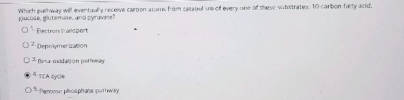 Which pathway will eventually receive carbon atons from catabolism of every one of these substrates: 10 carbon fatty acid. glucose, glutamate, and pyruvate? Electron transport 2. Depolymerization 3. Beta oxidation pathway •4 ТСА сусе O S.Pentose phosphate pattway
3. Which of the following pathways operate when cells are growing anaerobically? a. Glycolysis b. Pyruvate...
 3. Which of the following pathways operate when cells are growing anaerobically? a. Glycolysis b. Pyruvate Oxidation c. Kreb's Cycle d. Electron Transport Chain e. Two of the above
Please answer all... Thank you! 45) Which of the following is true of cyclic photophosphorylation? (1...
 Please answer all... Thank you!
45) Which of the following is true of cyclic photophosphorylation? (1 pts) Water is split to produce oxygen. NADP+ is reduced directly at the end of a liner O-R system. Electrons emitted during radiant excitation of bacteriochlorophylls are retunred through a cyclic O-R system O None of the above are correct. 46) Which of the following is true of the glycolytic pathway? (1 pts) The pathway begins with glucose. The pathway ends with pyruvate. The...
Please answer all... Thank you!
45) Which of the following is true of cyclic photophosphorylation? (1 pts) Water is split to produce oxygen. NADP+ is reduced directly at the end of a liner O-R system. Electrons emitted during radiant excitation of bacteriochlorophylls are retunred through a cyclic O-R system O None of the above are correct. 46) Which of the following is true of the glycolytic pathway? (1 pts) The pathway begins with glucose. The pathway ends with pyruvate. The...
1. Which of the following pathways is NOT present in red blood cells? a. Cholesterol synthesis...
1. Which of the following pathways is NOT present in red blood cells? a. Cholesterol synthesis b. Glycolysis c. The pentose phosphate pathway d. Fatty acid oxidation
From the following which is true about cellular respiration (select all that apply) 1. In prokaryotes,...
From the following which is true about cellular respiration (select all that apply) 1. In prokaryotes, the electrons transport is in the plasma membrane 2. Prokaryotic fermentation net yield is 4 ATP and oxidative respiration has 32 ATP 3. The major regulatory enzyme of glycolysis is Hexokinase 4. Substrate-level phosphorylation is catalyzed by kinase and transfers the phosphate group from an intermediate in a metabolic pathway directly to a molecule of ADP B) Which statement is false about phosphate esters...
Matching ___ respiratory pathways in which acetate (and other C2 compounds) are carabolized. ___ respiration in...
Matching ___ respiratory pathways in which acetate (and other C2 compounds) are carabolized. ___ respiration in which an inorganic molecule is the final receptor ___ in gram negatives, periplasmic binding proteins and ATP hydrolyzing proteins are needed in this transport system ___ major means for direcr synthesis of NADPH for deoxynucleotide and fatty acid synthesis ___ organisms which concerve energy from organic chemicals ___ tendency to donate electrons as expressed as volts (V) compared with reference (H2) ___ organic molecule...
Could you please give me answers for these ? thanks 1. Atomic radius decreases as we move from left to right in the periodic table. Which of the following is the BEST explanation for this trend?...
Could you please give me answers for these ? thanks 1. Atomic radius decreases as we move from left to right in the periodic table. Which of the following is the BEST explanation for this trend? a. The electrons in the valence shell increase in number and thus interact more with one another as we move from left to right. b. There is more shielding of the inner electrons as we move from left to right. c. The electrons in...
QUESTION 3 Which of the following compounds contain a carbon atom is in the highest oxidation...
 QUESTION 3 Which of the following compounds contain a carbon atom is in the highest oxidation state carbon monoxide an aldehyde an alcohol carbon dioxide methyl chloride QUESTION 4 How many isomeric monochloro products can be formed from the chlorination of methylcyclopropane? QUESTION 5 Provide the IUPAC name for a product of the monobromination of butane
QUESTION 1 Which of the following processes/pathways CANNOT occur in the absence of O2? Oxidative phosphorylation...
QUESTION 1 Which of the following processes/pathways CANNOT occur in the absence of O2? Oxidative phosphorylation Substrate level phosphorylation Oxidation of NADH Photosynthesis Fermentation 1 points QUESTION 2 Phosphofructokinase (PFK-1) is one of the most regulated enzymes in metabolism. Which of the following would be expected to be an allosteric inhibitor of PFK-1? Glucose Fructose-6-phosphate Acetyl CoA AMP 1 points QUESTION 3 Which of the following is a reactant of the first reaction of glycolysis? Glucose ADP ATP...
Which of the following statements is true concerning catabolic pathways? 1. FAD is used as the...
Which of the following statements is true concerning catabolic pathways? 1. FAD is used as the primary reducing agent in catabolic pathways. 2. The end products of catabolic pathways are highly reduced compared to the initial substrate for the pathway. 3. NADH is a typical product of catabolic pathways. 4. NADPH is used as the primary reducing agent in catabolic pathways. 5. More ATP is used than generated in catabolic pathways.
 Which pathway will eventually receive carbon atons from catabolism of every one of these substrates: 10 carbon fatty acid. glucose, glutamate, and pyruvate? Electron transport 2. Depolymerization 3. Beta oxidation pathway •4 ТСА сусе O S.Pentose phosphate pattway
 3. Which of the following pathways operate when cells are growing anaerobically? a. Glycolysis b. Pyruvate Oxidation c. Kreb's Cycle d. Electron Transport Chain e. Two of the above
 Please answer all... Thank you!
45) Which of the following is true of cyclic photophosphorylation? (1 pts) Water is split to produce oxygen. NADP+ is reduced directly at the end of a liner O-R system. Electrons emitted during radiant excitation of bacteriochlorophylls are retunred through a cyclic O-R system O None of the above are correct. 46) Which of the following is true of the glycolytic pathway? (1 pts) The pathway begins with glucose. The pathway ends with pyruvate. The...
Please answer all... Thank you!
45) Which of the following is true of cyclic photophosphorylation? (1 pts) Water is split to produce oxygen. NADP+ is reduced directly at the end of a liner O-R system. Electrons emitted during radiant excitation of bacteriochlorophylls are retunred through a cyclic O-R system O None of the above are correct. 46) Which of the following is true of the glycolytic pathway? (1 pts) The pathway begins with glucose. The pathway ends with pyruvate. The...
 QUESTION 3 Which of the following compounds contain a carbon atom is in the highest oxidation state carbon monoxide an aldehyde an alcohol carbon dioxide methyl chloride QUESTION 4 How many isomeric monochloro products can be formed from the chlorination of methylcyclopropane? QUESTION 5 Provide the IUPAC name for a product of the monobromination of butane
Most questions answered within 3 hours.
-
Where is the error in this code sequence?
String s1 = "Hello";
String s2 = "ello";...
asked 10 months ago -
Financial data for Joel de Paris, Inc., for last year
follow:
Joel de Paris, Inc.
Balance...
asked 10 months ago -
Consider this reaction:
Al2(SO4)3 (aq)+ BaCl3
(aq) Al2Cl6 (aq)- +
3BaSO4(s) . What is the...
asked 10 months ago -
Suppose that Savneet is considering increasing her
recent random sample from 20 car rentals to 40...
asked 10 months ago -
Trucks arrive at an unloading terminal at an average rate of 120
per hour.
Trucks arrive...
asked 10 months ago -
Why are methanol and ethanol completely soluble in water while
octanol is not very little soluble....
asked 10 months ago -
A facilities manager at a university reads in a research report
that the mean amount of...
asked 10 months ago -
When the CuSO4 is rehydrated by adding water to the anhydrous
compound, is this an endothermic...
asked 10 months ago -
A ray of sunlight is passing from diamond into crown glass; the
angle of incidence is...
asked 10 months ago -
A block of mass 0.249 kg is placed on top of a light, vertical
spring of...
asked 10 months ago -
how do the kidneys compensate in the presences of acidosis
a) trigger hyperventilate
b) reserve acid...
asked 10 months ago -
Question 501 pts
The rental rate of capital to the firm increases. Which of the
following...
asked 10 months ago