This question is regarding the retinofugal pathway: Can you describe what would happen to your vision...
This question is regarding the retinofugal pathway:
Can you describe what would happen to your vision if there was a disruptance at the Optic nerve, The optic chiasm and The Optic tract
Homework Answers
Damage to an optic nerve or damage to its pathways to the brain results in loss of vision. At a structure in the brain called the optic chiasm, each optic nerve splits, and half of its fibers cross over to the other side. Because of this anatomic arrangement, damage along the optic nerve pathway causes specific patterns of vision loss.
By understanding the pattern of vision loss, a doctor can often determine where the problem is in the pathway.Nerve signals travel along the optic nerve from each eye. The two optic nerves meet at the optic chiasm. There, the optic nerve from each eye divides, and half of the nerve fibers from each side cross to the other side. Because of this arrangement, the right side of the brain receives information from the left visual field of both eyes, and the left side of the brain receives information from the right visual field of both eyes. Damage to an eye or the visual pathway causes different types of vision loss depending on where the damage occurs.
Add Answer to:
This question is regarding the retinofugal pathway:
Can you describe what would happen to your vision...
Question 47 Describe a visual pathway from the retina to the visual cortex of the occipital...
 Question 47 Describe a visual pathway from the retina to the visual cortex of the occipital lobe. Include the terms in the textbox photoreceptors Irods optic tract Icones retina thalamus ganglion cells optic disc visual cortex of occipital lobe optic nerve optic chiasm 1.! HTML Editor BIA-N-I E *** 12pt - 2 ce to search
Describe your personal mission and vision statement. If you don't have a personal mission and vision...
Describe your personal mission and vision statement. If you don't have a personal mission and vision statement, what would yours look like? How has (or would) having a personal mission and vision statement affected (affect) your life? (2 Paragraph )
Ignore words in blue. Question A2: Make predictions: In the table below, describe what would happen...
 Ignore words in blue.
Question A2: Make predictions: In the table below, describe what would happen if the protein complex listed were inhibited. If this piece of the If this piece of the pathway is inhibited, pathway is inhibited, what molecules will what molecules will be abnormally accumulate abnormally depleted in (build up) in the the organelle? organelle? H2O 02 Consider this piece of the pathway Any complex in the chloroplast's electron transport chain A complex in the mitochondrial electron...
Ignore words in blue.
Question A2: Make predictions: In the table below, describe what would happen if the protein complex listed were inhibited. If this piece of the If this piece of the pathway is inhibited, pathway is inhibited, what molecules will what molecules will be abnormally accumulate abnormally depleted in (build up) in the the organelle? organelle? H2O 02 Consider this piece of the pathway Any complex in the chloroplast's electron transport chain A complex in the mitochondrial electron...
Describe your vision and goals for successful completion of the course. What is your vision and...
Describe your vision and goals for successful completion of the course. What is your vision and mission for long term success? What will you do over the next eight weeks to achieve your vision and mission? Integrate your understanding of the lectures and readings coures MSL601 Intro to Graduate Education 03OG1
What would happen to the signaling pathway if the receptor were mutated? What about if the...
What would happen to the signaling pathway if the receptor were mutated? What about if the hormone was mutated?
2A. Infant Vision. Describe how infant vision develops. What are the major milestones of vision development...
 2A. Infant Vision. Describe how infant vision develops. What are the major milestones of vision development in infancy? Describe vision development in domparison to the other senses. What can they see? What do infants prefer to look at? Provide specific examples. Be sure to answer all parts of the question
Briefly describe main motor pathway such as corticospinal tract. What is a significance of pyramidal decussation?
Briefly describe main motor pathway such as corticospinal tract. What is a significance of pyramidal decussation?
What would happen to a neuron if it were exposed to tetrodotoxin? 1. Be specific regarding...
What would happen to a neuron if it were exposed to tetrodotoxin? 1. Be specific regarding tetrodotoxin’s effect on the structures present in the membrane of this cell. 2. Considering your answer above, what effect would that have on the neuron’s ability to communicate
6. Application problems -- Explain the effect of poisons at various pathway points, what would happen...
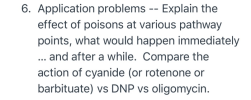 6. Application problems -- Explain the effect of poisons at various pathway points, what would happen immediately ... and after a while. Compare the action of cyanide (or rotenone or barbituate) vs DNP vs oligomycin.
6. Application: Let's say you injected a dye into a cell. Describe what would happen to...
 6. Application: Let's say you injected a dye into a cell. Describe what would happen to the dye if the cells in animal tissue were connected by each of the following: tight junctions, desmosomes, and gap junctions d. Application: Let's say you inject a dye extracellularly on one side of a sheet of animal cells. Describe what would happen to the dye if the cells in the tissue were connected by each of the following: tight junctions, desmosomes, gap junctions
 Question 47 Describe a visual pathway from the retina to the visual cortex of the occipital lobe. Include the terms in the textbox photoreceptors Irods optic tract Icones retina thalamus ganglion cells optic disc visual cortex of occipital lobe optic nerve optic chiasm 1.! HTML Editor BIA-N-I E *** 12pt - 2 ce to search
 Ignore words in blue.
Question A2: Make predictions: In the table below, describe what would happen if the protein complex listed were inhibited. If this piece of the If this piece of the pathway is inhibited, pathway is inhibited, what molecules will what molecules will be abnormally accumulate abnormally depleted in (build up) in the the organelle? organelle? H2O 02 Consider this piece of the pathway Any complex in the chloroplast's electron transport chain A complex in the mitochondrial electron...
Ignore words in blue.
Question A2: Make predictions: In the table below, describe what would happen if the protein complex listed were inhibited. If this piece of the If this piece of the pathway is inhibited, pathway is inhibited, what molecules will what molecules will be abnormally accumulate abnormally depleted in (build up) in the the organelle? organelle? H2O 02 Consider this piece of the pathway Any complex in the chloroplast's electron transport chain A complex in the mitochondrial electron...
 2A. Infant Vision. Describe how infant vision develops. What are the major milestones of vision development in infancy? Describe vision development in domparison to the other senses. What can they see? What do infants prefer to look at? Provide specific examples. Be sure to answer all parts of the question
 6. Application problems -- Explain the effect of poisons at various pathway points, what would happen immediately ... and after a while. Compare the action of cyanide (or rotenone or barbituate) vs DNP vs oligomycin.
 6. Application: Let's say you injected a dye into a cell. Describe what would happen to the dye if the cells in animal tissue were connected by each of the following: tight junctions, desmosomes, and gap junctions d. Application: Let's say you inject a dye extracellularly on one side of a sheet of animal cells. Describe what would happen to the dye if the cells in the tissue were connected by each of the following: tight junctions, desmosomes, gap junctions
Most questions answered within 3 hours.
-
Where is the error in this code sequence?
String s1 = "Hello";
String s2 = "ello";...
asked 10 months ago -
Financial data for Joel de Paris, Inc., for last year
follow:
Joel de Paris, Inc.
Balance...
asked 10 months ago -
Consider this reaction:
Al2(SO4)3 (aq)+ BaCl3
(aq) Al2Cl6 (aq)- +
3BaSO4(s) . What is the...
asked 10 months ago -
Suppose that Savneet is considering increasing her
recent random sample from 20 car rentals to 40...
asked 10 months ago -
Trucks arrive at an unloading terminal at an average rate of 120
per hour.
Trucks arrive...
asked 10 months ago -
Why are methanol and ethanol completely soluble in water while
octanol is not very little soluble....
asked 10 months ago -
A facilities manager at a university reads in a research report
that the mean amount of...
asked 10 months ago -
When the CuSO4 is rehydrated by adding water to the anhydrous
compound, is this an endothermic...
asked 10 months ago -
A ray of sunlight is passing from diamond into crown glass; the
angle of incidence is...
asked 10 months ago -
A block of mass 0.249 kg is placed on top of a light, vertical
spring of...
asked 10 months ago -
how do the kidneys compensate in the presences of acidosis
a) trigger hyperventilate
b) reserve acid...
asked 10 months ago -
Question 501 pts
The rental rate of capital to the firm increases. Which of the
following...
asked 10 months ago