
Homework Answers

Add Answer to:
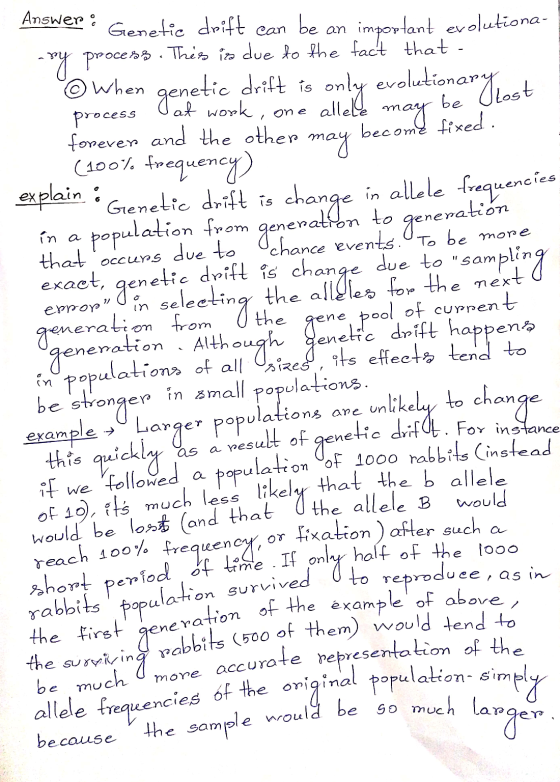
Genetic drift can be an important evolutionary process. This is due to the fact that (A...
Genetic drift is most likely to be an important evolutionary force in___________________. a. small microbial populations...
Genetic drift is most likely to be an important evolutionary force in___________________. a. small microbial populations b. microbial populationsthat are artificially established in the laboratory c. microbial populations that are infected with bacteriophages d. microbial populationsthat are isolated from the natural environment e. large microbial populations
While drift may, in fact, be important in all of the following forms of speciation, which...
While drift may, in fact, be important in all of the following forms of speciation, which form is it thought to be MOST important? Allopatric Sympatric Parapatric Peripatric Driftiatric Hybridization and gene flow occurs in a narrow zone of contact in which form of speciation? Allopatric Sympatric Parapatric Peripatric None of the above Which evolutionary force, acting alone, can cause a population to “ fall off” of an adaptive peak? Natural selection Random genetic drift Directed genetic drift Speciation Mutation
Select the option that contains three evolutionary forces a) natural selection, genetic drift, gene flow b)...
Select the option that contains three evolutionary forces a) natural selection, genetic drift, gene flow b) somatic cells, chromosomes, natural selection c) non-random mating, genomes, variation d) proteins, genetic drift, alleles e) natural selection, DDT resistance, environment
13. Which of the following is the only evolutionary process that consistently produces adaptation? a. Genetic...
 13. Which of the following is the only evolutionary process that consistently produces adaptation? a. Genetic drift b. Natural selection c. Gene flow d. Mutations 14. Which of the following is NOT a possible result when isolated populations come into contact? a. Dispersal b. Stability c. Reinforcement d. Fusion e. New Species 15. What is greater than mutations in producing variation in diploids? a, transformation b. sexual recombination c. natural selection d. punctuated equilibrium e. conjugation 16. Which type of...
1. What happens to the within-group and between-group genetic variation of the population when gene flow...
1. What happens to the within-group and between-group genetic variation of the population when gene flow occurs in the population? 2. What happens to the within-group and between-group genetic variation of the population when genetic drift occurs in the population? 3. When only one type of allele at a locus is found for a gene, what is this called? 4. What happens to a genetic variation within a population when natural selection is acting on a population? 5. What happens...
During the evolutionary synthesis, biologists conclusively identified natural selection, gene flow, genetic drift, and mutation as...
During the evolutionary synthesis, biologists conclusively identified natural selection, gene flow, genetic drift, and mutation as the major causes of evolution within species. Using the scientific definition of evolution, explain how these forces cause populations, species, and higher taxa to evolve.
are these correct Stopping which of these evolutionary forces can lead to speciation? A. genetic drift...
 are these correct
Stopping which of these evolutionary forces can lead to speciation? A. genetic drift OB. gene flow OC. natural selection OD. sexual selection O E. mutations QUESTION 2 Speciation is most commonly a result of A. copatry OB. antipatry OC. allopatry OD. sympatry O E. sexual selection
are these correct
Stopping which of these evolutionary forces can lead to speciation? A. genetic drift OB. gene flow OC. natural selection OD. sexual selection O E. mutations QUESTION 2 Speciation is most commonly a result of A. copatry OB. antipatry OC. allopatry OD. sympatry O E. sexual selection
Which of the following statements about genetic drift as an evolutionary factor is true? a. It...
Which of the following statements about genetic drift as an evolutionary factor is true? a. It is more potent in a population with small numbers than in a population with large numbers. b. It is responsible for the selection of mutations. c. It is connected to the movements of alleles between populations of a single species. d. Its strength is proportional to the size of a population: the larger the population, the greater the force. e. Both a and b
Select all of the statements about genetic drift that are true. It can cause alleles to...
 Select all of the statements about genetic drift that are true. It can cause alleles to be lost in a population by chance. Genetic drift causes allele frequencies to change because only the strongest individuals in a population are reproducing Its strength is proportional to the size of a population -the larger the population, the greater the force Smaller populations experience greater changes in allele frequency due to genetic drift than large populations. It is a random process with respect...
The process by which humans selectively breed organisms for a favorable (for humans) character is Oa....
 The process by which humans selectively breed organisms for a favorable (for humans) character is Oa. None of the answers are correct Ob. Natural selection C. Random mating d. Artificial selection The differential survival and reproduction of individuals from an evolutionary perspective is a. Genetic Drift b. Artificial Selection Bottle Neck d. Natural Selection
 13. Which of the following is the only evolutionary process that consistently produces adaptation? a. Genetic drift b. Natural selection c. Gene flow d. Mutations 14. Which of the following is NOT a possible result when isolated populations come into contact? a. Dispersal b. Stability c. Reinforcement d. Fusion e. New Species 15. What is greater than mutations in producing variation in diploids? a, transformation b. sexual recombination c. natural selection d. punctuated equilibrium e. conjugation 16. Which type of...
 are these correct
Stopping which of these evolutionary forces can lead to speciation? A. genetic drift OB. gene flow OC. natural selection OD. sexual selection O E. mutations QUESTION 2 Speciation is most commonly a result of A. copatry OB. antipatry OC. allopatry OD. sympatry O E. sexual selection
are these correct
Stopping which of these evolutionary forces can lead to speciation? A. genetic drift OB. gene flow OC. natural selection OD. sexual selection O E. mutations QUESTION 2 Speciation is most commonly a result of A. copatry OB. antipatry OC. allopatry OD. sympatry O E. sexual selection
 Select all of the statements about genetic drift that are true. It can cause alleles to be lost in a population by chance. Genetic drift causes allele frequencies to change because only the strongest individuals in a population are reproducing Its strength is proportional to the size of a population -the larger the population, the greater the force Smaller populations experience greater changes in allele frequency due to genetic drift than large populations. It is a random process with respect...
 The process by which humans selectively breed organisms for a favorable (for humans) character is Oa. None of the answers are correct Ob. Natural selection C. Random mating d. Artificial selection The differential survival and reproduction of individuals from an evolutionary perspective is a. Genetic Drift b. Artificial Selection Bottle Neck d. Natural Selection
Most questions answered within 3 hours.
-
Where is the error in this code sequence?
String s1 = "Hello";
String s2 = "ello";...
asked 10 months ago -
Financial data for Joel de Paris, Inc., for last year
follow:
Joel de Paris, Inc.
Balance...
asked 10 months ago -
Consider this reaction:
Al2(SO4)3 (aq)+ BaCl3
(aq) Al2Cl6 (aq)- +
3BaSO4(s) . What is the...
asked 10 months ago -
Suppose that Savneet is considering increasing her
recent random sample from 20 car rentals to 40...
asked 10 months ago -
Trucks arrive at an unloading terminal at an average rate of 120
per hour.
Trucks arrive...
asked 10 months ago -
Why are methanol and ethanol completely soluble in water while
octanol is not very little soluble....
asked 10 months ago -
A facilities manager at a university reads in a research report
that the mean amount of...
asked 10 months ago -
When the CuSO4 is rehydrated by adding water to the anhydrous
compound, is this an endothermic...
asked 10 months ago -
A ray of sunlight is passing from diamond into crown glass; the
angle of incidence is...
asked 10 months ago -
A block of mass 0.249 kg is placed on top of a light, vertical
spring of...
asked 10 months ago -
how do the kidneys compensate in the presences of acidosis
a) trigger hyperventilate
b) reserve acid...
asked 10 months ago -
Question 501 pts
The rental rate of capital to the firm increases. Which of the
following...
asked 10 months ago