
Homework Answers
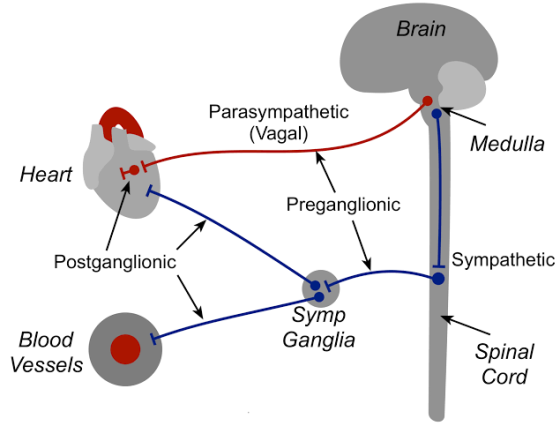
5). Preganglion neuron- The autonomic nervous system is the part of the peripheral nervous system that regulates the basic visceral processes needed for the maintenance of normal bodily functions. It operates independently of voluntary control, although certain events, such as stress, fear, sexual excitement, and alterations in the sleep-wake cycle, change the level of autonomic activity. The autonomic system usually is defined as a motor system that innervates three major types of tissue: cardiac muscle, smooth muscle, and glands. However, it also relays visceral sensory information to the central nervous system and processes it so that alterations can be made in the activity of specific autonomic motor outflows, such as those that control the heart, blood vessels, and other visceral organs. It also stimulates the release of certain hormones involved in energy metabolism (e.g., insulin, glucagon, and epinephrine [also called adrenaline]) or cardiovascular functions (e.g., renin and vasopressin). These integrated responses maintain the normal internal environment of the body in an equilibrium state called homeostasis.
The autonomic system consists of two major divisions: the sympathetic nervous system and the parasympathetic nervous system. These often function in antagonistic ways. The motor outflow of both systems is formed by two serially connected sets of neurons. The first set, called preganglionic neurons, originates in the brainstem or the spinal cord, and the second set, called ganglion cells or postganglionic neurons, lies outside the central nervous system in collections of nerve cells called autonomic ganglia. Parasympathetic ganglia tend to lie close to or within the organs or tissues that their neurons innervate, whereas sympathetic ganglia are located at more distant sites from their target organs. Both systems have associated sensory fibres that send feedback into the central nervous system regarding the functional condition of target tissues.
 Postganglionic neuron - In the
autonomic nervous system, fibers from the ganglion to the effector
organ are called postganglionic fibers.
Postganglionic neuron - In the
autonomic nervous system, fibers from the ganglion to the effector
organ are called postganglionic fibers.
The neurotransmitters of postganglionic fibers differ:
- In the parasympathetic division, neurons are cholinergic. That is to say Choline is the primary neurotransmitter responsible for the communication between neurons on the parasympathetic pathway.
- In the sympathetic division, neurons are mostly
adrenergic (that is, epinephrine and norepinephrine
function as the primary neurotransmitters). Notable exceptions to
this rule include the sympathetic innervation of sweat glands and
arrectores pilorum muscles where the neurotransmitter at both pre
and post ganglionic synapses is acetylcholine. Another notable
structure is the medulla of the adrenal gland, where chromaffin
cells function as modified post-ganglionic nerves. Instead of
releasing epinephrine and norepinephrine into a synaptic cleft,
these cells of the adrenal medulla release the catecholamines into
the blood stream as hormones.
(6)All cells within the body have a characteristic resting membrane potential depending on their cell type. Of primary importance, however, are neurons and all three types of muscle cells: smooth, skeletal, and cardiac.
Neurons and muscle cells are excitable cells such that these cell types can transition from a resting state to an excited state. The resting membrane potential of a cell is defined as the electrical potential difference across the plasma membrane when that cell is in a non-excited state.
-
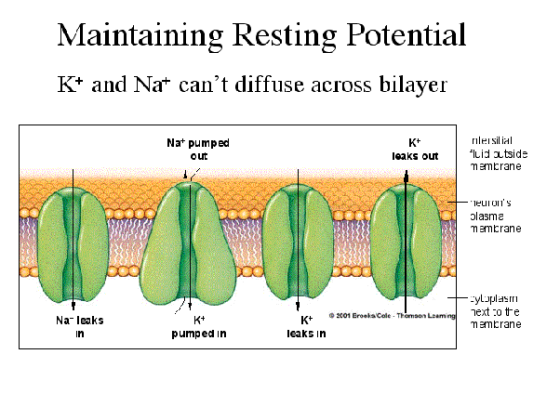
A resting (non-signaling) neuron has a voltage across its membrane called the resting membrane potential, or simply the resting potential.
-
The resting potential is determined by concentration gradients of ions across the membrane and by membrane permeability to each type of ion.
-
The resting membrane potential is determined by the uneven distribution of ions (charged particles) between the inside and the outside of the cell, and by the different permeability of the membrane to different types of ions.
the main excitable cell is the neuron, which
also has the simplest mechanism for the action potential.
Neurons are electrically excitable cells composed,
in general, of one or more dendrites, a single soma, a single axon
and one or more axon terminals.
Neurons are a special type of cell with the sole purpose of transferring information around the body. Neurons are similar to other cells in that they have a cell body with a nucleus and organelles. However, they have a few extra features which allow them to be fantastic at transferring action potentials:
- dendrites: receive signals from neighboring neurons (like a radio antenna)
- axon: transmit signals over a distance (like telephone wires)
- axon terminal: transmit signals to other neuron dendrites or tissues (like a radio transmitter)
- myelin sheath: speeds up signal transmission along the axon.
- Action potentials (those electrical impulses that send signals around your body) are nothing more than a temporary shift (from negative to positive) in the neuron’s membrane potential caused by ions suddenly flowing in and out of the neuron. During the resting state (before an action potential occurs) all of the gated sodium and potassium channels are closed. These gated channels are different from the leakage channels, and only open once an action potential has been triggered. We say these channels are “voltage-gated” because they are open and closed depends on the voltage difference across the cell membrane. Voltage-gated sodium channels have two gates (gate m and gate h), while the potassium channel only has one (gate n).
(7) - 3 Threshold
A graded potential is produced when a ligand
opens a ligand-gated channel in the dendrites, allowing ions to
enter (or exit) the cell. For example, Na+ will
enter the cell and K+ will exit, until they both reach
equilibrium.In principle, graded potentials can
occur in any region of the cell plasma membrane,
however, in neurons, graded potentials occur in
specialized regions of synaptic contact with other cells
(post-synaptic plasma membrane in dendrites or soma), or membrane
regions involved in receiving sensory stimuli.Graded
potentials are changes in membrane potential that vary in
size, as opposed to being all-or-none. They include diverse
potentials such as receptor potentials, electrotonic potentials,
subthreshold membrane potential oscillations, slow-wave potential,
pacemaker potentials, and synaptic potentials, which scale with the
magnitude of the stimulus. They arise from the summation of the
individual actions of ligand-gated ion channel proteins, and
decrease over time and space. They do not typically involve
voltage-gated sodium and potassium channels.
These impulses are incremental and may be excitatory or inhibitory. They occur at the postsynaptic dendrite in response to presynaptic neuron firing and release of neurotransmitter, or may occur in skeletal, smooth, or cardiac muscle in response to nerve input. The magnitude of a graded potential is determined by the strength of the stimulus.
Add Answer to:
5. Draw a diagram of the preganglionic neuron, postganglionic neuron, and effector for both Sympathetic Nervous...
4. Draw a synapse between 2 neurons. Label the following: Presynaptic neuron, Postsynaptic neuron, Synaptic vesicles,...
 4. Draw a synapse between 2 neurons. Label the following: Presynaptic neuron, Postsynaptic neuron, Synaptic vesicles, Voltage-regulated calcium channel, Chemical-regulated sodium channel. 5. Draw a diagram of the preganglionic neuron, postganglionic neuron, and effector for both Sympathetic Nervous System and Parasympathetic Nervous System. indicate which neurotransmitter is released by each neuron and label the receptors at all locations for the neurotransmitter. 6. Which cells have a resting membrane potential? Which cells can have an action potential? 7. Circle which of...
2. Curare blocks acetylcholine receptors at the motor end plate. This would result in: (1) Inability...
 2. Curare blocks acetylcholine receptors at the motor end plate. This would result in: (1) Inability of the muscle fiber to respond to nervous stimulation (2) Increased muscle stimulation (3) Increased actylcholinesterase production (4) Lack of calcium uptake by the muscle fiber 3. The structure that is analogous to the Zline of skeletal muscle is the __ of smooth muscle. The structure that is analogous to troponin of skeletal muscle is _ muscle is ___ of smooth muscle. 4. Draw...
15-23 15) The sympathetic and parasympathetic nervous systems differ A) one has a two-neuron chain from...
 15-23
15) The sympathetic and parasympathetic nervous systems differ A) one has a two-neuron chain from the CNS to the effector organs, while the other has a singe 15) efferent neuron. B) in the body location of their ganglia C) in that the pre-ganglionar neuron of one systen is inside the CNS, while that of the other system is outside the CNS D) one has only myelinated axons, while the other only has unmyelinated axons 16) Collections of nerve cell...
15-23
15) The sympathetic and parasympathetic nervous systems differ A) one has a two-neuron chain from the CNS to the effector organs, while the other has a singe 15) efferent neuron. B) in the body location of their ganglia C) in that the pre-ganglionar neuron of one systen is inside the CNS, while that of the other system is outside the CNS D) one has only myelinated axons, while the other only has unmyelinated axons 16) Collections of nerve cell...
Which of the following is TRUE? A. Acetylcholine is the neurotransmitter released at both sympathetic and...
Which of the following is TRUE? A. Acetylcholine is the neurotransmitter released at both sympathetic and parasympathetic effector cell receptors. B. In the sympathetic nervous pathway, sodium ion channels will be targeted by norepinephrine in the heart. C. In the sympathetic nervous pathway, chloride ion channels will be targeted by norepinephrine in the heart. D. In the parasympathetic nervous pathway, sodium ion channels will be targeted by norepinephrine in the small intestine.
5. Which nerves contain parasympathetic neurons? 6. Which nerves contain sympathetic neurons? 2. What kinds of...
5. Which nerves contain parasympathetic neurons? 6. Which nerves contain sympathetic neurons? 2. What kinds of cells make up the adrenal medulla? 3. What is the entire point of the sympathetic response? 4. Which division of the ANS raises blood sugar and oxygen? 5. Which division of the ANS promote mucus secretion and iris constriction? 6. How can norepinephrine dilate some blood vessels and constrict others? 1. How can imagine a stress state? 2. What does the parasympathetic nervous system...
need help with 1-7 all questions need help with all 1-7 questions Norepinephrine binds to the...
 need help with 1-7 all questions
need help with all 1-7 questions
Norepinephrine binds to the receptors on the heart causing increased heart rate and force of contraction. O ay adrenergic OB3 adrenergic B2 adrenergic OB1 adrenergic O az adrenergic In a reflex arc, which of the following conducts efferent impulses from the integration center to an effector organ? interneuron O sensory neuron synapse O motor neuron O receptor The sympathetic division has: Olong preganglionic fibers and short postganglionic fibers...
need help with 1-7 all questions
need help with all 1-7 questions
Norepinephrine binds to the receptors on the heart causing increased heart rate and force of contraction. O ay adrenergic OB3 adrenergic B2 adrenergic OB1 adrenergic O az adrenergic In a reflex arc, which of the following conducts efferent impulses from the integration center to an effector organ? interneuron O sensory neuron synapse O motor neuron O receptor The sympathetic division has: Olong preganglionic fibers and short postganglionic fibers...
Answer Thi Q. thank You The Nervous System edit) 1. The junction between one neuron and the next, or between a neuron and an effector is called: A) A synapse 8) A dendrite C) A neuotransmiter D )...
 Answer Thi Q. thank You
The Nervous System edit) 1. The junction between one neuron and the next, or between a neuron and an effector is called: A) A synapse 8) A dendrite C) A neuotransmiter D ) A ventricle E) None of the above 2. A fast excitatory synapses follows this order A) (1) neurotransmiter released (2) diftused across the synaptic cleft to a receptor protein (3) binding of the transmitter opens pores in the ion channels and positive...
Answer Thi Q. thank You
The Nervous System edit) 1. The junction between one neuron and the next, or between a neuron and an effector is called: A) A synapse 8) A dendrite C) A neuotransmiter D ) A ventricle E) None of the above 2. A fast excitatory synapses follows this order A) (1) neurotransmiter released (2) diftused across the synaptic cleft to a receptor protein (3) binding of the transmitter opens pores in the ion channels and positive...
hat is the best description of pulmonary blood flow? A) low flow, high pressure C) high flow, low pressure B) low...
 hat is the best description of pulmonary blood flow? A) low flow, high pressure C) high flow, low pressure B) low flow, low pressure D) high flow, high pressure Vhich of the following is the skeletal muscle reflex responsible for preventing excessive tension in the uscle due to overcontraction? A) joint capsule receptors C) Golgi tendon organs B) muscle spindle fibers D) autonomic reflex Vhich of the following stimulates the cells of the adrenal medulla to secrete its excitatory hormones?...
Efer Figure2 to answer questions 18-21: 8. produce the myelin sheaths of neurons in the central F...
 efer Figure2 to answer questions 18-21: 8. produce the myelin sheaths of neurons in the central Figure 2 nervous system. 19 form the Blood Brain Barrier 20._ are responsible for neurotransmitter release. 21 have ligand gated ion channels that are activated by neurotransmitters 22. Functionally, which cellular location is the neuron's "decision- making site" as to whether or not an action potential will be initiated? A axonal membrane B. axon hillock C. dendritic membrane D. presynaptic membrane 23. Calcium and...
8 A reflex are a) is the simplest neural circuit b) requires a receptor, sensory neuron, integration center, motor neuron e) san cause a motor response before a person is consciously aware of it...
 8 A reflex are a) is the simplest neural circuit b) requires a receptor, sensory neuron, integration center, motor neuron e) san cause a motor response before a person is consciously aware of it All the above (a, b and c) are corect 9. The correct distribution of spinal nerves is I coccygeal a) 4 cervical, 16 thoracie, 3 lumbar, 8 sacral and b) 12 cervical, 12 thoracic, 3 lumbar, 8 sacral and I coccyseal c) 8 cervical, 12 thoracic,...
 4. Draw a synapse between 2 neurons. Label the following: Presynaptic neuron, Postsynaptic neuron, Synaptic vesicles, Voltage-regulated calcium channel, Chemical-regulated sodium channel. 5. Draw a diagram of the preganglionic neuron, postganglionic neuron, and effector for both Sympathetic Nervous System and Parasympathetic Nervous System. indicate which neurotransmitter is released by each neuron and label the receptors at all locations for the neurotransmitter. 6. Which cells have a resting membrane potential? Which cells can have an action potential? 7. Circle which of...
 2. Curare blocks acetylcholine receptors at the motor end plate. This would result in: (1) Inability of the muscle fiber to respond to nervous stimulation (2) Increased muscle stimulation (3) Increased actylcholinesterase production (4) Lack of calcium uptake by the muscle fiber 3. The structure that is analogous to the Zline of skeletal muscle is the __ of smooth muscle. The structure that is analogous to troponin of skeletal muscle is _ muscle is ___ of smooth muscle. 4. Draw...
 15-23
15) The sympathetic and parasympathetic nervous systems differ A) one has a two-neuron chain from the CNS to the effector organs, while the other has a singe 15) efferent neuron. B) in the body location of their ganglia C) in that the pre-ganglionar neuron of one systen is inside the CNS, while that of the other system is outside the CNS D) one has only myelinated axons, while the other only has unmyelinated axons 16) Collections of nerve cell...
15-23
15) The sympathetic and parasympathetic nervous systems differ A) one has a two-neuron chain from the CNS to the effector organs, while the other has a singe 15) efferent neuron. B) in the body location of their ganglia C) in that the pre-ganglionar neuron of one systen is inside the CNS, while that of the other system is outside the CNS D) one has only myelinated axons, while the other only has unmyelinated axons 16) Collections of nerve cell...
 need help with 1-7 all questions
need help with all 1-7 questions
Norepinephrine binds to the receptors on the heart causing increased heart rate and force of contraction. O ay adrenergic OB3 adrenergic B2 adrenergic OB1 adrenergic O az adrenergic In a reflex arc, which of the following conducts efferent impulses from the integration center to an effector organ? interneuron O sensory neuron synapse O motor neuron O receptor The sympathetic division has: Olong preganglionic fibers and short postganglionic fibers...
need help with 1-7 all questions
need help with all 1-7 questions
Norepinephrine binds to the receptors on the heart causing increased heart rate and force of contraction. O ay adrenergic OB3 adrenergic B2 adrenergic OB1 adrenergic O az adrenergic In a reflex arc, which of the following conducts efferent impulses from the integration center to an effector organ? interneuron O sensory neuron synapse O motor neuron O receptor The sympathetic division has: Olong preganglionic fibers and short postganglionic fibers...
 Answer Thi Q. thank You
The Nervous System edit) 1. The junction between one neuron and the next, or between a neuron and an effector is called: A) A synapse 8) A dendrite C) A neuotransmiter D ) A ventricle E) None of the above 2. A fast excitatory synapses follows this order A) (1) neurotransmiter released (2) diftused across the synaptic cleft to a receptor protein (3) binding of the transmitter opens pores in the ion channels and positive...
Answer Thi Q. thank You
The Nervous System edit) 1. The junction between one neuron and the next, or between a neuron and an effector is called: A) A synapse 8) A dendrite C) A neuotransmiter D ) A ventricle E) None of the above 2. A fast excitatory synapses follows this order A) (1) neurotransmiter released (2) diftused across the synaptic cleft to a receptor protein (3) binding of the transmitter opens pores in the ion channels and positive...
 hat is the best description of pulmonary blood flow? A) low flow, high pressure C) high flow, low pressure B) low flow, low pressure D) high flow, high pressure Vhich of the following is the skeletal muscle reflex responsible for preventing excessive tension in the uscle due to overcontraction? A) joint capsule receptors C) Golgi tendon organs B) muscle spindle fibers D) autonomic reflex Vhich of the following stimulates the cells of the adrenal medulla to secrete its excitatory hormones?...
 efer Figure2 to answer questions 18-21: 8. produce the myelin sheaths of neurons in the central Figure 2 nervous system. 19 form the Blood Brain Barrier 20._ are responsible for neurotransmitter release. 21 have ligand gated ion channels that are activated by neurotransmitters 22. Functionally, which cellular location is the neuron's "decision- making site" as to whether or not an action potential will be initiated? A axonal membrane B. axon hillock C. dendritic membrane D. presynaptic membrane 23. Calcium and...
 8 A reflex are a) is the simplest neural circuit b) requires a receptor, sensory neuron, integration center, motor neuron e) san cause a motor response before a person is consciously aware of it All the above (a, b and c) are corect 9. The correct distribution of spinal nerves is I coccygeal a) 4 cervical, 16 thoracie, 3 lumbar, 8 sacral and b) 12 cervical, 12 thoracic, 3 lumbar, 8 sacral and I coccyseal c) 8 cervical, 12 thoracic,...
Most questions answered within 3 hours.
-
Where is the error in this code sequence?
String s1 = "Hello";
String s2 = "ello";...
asked 10 months ago -
Financial data for Joel de Paris, Inc., for last year
follow:
Joel de Paris, Inc.
Balance...
asked 10 months ago -
Consider this reaction:
Al2(SO4)3 (aq)+ BaCl3
(aq) Al2Cl6 (aq)- +
3BaSO4(s) . What is the...
asked 10 months ago -
Suppose that Savneet is considering increasing her
recent random sample from 20 car rentals to 40...
asked 10 months ago -
Trucks arrive at an unloading terminal at an average rate of 120
per hour.
Trucks arrive...
asked 10 months ago -
Why are methanol and ethanol completely soluble in water while
octanol is not very little soluble....
asked 10 months ago -
A facilities manager at a university reads in a research report
that the mean amount of...
asked 10 months ago -
When the CuSO4 is rehydrated by adding water to the anhydrous
compound, is this an endothermic...
asked 10 months ago -
A ray of sunlight is passing from diamond into crown glass; the
angle of incidence is...
asked 10 months ago -
A block of mass 0.249 kg is placed on top of a light, vertical
spring of...
asked 10 months ago -
how do the kidneys compensate in the presences of acidosis
a) trigger hyperventilate
b) reserve acid...
asked 10 months ago -
Question 501 pts
The rental rate of capital to the firm increases. Which of the
following...
asked 10 months ago