When protein is used for energy, the amino group is removed and the carbon skeleton id...
When protein is used for energy, the amino group is removed and the carbon skeleton id metabolized for energy. When this happens, what is present in the urine?
Homework Answers
Amino acid catabolism results in removal of amino group and usage of carbon skeleton for energy. The nitrogen of the amino groups cannot be used for the production of energy and is removed from the body in the form of urea. The amino nitrogen is converted to urea and excreted in the urine.
Add Answer to:
When protein is used for energy, the amino group is removed and
the carbon skeleton id...
7. What will happen to the carbon skeleton of the deaminated amino acids when excessive protein...
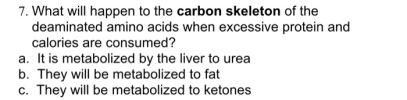 7. What will happen to the carbon skeleton of the deaminated amino acids when excessive protein and calories are consumed? a. It is metabolized by the liver to urea b. They will be metabolized to fat c. They will be metabolized to ketones
“Amino acids used in making a polypeptide have an amino group and carboxyl group, and these...
“Amino acids used in making a polypeptide have an amino group and carboxyl group, and these groups can be present on any carbon atoms.” Is that a correct statement? Why so? What is the basis for classification of amino acids to non-polar (but not aromatic), polar, and two oppositely charged (at physiological pH) amino acids? Provide examples with their exact name, three letter and single letter codes.
1. During the aerobic metabolism of glucose, glucose is a. Reduced to form water b. Oxidized...
 1. During the aerobic metabolism of glucose, glucose is a. Reduced to form water b. Oxidized to form water c. Reduced to form CO2 d. Oxidized to form CO2 2. Which of the following describes the equation: FAD + XH à FADH2 + X. a. FAD is reduced to FADH2 b. It is a coupled reduction - oxidation reaction c. XH, is oxidized to X d. All of the above 3. Which of the following is FALSE about glycolysis? a....
A) Draw a skeleton structure of a molecule with 3 carbon atoms, containing a aldehyde group....
A) Draw a skeleton structure of a molecule with 3 carbon atoms, containing a aldehyde group. B) What is the geometry of the aldehyde carbon? C) Draw two isomers of the structure, at least one which has no pi bonds
State what happens to most of the absorbed amino acids when a high-protein meal is ingested
State what happens to most of the absorbed amino acids when a high-protein meal is ingested
Which of the following is used to measure protein quality? 1.the amount of essential amino acids...
Which of the following is used to measure protein quality? 1.the amount of essential amino acids present and the protein efficiency ratio 2.the protein chemical score and digestibility 3.the digestibility of the protein and the amount of essential amino acids 4.the protein-efficiency ratio and the digestibility of the protein
1. When amino acids are degraded the first step is to remove the amino group. To...
1. When amino acids are degraded the first step is to remove the amino group. To which of the following molecules is the amino group typically transferred? A. Pyruvate B. Oxaloacetate C. Fumarate D. Alpha-ketoglutarate 2. Most amino acid degradation takes place in the ... A. Adipose B. Muscle C. Liver D. Epithelium 3. Urea contains two nitrogen atoms. What is the source of these two nitrogen atoms? A. Both from NH4+ B. NH4+ and aspartate C. NH4+ and serine...
When you drink a cup of milk, what happens to the protein in the milk after...
 When you drink a cup of milk, what happens to the
protein in the milk after it has been swallowed? To describe these
processes, you must be able to use the vocabulary
effectively.
FILL IN THE BLANKS
tripeptide is the active form of a digestive enzyme in the stomach that breaks polypeptide chains into smaller acid group polypeptides. dipeptide 2. Cleavage of proteins by pepsin in the stomach results in formation of which get broken down amino acids further in...
When you drink a cup of milk, what happens to the
protein in the milk after it has been swallowed? To describe these
processes, you must be able to use the vocabulary
effectively.
FILL IN THE BLANKS
tripeptide is the active form of a digestive enzyme in the stomach that breaks polypeptide chains into smaller acid group polypeptides. dipeptide 2. Cleavage of proteins by pepsin in the stomach results in formation of which get broken down amino acids further in...
If an essential amino acid is missing, the protein strand will _____. a. be completed with...
If an essential amino acid is missing, the protein strand will _____. a. be completed with substitute essential amino acids b. halt production until an essential amino acid is available c. break down and return the surplus amino acids to the bloodstream d. use nonessential amino acids instead e. use the shorter strands to make up the protein Which statement about dietary protein is accurate? a. It should supply the nonessential amino acids. b. When food energy is limited, dietary...
Lecture 3 Identify amino-/carboxy termini, and R-group on amino acid What is chirality? Identify a carbon...
 Lecture 3 Identify amino-/carboxy termini, and R-group on amino acid What is chirality? Identify a carbon that is chiral (i.e., has 4 different groups attached) Chiral compounds rotate plane polarized light Memorize amino acid 1) structure, 2) classification (hydrophobic, aliphatic, aromatic, negatively charged, positively charged, polar uncharged) Be able to draw glycine (the generic amino acid) Given an amino acid structure and pKas of ionizable groups, be able to determine the charge at pH 1, pH 14, and pH 7...
 7. What will happen to the carbon skeleton of the deaminated amino acids when excessive protein and calories are consumed? a. It is metabolized by the liver to urea b. They will be metabolized to fat c. They will be metabolized to ketones
 1. During the aerobic metabolism of glucose, glucose is a. Reduced to form water b. Oxidized to form water c. Reduced to form CO2 d. Oxidized to form CO2 2. Which of the following describes the equation: FAD + XH à FADH2 + X. a. FAD is reduced to FADH2 b. It is a coupled reduction - oxidation reaction c. XH, is oxidized to X d. All of the above 3. Which of the following is FALSE about glycolysis? a....
 When you drink a cup of milk, what happens to the
protein in the milk after it has been swallowed? To describe these
processes, you must be able to use the vocabulary
effectively.
FILL IN THE BLANKS
tripeptide is the active form of a digestive enzyme in the stomach that breaks polypeptide chains into smaller acid group polypeptides. dipeptide 2. Cleavage of proteins by pepsin in the stomach results in formation of which get broken down amino acids further in...
When you drink a cup of milk, what happens to the
protein in the milk after it has been swallowed? To describe these
processes, you must be able to use the vocabulary
effectively.
FILL IN THE BLANKS
tripeptide is the active form of a digestive enzyme in the stomach that breaks polypeptide chains into smaller acid group polypeptides. dipeptide 2. Cleavage of proteins by pepsin in the stomach results in formation of which get broken down amino acids further in...
 Lecture 3 Identify amino-/carboxy termini, and R-group on amino acid What is chirality? Identify a carbon that is chiral (i.e., has 4 different groups attached) Chiral compounds rotate plane polarized light Memorize amino acid 1) structure, 2) classification (hydrophobic, aliphatic, aromatic, negatively charged, positively charged, polar uncharged) Be able to draw glycine (the generic amino acid) Given an amino acid structure and pKas of ionizable groups, be able to determine the charge at pH 1, pH 14, and pH 7...
Most questions answered within 3 hours.
-
Where is the error in this code sequence?
String s1 = "Hello";
String s2 = "ello";...
asked 10 months ago -
Financial data for Joel de Paris, Inc., for last year
follow:
Joel de Paris, Inc.
Balance...
asked 10 months ago -
Consider this reaction:
Al2(SO4)3 (aq)+ BaCl3
(aq) Al2Cl6 (aq)- +
3BaSO4(s) . What is the...
asked 10 months ago -
Suppose that Savneet is considering increasing her
recent random sample from 20 car rentals to 40...
asked 10 months ago -
Trucks arrive at an unloading terminal at an average rate of 120
per hour.
Trucks arrive...
asked 10 months ago -
Why are methanol and ethanol completely soluble in water while
octanol is not very little soluble....
asked 10 months ago -
A facilities manager at a university reads in a research report
that the mean amount of...
asked 10 months ago -
When the CuSO4 is rehydrated by adding water to the anhydrous
compound, is this an endothermic...
asked 10 months ago -
A ray of sunlight is passing from diamond into crown glass; the
angle of incidence is...
asked 10 months ago -
A block of mass 0.249 kg is placed on top of a light, vertical
spring of...
asked 10 months ago -
how do the kidneys compensate in the presences of acidosis
a) trigger hyperventilate
b) reserve acid...
asked 10 months ago -
Question 501 pts
The rental rate of capital to the firm increases. Which of the
following...
asked 10 months ago