
Homework Answers
The answer is option 3) Parasitism. In this relationship the organism which get the benefits is called parasite and the one who suffers is called host. For example, Tapeworms ( parasite ) and human ( host ), lice ( parasite ) and human ( host ).
Symbiosis is defined as when two organisms live together but are
not necessarily beneficial to each other but in mutualism, both
organisms that live together and both gets benefits from each
other.
Competition is termed as the struggle for living by
two organisms by using the same resources. Where as predation is
defined as when one organisms hunts the other organism for food and
survival. Here the one which hunts the other is termed as predator
and the other being hunted is termed as prey.
Add Answer to:
Two organism that live together and A benefits from the B but the B one suffers...
Symbiosis is: A close, long-term rendtion Shiamong two or more species that live and interact together...
 Symbiosis is: A close, long-term rendtion Shiamong two or more species that live and interact together There are 3 types of Symbiotic Relationships: 1) MOHOU SMA special type of relationship in which one organism feeds on and lives in or on another organism. Thus, the parasite_ _ and the host organism is 2) COMMU - A relationship in which both members _, but the other 3) Parasitism → A relationship in which one member organism neither benefits nor is harmed......
Fungi symbioses with other organisms range from predation to mutualisms, and include benefits to humans, and...
 Fungi symbioses with other organisms range from predation to mutualisms, and include benefits to humans, and disease predation parasitism commensalism mutualism human uses Mycoses (disease) Assign each example below to a category of relationship type in the table above. Also identify the type of organism that is in the relationship with the fungus, if it is not already noted. Saccaromyces cervisioe Ringworm Consumption of carbon compounds in industrial wastes Biofuel production Mycorrhizae (what are the 2 categories of this type?...
1. The greenhouse effect is due to high atmospheric A. Nitrogen B. Ammonia C. Carbon monoxide...
1. The greenhouse effect is due to high atmospheric A. Nitrogen B. Ammonia C. Carbon monoxide D. Carbon dioxide E. Oxygen 2. Evolution occurs at the level of A. individuals B. populations C. communities 3.Two species which coevolve is A. competition B. a community C. an ecosystem D. predation E. symbiosis 4. What is a population? A. members of a species that live in a given area B. all of the organisms that live in a given area C. the...
1.Please read about these biotic interactions in your textbook. Then please show which species benefits (by...
 1.Please read about these biotic interactions in your textbook. Then please show which species benefits (by drawing a + in the correct row) or incurs costs (indicate with a ) from each of these interactions. (4 pts) Species 1 Species 2 interaction predation (both carnivory & herbivory) parasitism mutualism competition 2. Scientific writing differs from other forms of writing in that scientific wrfting must be concise, clear, & complete (the 3 C's). Remember that hypotheses must be testable, tentative, logical...
31. Which of the following is NOT an anti-predator defense mechanism? A. Plant chemicals, including coffee...
31. Which of the following is NOT an anti-predator defense mechanism? A. Plant chemicals, including coffee and tea caffeine, make caterpillars sick or jittery. B. The large eyespots on a moth's wing are exposed abruptly to startle a hungry bird. C. Many trees, vines, and shrubs have stems lines with long thorns. D. Many plants have brightly colored fruit and flowers. 32. An intimate relationship between two different species is called A. competition. B. a community. C. an ecosystem.D. symbiosis....
asap Chapter 08 Social Relations: 1-26 1. Fitness is defined as the A. health of an...
 asap
Chapter 08 Social Relations: 1-26 1. Fitness is defined as the A. health of an individual organism. B. ability of an organism to adap C. quality of offspring produced. D. number of genes contri an organism to adapt to new environmental situations. of genes contributed by an individual to the next generation. 2. Secondary sexual ondary sexual characteristics are often considered a handicap because of increased A. predation. B. competition C. parasitism. D. infertility. 3. In any animal, the...
asap
Chapter 08 Social Relations: 1-26 1. Fitness is defined as the A. health of an individual organism. B. ability of an organism to adap C. quality of offspring produced. D. number of genes contri an organism to adapt to new environmental situations. of genes contributed by an individual to the next generation. 2. Secondary sexual ondary sexual characteristics are often considered a handicap because of increased A. predation. B. competition C. parasitism. D. infertility. 3. In any animal, the...
38. Which gas is increasing in the atmosphere and threatening the world with an enhanced greenhouse...
 38. Which gas is increasing in the atmosphere and threatening the world with an enhanced greenhouse effect? a. nitrogen b. carbon dioxide c. neon d. fluorocarbons 39. The role an organism plays in the community of an ecosystem that can be described in terms of space, food, temperature, moisture, etc., is called its: a. niche b. microhabitat c. community d. habitat 40. A one-way relationship in which one species benefits at the expense of another is: a. commensalism b. symbiosis...
QUESTION 2 Transcription differ from translation in that transcription reads off other RNA strands to make...
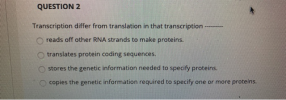 QUESTION 2 Transcription differ from translation in that transcription reads off other RNA strands to make proteins. translates protein coding sequences. stores the genetic information needed to specify proteins. copies the genetic information required to specify one or more proteins. QUESTION 3 Biofilms and mixed infections are examples of Synergism Mutualism Parasitism Commensalism QUESTION 4 Which of the following is/are TRUE? Select all TRUE statements. In mutualism species 1 benefits while species 2 is not affected. Chemoautotrophs get energy from...
3. Two species changing forms or resource use only where they occur together? Select one: O...
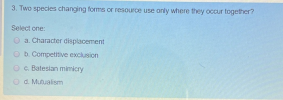 3. Two species changing forms or resource use only where they occur together? Select one: O a. Character displacement b. Competitive exclusion c. Batesian mimicry d. Mutualism
QUESTION 1 Use the the sequence to answer the question below. 5- GGCGAUAUGGCGGUUUCGGGCCGGUGAAAUUGCCA-3' Based on the...
 QUESTION 1 Use the the sequence to answer the question below. 5- GGCGAUAUGGCGGUUUCGGGCCGGUGAAAUUGCCA-3' Based on the sequence above, select all TRUE statements. The antisense or complementary sequence would begin as given below.. s' CCGCUA.... 3 There are 11 codons. This sequence is in the right orientation or direction. There are 33 bases + This is a DNA sequence.. This sequence would code for 6 amino acids There is one stop codon. QUESTION 2 Transcription differ from translation in that transcription...
 Symbiosis is: A close, long-term rendtion Shiamong two or more species that live and interact together There are 3 types of Symbiotic Relationships: 1) MOHOU SMA special type of relationship in which one organism feeds on and lives in or on another organism. Thus, the parasite_ _ and the host organism is 2) COMMU - A relationship in which both members _, but the other 3) Parasitism → A relationship in which one member organism neither benefits nor is harmed......
 Fungi symbioses with other organisms range from predation to mutualisms, and include benefits to humans, and disease predation parasitism commensalism mutualism human uses Mycoses (disease) Assign each example below to a category of relationship type in the table above. Also identify the type of organism that is in the relationship with the fungus, if it is not already noted. Saccaromyces cervisioe Ringworm Consumption of carbon compounds in industrial wastes Biofuel production Mycorrhizae (what are the 2 categories of this type?...
 1.Please read about these biotic interactions in your textbook. Then please show which species benefits (by drawing a + in the correct row) or incurs costs (indicate with a ) from each of these interactions. (4 pts) Species 1 Species 2 interaction predation (both carnivory & herbivory) parasitism mutualism competition 2. Scientific writing differs from other forms of writing in that scientific wrfting must be concise, clear, & complete (the 3 C's). Remember that hypotheses must be testable, tentative, logical...
 asap
Chapter 08 Social Relations: 1-26 1. Fitness is defined as the A. health of an individual organism. B. ability of an organism to adap C. quality of offspring produced. D. number of genes contri an organism to adapt to new environmental situations. of genes contributed by an individual to the next generation. 2. Secondary sexual ondary sexual characteristics are often considered a handicap because of increased A. predation. B. competition C. parasitism. D. infertility. 3. In any animal, the...
asap
Chapter 08 Social Relations: 1-26 1. Fitness is defined as the A. health of an individual organism. B. ability of an organism to adap C. quality of offspring produced. D. number of genes contri an organism to adapt to new environmental situations. of genes contributed by an individual to the next generation. 2. Secondary sexual ondary sexual characteristics are often considered a handicap because of increased A. predation. B. competition C. parasitism. D. infertility. 3. In any animal, the...
 38. Which gas is increasing in the atmosphere and threatening the world with an enhanced greenhouse effect? a. nitrogen b. carbon dioxide c. neon d. fluorocarbons 39. The role an organism plays in the community of an ecosystem that can be described in terms of space, food, temperature, moisture, etc., is called its: a. niche b. microhabitat c. community d. habitat 40. A one-way relationship in which one species benefits at the expense of another is: a. commensalism b. symbiosis...
 QUESTION 2 Transcription differ from translation in that transcription reads off other RNA strands to make proteins. translates protein coding sequences. stores the genetic information needed to specify proteins. copies the genetic information required to specify one or more proteins. QUESTION 3 Biofilms and mixed infections are examples of Synergism Mutualism Parasitism Commensalism QUESTION 4 Which of the following is/are TRUE? Select all TRUE statements. In mutualism species 1 benefits while species 2 is not affected. Chemoautotrophs get energy from...
 3. Two species changing forms or resource use only where they occur together? Select one: O a. Character displacement b. Competitive exclusion c. Batesian mimicry d. Mutualism
 QUESTION 1 Use the the sequence to answer the question below. 5- GGCGAUAUGGCGGUUUCGGGCCGGUGAAAUUGCCA-3' Based on the sequence above, select all TRUE statements. The antisense or complementary sequence would begin as given below.. s' CCGCUA.... 3 There are 11 codons. This sequence is in the right orientation or direction. There are 33 bases + This is a DNA sequence.. This sequence would code for 6 amino acids There is one stop codon. QUESTION 2 Transcription differ from translation in that transcription...
Most questions answered within 3 hours.
-
Where is the error in this code sequence?
String s1 = "Hello";
String s2 = "ello";...
asked 11 months ago -
Financial data for Joel de Paris, Inc., for last year
follow:
Joel de Paris, Inc.
Balance...
asked 11 months ago -
Consider this reaction:
Al2(SO4)3 (aq)+ BaCl3
(aq) Al2Cl6 (aq)- +
3BaSO4(s) . What is the...
asked 11 months ago -
Suppose that Savneet is considering increasing her
recent random sample from 20 car rentals to 40...
asked 11 months ago -
Trucks arrive at an unloading terminal at an average rate of 120
per hour.
Trucks arrive...
asked 11 months ago -
Why are methanol and ethanol completely soluble in water while
octanol is not very little soluble....
asked 11 months ago -
A facilities manager at a university reads in a research report
that the mean amount of...
asked 11 months ago -
When the CuSO4 is rehydrated by adding water to the anhydrous
compound, is this an endothermic...
asked 11 months ago -
A ray of sunlight is passing from diamond into crown glass; the
angle of incidence is...
asked 11 months ago -
A block of mass 0.249 kg is placed on top of a light, vertical
spring of...
asked 11 months ago -
how do the kidneys compensate in the presences of acidosis
a) trigger hyperventilate
b) reserve acid...
asked 11 months ago -
Question 501 pts
The rental rate of capital to the firm increases. Which of the
following...
asked 11 months ago