


Homework Answers
12. Small amount of ATP is gained by Glucose in Glycolysis.
The net gain of Glycolysis 2 molecules of pyruvate, 2 molecules of ATP and 2 NADH molecules. The net gain is produced to cells for energy.
But the total energy gained by the complete breakdown of the glucose molecule by glycolysis formation 2 molecules of Acetyl coA and their catabolism by citricacid cycle following oxidative phosphorylation producing a net gain 30 molecules of ATP in eukaryotes..
13. Protons are pumped into intermembrane space during oxidative phosphorylation.
As oxygen is very important to present in the cells in this case oxygen molecule is used in the oxidative phosphorylation which is the last step of cellular respiration.
Oxidative phosphorylation is made up of two components 1.Electron transport chain and 2. Chemiosmosis.
In Electron transport chain the electrons are passed from one molecule to another to produce an electrochemical gradient by the energy released by this electron transfers.
So, now role of oxygen comes at the end of the ETC(Electron Transport Chain), where it accepts electrons and picks the protons to form water molecule. If there is no oxygen to accept electrons we cannot produce ATP through Chemiosmosis which is used by most of the metabolic processes to function.
ETC:
It is a collection of membrane embedded proteins and organic molecules where most of them are organized in the complexes labelled I to IV and many copies of them are found in the inner mitochondrial membrane in eukaryotes and in prokaryotes ETC is found in plasma membrane.
So, in ETC the electrons travel through the chain from high energy level (less electron deficient places) to low energy levels (more electron deficient places). So, the energy released from these electron transfers are used by these complexes to pump the protons into the intermembrane space from mitochondrial matrix forming a proton gradient.
NOTE: Electron donors in the ETC are NADH and FADH2 which are produced from glycolysis, Citric acid cycle and other metabolic processes.
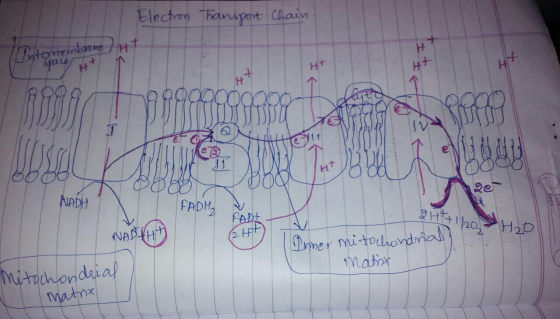
In Chemiosmosis the stored energy is used to produce ATP. The protons in the ETC are used in Chemiosmosis.
Add Answer to:
please give the exact answer
the question is
Small quantities of ATP are made from ____...
Incorrect Question 12 0/1 pts Small quantities of ATP are made from-_in__ Answer 1: Answer 2:...
 Incorrect Question 12 0/1 pts Small quantities of ATP are made from-_in__ Answer 1: Answer 2: Incorrect o Question 13 rtion 13 0/1 pts Which event takes place during oxidative phosphorylation? - Protons are pumped into the intermembrane space • NAD+ and FAD are reduced Water is consumed to drive the roatlans MacBook Air
MULTIPLE CHOICE. Choose the one alternative that best completes the statement or answers the question. Metabolism...
 MULTIPLE CHOICE. Choose the one alternative that best completes the statement or answers the question. Metabolism and Cellular Respiration Refer to Figure below as a guide to answer the folloaing questions Acetyt CoA Oxaloacetic acid CoA NADH Citric acid NAD Isocitric acid Malic acid Fumaric acid NAD co NADH -FADH FAD+ a-Ketoglutaric acid Succinic acid CO2NAD ATP Succinyl CoA ADP P NADH Figure above. Starting with citric acid and ending with oxaloacetic acid, how many ATP 6) Refer to molecules...
QUESTION 1 Which of the following options lists the stages in cellular respiration in the correct...
 QUESTION 1 Which of the following options lists the stages in cellular respiration in the correct order? A. glycolysis, oxidative phosphorylation, pyruvate oxidation, and the citric acid cycle B glycolysis, pyruvate oxidation, the citric acid cycle, and oxidative phosphorylation C. pyruvate oxidation, oxidative phosphorylation, glycolysis, and the citric acid cycle D. the citric acid cycle, oxidative phosphorylation, pyruvate oxidation, and glycolysis QUESTION 2 When a glucose molecule loses a hydrogen atom as the result of an oxidation-reduction reaction, the glucose...
PLEASE ANSWER ALL PARTS. THANK YOU! 10. (12 pts) During cellular respiration the energy from oxidizing...
 PLEASE ANSWER ALL PARTS. THANK YOU!
10. (12 pts) During cellular respiration the energy from oxidizing glucose to CO2 is used to synthesize ATP. NADH is an important intermediate that feeds electrons into the electron chain. A. (6 pts) Write down the net chemical equations (reactants products) that generate NADH in the citric acid cycle. Make sure to also name the enzymes that catalyze each individual reaction. B. (2 pts) All the dehydrogenases of glycolysis and the citric acid cycle...
PLEASE ANSWER ALL PARTS. THANK YOU!
10. (12 pts) During cellular respiration the energy from oxidizing glucose to CO2 is used to synthesize ATP. NADH is an important intermediate that feeds electrons into the electron chain. A. (6 pts) Write down the net chemical equations (reactants products) that generate NADH in the citric acid cycle. Make sure to also name the enzymes that catalyze each individual reaction. B. (2 pts) All the dehydrogenases of glycolysis and the citric acid cycle...
D Question 19 2 pts Which of the following statements best describes the primary role played...
 D Question 19 2 pts Which of the following statements best describes the primary role played by oxygen in cellular respiration? It yields energy in the form of ATP as it is passed down the electron transport chain. It serves as an acceptor for carbon, forming CO2 in the citric acid cycle. It oxidizes glucose to form two molecules of pyruvate. It serves as the final acceptor for electrons from the electron transport chain. Question 20 2 pts Which of...
please answer question 1,2,3,4,5. (1) How is ATP made during glycolysis? (2) How is ATP made...
 please answer question 1,2,3,4,5.
(1) How is ATP made during glycolysis? (2) How is ATP made during the electron transport chain/oxidative phosphorylation? (3) What is the role of FADH2 during respiration? (4) What is the role of a proton gradient during oxidative phosphorylation? (5) Which is the role of oxygen during oxidative phosphorylation?
please answer question 1,2,3,4,5.
(1) How is ATP made during glycolysis? (2) How is ATP made during the electron transport chain/oxidative phosphorylation? (3) What is the role of FADH2 during respiration? (4) What is the role of a proton gradient during oxidative phosphorylation? (5) Which is the role of oxygen during oxidative phosphorylation?
QUESTION 1 Which of the following processes/pathways CANNOT occur in the absence of O2? Oxidative phosphorylation...
QUESTION 1 Which of the following processes/pathways CANNOT occur in the absence of O2? Oxidative phosphorylation Substrate level phosphorylation Oxidation of NADH Photosynthesis Fermentation 1 points QUESTION 2 Phosphofructokinase (PFK-1) is one of the most regulated enzymes in metabolism. Which of the following would be expected to be an allosteric inhibitor of PFK-1? Glucose Fructose-6-phosphate Acetyl CoA AMP 1 points QUESTION 3 Which of the following is a reactant of the first reaction of glycolysis? Glucose ADP ATP...
4. Referring to the preceding question, how and why does the net yield of ATP molecules...
 4. Referring to the preceding
question, how and why does the net yield of ATP molecules differ in
mammalian muscle cells? Be specific.
3. Complete Table 2 to account for the net yield of ATP molecules produced from the oxidation of one glucose molecule in mammalian liver cells. (12 points) TABLE 2 Pathway # ATP #NADH #ATP made in ox-phos by this pathway's NADH #FADH2 # ATP made in ox-phos by this pathway's FADH Glycolysis Transition Reaction Citric Acid Cycle...
4. Referring to the preceding
question, how and why does the net yield of ATP molecules differ in
mammalian muscle cells? Be specific.
3. Complete Table 2 to account for the net yield of ATP molecules produced from the oxidation of one glucose molecule in mammalian liver cells. (12 points) TABLE 2 Pathway # ATP #NADH #ATP made in ox-phos by this pathway's NADH #FADH2 # ATP made in ox-phos by this pathway's FADH Glycolysis Transition Reaction Citric Acid Cycle...
Please help with A-O 7.) (15 pts) What is the net yield of ATP when each...
 Please help with A-O
7.) (15 pts) What is the net yield of ATP when each of the following substrates is completely oxidized to CO2 via glycolysis, the citric acid cycle electron transport and oxidative phosphorylation using the malate aspartate shuttle? (a) pyruvate (b) lactate (c) galactose (d) glycerol (e) fructose (f) dihydroxyacetone (g) glucose 1-P (h) acetyl COA (i) nonreducing end of glycogen () (1,6) branch point of glycogen (k) sucrose (1) lactose (m) mannose (n) glyceraldehyde (0) Dihydroxyacetone...
Please help with A-O
7.) (15 pts) What is the net yield of ATP when each of the following substrates is completely oxidized to CO2 via glycolysis, the citric acid cycle electron transport and oxidative phosphorylation using the malate aspartate shuttle? (a) pyruvate (b) lactate (c) galactose (d) glycerol (e) fructose (f) dihydroxyacetone (g) glucose 1-P (h) acetyl COA (i) nonreducing end of glycogen () (1,6) branch point of glycogen (k) sucrose (1) lactose (m) mannose (n) glyceraldehyde (0) Dihydroxyacetone...
ULUDUL L avendetide Question What biochemical pathway involves the reduction of both FAD and NAD* in...
 ULUDUL L avendetide Question What biochemical pathway involves the reduction of both FAD and NAD* in the same process allowing their reduced forms to donate electrons to the electron transport chain? Select the correct answer below: O the urea cycle O oxidative phosphorylation O the citric acid cycle O fatty acid activation
 Incorrect Question 12 0/1 pts Small quantities of ATP are made from-_in__ Answer 1: Answer 2: Incorrect o Question 13 rtion 13 0/1 pts Which event takes place during oxidative phosphorylation? - Protons are pumped into the intermembrane space • NAD+ and FAD are reduced Water is consumed to drive the roatlans MacBook Air
 MULTIPLE CHOICE. Choose the one alternative that best completes the statement or answers the question. Metabolism and Cellular Respiration Refer to Figure below as a guide to answer the folloaing questions Acetyt CoA Oxaloacetic acid CoA NADH Citric acid NAD Isocitric acid Malic acid Fumaric acid NAD co NADH -FADH FAD+ a-Ketoglutaric acid Succinic acid CO2NAD ATP Succinyl CoA ADP P NADH Figure above. Starting with citric acid and ending with oxaloacetic acid, how many ATP 6) Refer to molecules...
 QUESTION 1 Which of the following options lists the stages in cellular respiration in the correct order? A. glycolysis, oxidative phosphorylation, pyruvate oxidation, and the citric acid cycle B glycolysis, pyruvate oxidation, the citric acid cycle, and oxidative phosphorylation C. pyruvate oxidation, oxidative phosphorylation, glycolysis, and the citric acid cycle D. the citric acid cycle, oxidative phosphorylation, pyruvate oxidation, and glycolysis QUESTION 2 When a glucose molecule loses a hydrogen atom as the result of an oxidation-reduction reaction, the glucose...
 PLEASE ANSWER ALL PARTS. THANK YOU!
10. (12 pts) During cellular respiration the energy from oxidizing glucose to CO2 is used to synthesize ATP. NADH is an important intermediate that feeds electrons into the electron chain. A. (6 pts) Write down the net chemical equations (reactants products) that generate NADH in the citric acid cycle. Make sure to also name the enzymes that catalyze each individual reaction. B. (2 pts) All the dehydrogenases of glycolysis and the citric acid cycle...
PLEASE ANSWER ALL PARTS. THANK YOU!
10. (12 pts) During cellular respiration the energy from oxidizing glucose to CO2 is used to synthesize ATP. NADH is an important intermediate that feeds electrons into the electron chain. A. (6 pts) Write down the net chemical equations (reactants products) that generate NADH in the citric acid cycle. Make sure to also name the enzymes that catalyze each individual reaction. B. (2 pts) All the dehydrogenases of glycolysis and the citric acid cycle...
 D Question 19 2 pts Which of the following statements best describes the primary role played by oxygen in cellular respiration? It yields energy in the form of ATP as it is passed down the electron transport chain. It serves as an acceptor for carbon, forming CO2 in the citric acid cycle. It oxidizes glucose to form two molecules of pyruvate. It serves as the final acceptor for electrons from the electron transport chain. Question 20 2 pts Which of...
 please answer question 1,2,3,4,5.
(1) How is ATP made during glycolysis? (2) How is ATP made during the electron transport chain/oxidative phosphorylation? (3) What is the role of FADH2 during respiration? (4) What is the role of a proton gradient during oxidative phosphorylation? (5) Which is the role of oxygen during oxidative phosphorylation?
please answer question 1,2,3,4,5.
(1) How is ATP made during glycolysis? (2) How is ATP made during the electron transport chain/oxidative phosphorylation? (3) What is the role of FADH2 during respiration? (4) What is the role of a proton gradient during oxidative phosphorylation? (5) Which is the role of oxygen during oxidative phosphorylation?
 4. Referring to the preceding
question, how and why does the net yield of ATP molecules differ in
mammalian muscle cells? Be specific.
3. Complete Table 2 to account for the net yield of ATP molecules produced from the oxidation of one glucose molecule in mammalian liver cells. (12 points) TABLE 2 Pathway # ATP #NADH #ATP made in ox-phos by this pathway's NADH #FADH2 # ATP made in ox-phos by this pathway's FADH Glycolysis Transition Reaction Citric Acid Cycle...
4. Referring to the preceding
question, how and why does the net yield of ATP molecules differ in
mammalian muscle cells? Be specific.
3. Complete Table 2 to account for the net yield of ATP molecules produced from the oxidation of one glucose molecule in mammalian liver cells. (12 points) TABLE 2 Pathway # ATP #NADH #ATP made in ox-phos by this pathway's NADH #FADH2 # ATP made in ox-phos by this pathway's FADH Glycolysis Transition Reaction Citric Acid Cycle...
 Please help with A-O
7.) (15 pts) What is the net yield of ATP when each of the following substrates is completely oxidized to CO2 via glycolysis, the citric acid cycle electron transport and oxidative phosphorylation using the malate aspartate shuttle? (a) pyruvate (b) lactate (c) galactose (d) glycerol (e) fructose (f) dihydroxyacetone (g) glucose 1-P (h) acetyl COA (i) nonreducing end of glycogen () (1,6) branch point of glycogen (k) sucrose (1) lactose (m) mannose (n) glyceraldehyde (0) Dihydroxyacetone...
Please help with A-O
7.) (15 pts) What is the net yield of ATP when each of the following substrates is completely oxidized to CO2 via glycolysis, the citric acid cycle electron transport and oxidative phosphorylation using the malate aspartate shuttle? (a) pyruvate (b) lactate (c) galactose (d) glycerol (e) fructose (f) dihydroxyacetone (g) glucose 1-P (h) acetyl COA (i) nonreducing end of glycogen () (1,6) branch point of glycogen (k) sucrose (1) lactose (m) mannose (n) glyceraldehyde (0) Dihydroxyacetone...
 ULUDUL L avendetide Question What biochemical pathway involves the reduction of both FAD and NAD* in the same process allowing their reduced forms to donate electrons to the electron transport chain? Select the correct answer below: O the urea cycle O oxidative phosphorylation O the citric acid cycle O fatty acid activation
Most questions answered within 3 hours.
-
Where is the error in this code sequence?
String s1 = "Hello";
String s2 = "ello";...
asked 1 year ago -
Financial data for Joel de Paris, Inc., for last year
follow:
Joel de Paris, Inc.
Balance...
asked 1 year ago -
Consider this reaction:
Al2(SO4)3 (aq)+ BaCl3
(aq) Al2Cl6 (aq)- +
3BaSO4(s) . What is the...
asked 1 year ago -
Suppose that Savneet is considering increasing her
recent random sample from 20 car rentals to 40...
asked 1 year ago -
Trucks arrive at an unloading terminal at an average rate of 120
per hour.
Trucks arrive...
asked 1 year ago -
Why are methanol and ethanol completely soluble in water while
octanol is not very little soluble....
asked 1 year ago -
A facilities manager at a university reads in a research report
that the mean amount of...
asked 1 year ago -
When the CuSO4 is rehydrated by adding water to the anhydrous
compound, is this an endothermic...
asked 1 year ago -
A ray of sunlight is passing from diamond into crown glass; the
angle of incidence is...
asked 1 year ago -
A block of mass 0.249 kg is placed on top of a light, vertical
spring of...
asked 1 year ago -
how do the kidneys compensate in the presences of acidosis
a) trigger hyperventilate
b) reserve acid...
asked 1 year ago -
Question 501 pts
The rental rate of capital to the firm increases. Which of the
following...
asked 1 year ago