

Homework Answers
Request Answer!
We need at least 10 more requests to produce the answer.
0 / 10 have requested this problem solution
The more requests, the faster the answer.
Add Answer to:
A. You are studying a strain of bacteria that carries a temperature-sensitive mutation in one of...
To study DNA replication, researchers often use bacteria that harbor a temperature sensitive mutation in one...
 To study DNA replication, researchers often use bacteria that harbor a temperature sensitive mutation in one of the genes related to replication. This means that when cells are grown at lower temperatures (30°C) they are fine, but when shifted to 42°C the effect of the mutation becomes evident and that protein is no longer functional. Depending on the gene mutated, researchers observe that for some replication stops almost immediately, but for others more slowly. In this question you have a...
You are a scientist studying DNA replication. You have the ability to introduce temperature-sensitive mutations into...
You are a scientist studying DNA replication. You have the ability to introduce temperature-sensitive mutations into the bacteria that you are studying (temperature-sensitive mutations work normally at one temperature, but when you raise the temperature a little, the mutation exerts its effect. This allows you to grow colonies with mutations that would otherwise be lethal. The fact that these mutations are temperature sensitive has nothing to do with the problem, other than to make it accurate to how these would...
You are studying a mutant strain of bacteria in which the trp operon includes a mutation...
 You are studying a mutant strain of bacteria in which the trp operon includes a mutation in region 1 of the 5'UTR. Whereas in the wildtype strain the affected codons code for "trp, in the mutant strain these codons code for "stop". How will this mutation affect attenuation? Translation of the S'UTR will stop at the position of the mutation in region 1. As a result, region 3 of the 5'UTR will pair with region 2 in the mRNA causing...
Question 15 1 pts To study DNA replication, researchers often use bacteria that harbor a temperature...
 Question 15 1 pts To study DNA replication, researchers often use bacteria that harbor a temperature sensitive mutation in one of the genes related to replication. This means that when cells are grown at lower temperatures (30°C) they are fine, but when shifted to 42°C the effect of the mutation becomes evident and that protein is no longer functional. Depending on the gene mutated, researchers observe that for some replication stops almost immediately, but for others more slowly. In this...
You have a bacterial strain with a mutation that removes the transcription termination Sinal from the...
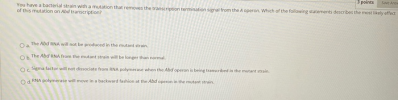 You have a bacterial strain with a mutation that removes the transcription termination Sinal from the A operon. Which of the following statements describes the most likely effect of this mutation on Abd transcription? The Abd RNA will not be produced in the mutant strain, On The Abd RNA from the mutant strain will be longer than normal. Sigma factor will not dissociate from RNA polymerase when the Abd operon is being transcribed in the mutant strain RNA polymerase will...
In E. coli which containa temperature-sensitive mutant in the gene for dCTP deaminase, production of dTTP...
In E. coli which containa temperature-sensitive mutant in the gene for dCTP deaminase, production of dTTP is decreased at restrictive temperature of 37 °C. Knowing what you do about replication in E. coli, what cellular outcomes do you expect when these bacteria are grown at 37 °C? (For the sake of this problem set assume that no alternative pathways for production of dTTP are utilized to circumvent the dCTP deaminase mutation.)
Please match the vocabulary words on the left side with the definitions on the right. the...
 Please match the vocabulary words on the left side with the
definitions on the right.
the vocabulary word to the definition antiparallel A basic form of DNA in a double-stranded spiral chromatin B. a family of enzymes that catalyze the elongation of new DNA strands proteins that bind to DNA forming spools around which the DNA can be wound to form chromosomes DNA polymerase DNA replication D. short lengths of DNA that are made during DNA replication to make the...
Please match the vocabulary words on the left side with the
definitions on the right.
the vocabulary word to the definition antiparallel A basic form of DNA in a double-stranded spiral chromatin B. a family of enzymes that catalyze the elongation of new DNA strands proteins that bind to DNA forming spools around which the DNA can be wound to form chromosomes DNA polymerase DNA replication D. short lengths of DNA that are made during DNA replication to make the...
16. Which of the following enzymes adds DNA to the ends or material with duplication? a....
 16. Which of the following enzymes adds DNA to the ends or material with duplication? a. Telomerase b. Polymerase d. Primase e. Ligase 1. Which of the following structures indicates where DNA replication begins a. DNA polymerase III b. Replication fork C. Helicase d. Origin of replication e. Centromeres 18. A select mutation is causing a cell lineape to be unable to replicate DNA SUccessfully NA successfully. When observed under a microscope, researchers observe that the DNA is able to...
QUESTION 11 Several temperature-sensitive mutant strains of yeast are shown to exhibit the following characteristics when...
 QUESTION 11 Several temperature-sensitive mutant strains of yeast are shown to exhibit the following characteristics when shifted to the restrictive temperature Based on your knowledge of components involved in DNA replication, splicing, transcription and translation, match the affected process to the likely mutated factor from the following list: Polymerase delta, U2 snRNP, Cdc6, tRNA-Ser, TFIID. Please type in your answer for each precisely as it is shown in the list. Introns remain in the mRNAs encoding ribosomal proteins Protein synthesis...
invas (2014) You prepare bacterial cell extracts by lysing the cells and removing insoluble debris via...
 invas (2014) You prepare bacterial cell extracts by lysing the cells and removing insoluble debris via centrifugation. These extracts provide the proteins required for DNA replication. Your DNA template is a small, double-stranded circular piece of DNA (a plasmid) with a single origin of replication and a single replication termination site. The termination site is on the opposite side of the plasmid from the origin. origin plasmid termination Figure 6-11 What part of the DNA replication process would be most...
 To study DNA replication, researchers often use bacteria that harbor a temperature sensitive mutation in one of the genes related to replication. This means that when cells are grown at lower temperatures (30°C) they are fine, but when shifted to 42°C the effect of the mutation becomes evident and that protein is no longer functional. Depending on the gene mutated, researchers observe that for some replication stops almost immediately, but for others more slowly. In this question you have a...
 You are studying a mutant strain of bacteria in which the trp operon includes a mutation in region 1 of the 5'UTR. Whereas in the wildtype strain the affected codons code for "trp, in the mutant strain these codons code for "stop". How will this mutation affect attenuation? Translation of the S'UTR will stop at the position of the mutation in region 1. As a result, region 3 of the 5'UTR will pair with region 2 in the mRNA causing...
 Question 15 1 pts To study DNA replication, researchers often use bacteria that harbor a temperature sensitive mutation in one of the genes related to replication. This means that when cells are grown at lower temperatures (30°C) they are fine, but when shifted to 42°C the effect of the mutation becomes evident and that protein is no longer functional. Depending on the gene mutated, researchers observe that for some replication stops almost immediately, but for others more slowly. In this...
 You have a bacterial strain with a mutation that removes the transcription termination Sinal from the A operon. Which of the following statements describes the most likely effect of this mutation on Abd transcription? The Abd RNA will not be produced in the mutant strain, On The Abd RNA from the mutant strain will be longer than normal. Sigma factor will not dissociate from RNA polymerase when the Abd operon is being transcribed in the mutant strain RNA polymerase will...
 Please match the vocabulary words on the left side with the
definitions on the right.
the vocabulary word to the definition antiparallel A basic form of DNA in a double-stranded spiral chromatin B. a family of enzymes that catalyze the elongation of new DNA strands proteins that bind to DNA forming spools around which the DNA can be wound to form chromosomes DNA polymerase DNA replication D. short lengths of DNA that are made during DNA replication to make the...
Please match the vocabulary words on the left side with the
definitions on the right.
the vocabulary word to the definition antiparallel A basic form of DNA in a double-stranded spiral chromatin B. a family of enzymes that catalyze the elongation of new DNA strands proteins that bind to DNA forming spools around which the DNA can be wound to form chromosomes DNA polymerase DNA replication D. short lengths of DNA that are made during DNA replication to make the...
 16. Which of the following enzymes adds DNA to the ends or material with duplication? a. Telomerase b. Polymerase d. Primase e. Ligase 1. Which of the following structures indicates where DNA replication begins a. DNA polymerase III b. Replication fork C. Helicase d. Origin of replication e. Centromeres 18. A select mutation is causing a cell lineape to be unable to replicate DNA SUccessfully NA successfully. When observed under a microscope, researchers observe that the DNA is able to...
 QUESTION 11 Several temperature-sensitive mutant strains of yeast are shown to exhibit the following characteristics when shifted to the restrictive temperature Based on your knowledge of components involved in DNA replication, splicing, transcription and translation, match the affected process to the likely mutated factor from the following list: Polymerase delta, U2 snRNP, Cdc6, tRNA-Ser, TFIID. Please type in your answer for each precisely as it is shown in the list. Introns remain in the mRNAs encoding ribosomal proteins Protein synthesis...
 invas (2014) You prepare bacterial cell extracts by lysing the cells and removing insoluble debris via centrifugation. These extracts provide the proteins required for DNA replication. Your DNA template is a small, double-stranded circular piece of DNA (a plasmid) with a single origin of replication and a single replication termination site. The termination site is on the opposite side of the plasmid from the origin. origin plasmid termination Figure 6-11 What part of the DNA replication process would be most...
Most questions answered within 3 hours.
-
Where is the error in this code sequence?
String s1 = "Hello";
String s2 = "ello";...
asked 11 months ago -
Financial data for Joel de Paris, Inc., for last year
follow:
Joel de Paris, Inc.
Balance...
asked 11 months ago -
Consider this reaction:
Al2(SO4)3 (aq)+ BaCl3
(aq) Al2Cl6 (aq)- +
3BaSO4(s) . What is the...
asked 11 months ago -
Suppose that Savneet is considering increasing her
recent random sample from 20 car rentals to 40...
asked 11 months ago -
Trucks arrive at an unloading terminal at an average rate of 120
per hour.
Trucks arrive...
asked 11 months ago -
Why are methanol and ethanol completely soluble in water while
octanol is not very little soluble....
asked 11 months ago -
A facilities manager at a university reads in a research report
that the mean amount of...
asked 11 months ago -
When the CuSO4 is rehydrated by adding water to the anhydrous
compound, is this an endothermic...
asked 11 months ago -
A ray of sunlight is passing from diamond into crown glass; the
angle of incidence is...
asked 11 months ago -
A block of mass 0.249 kg is placed on top of a light, vertical
spring of...
asked 11 months ago -
how do the kidneys compensate in the presences of acidosis
a) trigger hyperventilate
b) reserve acid...
asked 11 months ago -
Question 501 pts
The rental rate of capital to the firm increases. Which of the
following...
asked 11 months ago