
Homework Answers
Add Answer to:
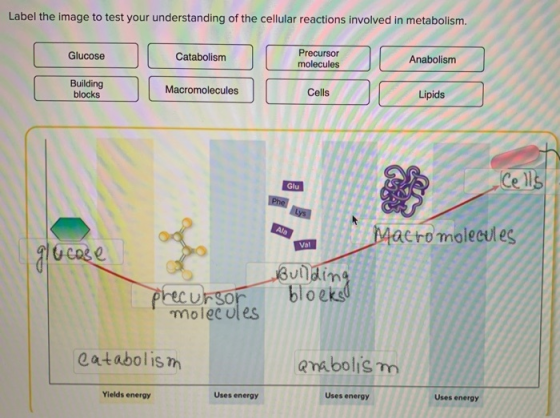
Label the image to test your understanding of the cellular reactions involved in metabolism. Glucose Catabolism...
Label the image to test your understanding of the cellular reactions involved in metabolism. Anabolism Catabolism...
 Label the image to test your understanding of the cellular reactions involved in metabolism. Anabolism Catabolism Building blocks Cells Macromolecules Precursor molecules Lipids Glucose Yields energy Uses energy Uses energy Uus energy < Prev 2 of 5 !! Next >
Label the image to test your understanding of the flow of genetic information in cells Translation...
 Label the image to test your understanding of the flow of genetic information in cells Translation of RNA DNA Regulatory RNAs mRNA Ribosome (rRNA + protein) RNA Transcription of DNA RNA Micro RNA interfering RNA antisense RNA Protein Reset
Label the image to test your understanding of the flow of genetic information in cells. TRNA...
 Label the image to test your understanding of the flow of genetic information in cells. TRNA DNA DNA Regulatory RNAS Translation of RNA Transcription of DNA Protein Ribosome RNA proteini IRNA mRNA Prey 1 of 10 !! Next > a Search or type URL
QUESTION 9 This question tests your ability to apply your understanding of various concepts that you have learned about...
 QUESTION 9 This question tests your ability to apply your understanding of various concepts that you have learned about in Biology of Cells. You should focus on showing your understanding of main processes and concepts, not recalling small details a) Jo takes part in a trial of "scientific foods", and is asked to eat a hamburger consisting of four ingredients: a bread roll, butter, onion, and a lean beef patty (i) Name the general types of chemical reactions that allow...
QUESTION 9 This question tests your ability to apply your understanding of various concepts that you...
 QUESTION 9 This question tests your ability to apply your understanding of various concepts that you have learned about in Biology of Cells. You should focus on showing your understanding of main processes and concepts, not recalling small details a) Jo takes part in a trial of "scientific foods", and is asked to eat a hamburger consisting of four ingredients: a bread roll, butter, onion, and a lean beef patty (i) Name the general types of chemical reactions that allow...
1. Why do fats provide more energy per molecule than glucose? Explain your answer in terms...
 1. Why do fats provide more energy per molecule than glucose? Explain your answer in terms of the electrons extracted during the process of cellular respiration. 2. A rare, frameshift genetic mutation can alter the structure of the Pyruvate Dehydrogenase Complex such that it no longer functions within the cell. Describe what parts of the process of cellular respiration would be impacted due to this non- functional enzyme. 3. The citric acid cycle functions to completely oxidize glucose in the...
Cellular Metabolism Lab We will walk through the steps of Cellular Respiration in this activity. Please...
Cellular Metabolism Lab We will walk through the steps of Cellular Respiration in this activity. Please do not skip ahead or leave out steps. Fully taking the time to cut out, arrange the shapes, and answer the attached questions will help you to gain a deeper understanding of cellular respiration (the process of making energy, ATP, the major contributor to our overall metabolism). Pages 941-948 in you TEXTBOOK should help you answer the questions. Grading Notes: You can either 1)...
Bio 121 I need to make (yeast fermentation) lab report. This is the lab experiment and...
 Bio 121
I need to make (yeast fermentation) lab
report.
This is the lab experiment and results:
This is a guide to making the lab report:
General Biology BIO121 Yeast Fermentation Lab Introduction Organisms stay alive by the utilization of energy through metabolism. The energy acquiring pathways in photosynthesis convert radiant energy from the sun into the chemical bond energy of carbohydrates. This photosynthetic process is limited to the producers or autotrophs, which include plants, photosynthetic bacteria and some protists....
Bio 121
I need to make (yeast fermentation) lab
report.
This is the lab experiment and results:
This is a guide to making the lab report:
General Biology BIO121 Yeast Fermentation Lab Introduction Organisms stay alive by the utilization of energy through metabolism. The energy acquiring pathways in photosynthesis convert radiant energy from the sun into the chemical bond energy of carbohydrates. This photosynthetic process is limited to the producers or autotrophs, which include plants, photosynthetic bacteria and some protists....
e. 18 Test Your Knowledge MULTIPLE CHOICE: Choose the one best answer. 1. Each element has...
 e. 18 Test Your Knowledge MULTIPLE CHOICE: Choose the one best answer. 1. Each element has its own characteristic atom in which a. the atomic mass is constant. b. the atomic number is constant. c. the mass number is constant. d. Two of the above are correct. e. All of the above are correct. 2. Which of the following is not a trace element in the human body? a. iodine b. zinc c. iron d. calcium e. fluorine 3. A...
1. Which of the following are the sites within the human body where carbon dioxide and...
1. Which of the following are the sites within the human body where carbon dioxide and oxygen are exchanged? A. Alveoli B. Arteries C. Synapses D. Venules 2. Which of the following describes the most important reason for repeating an experimental investigation? A. To verify the validity of the original findings B. To expand upon the original investigation C. To manipulate the independent variable D. To attempt to disprove the hypothesis 3. Lithium has an atomic number of 3 and...
 Label the image to test your understanding of the cellular reactions involved in metabolism. Anabolism Catabolism Building blocks Cells Macromolecules Precursor molecules Lipids Glucose Yields energy Uses energy Uses energy Uus energy < Prev 2 of 5 !! Next >
 Label the image to test your understanding of the flow of genetic information in cells Translation of RNA DNA Regulatory RNAs mRNA Ribosome (rRNA + protein) RNA Transcription of DNA RNA Micro RNA interfering RNA antisense RNA Protein Reset
 Label the image to test your understanding of the flow of genetic information in cells. TRNA DNA DNA Regulatory RNAS Translation of RNA Transcription of DNA Protein Ribosome RNA proteini IRNA mRNA Prey 1 of 10 !! Next > a Search or type URL
 QUESTION 9 This question tests your ability to apply your understanding of various concepts that you have learned about in Biology of Cells. You should focus on showing your understanding of main processes and concepts, not recalling small details a) Jo takes part in a trial of "scientific foods", and is asked to eat a hamburger consisting of four ingredients: a bread roll, butter, onion, and a lean beef patty (i) Name the general types of chemical reactions that allow...
 QUESTION 9 This question tests your ability to apply your understanding of various concepts that you have learned about in Biology of Cells. You should focus on showing your understanding of main processes and concepts, not recalling small details a) Jo takes part in a trial of "scientific foods", and is asked to eat a hamburger consisting of four ingredients: a bread roll, butter, onion, and a lean beef patty (i) Name the general types of chemical reactions that allow...
 1. Why do fats provide more energy per molecule than glucose? Explain your answer in terms of the electrons extracted during the process of cellular respiration. 2. A rare, frameshift genetic mutation can alter the structure of the Pyruvate Dehydrogenase Complex such that it no longer functions within the cell. Describe what parts of the process of cellular respiration would be impacted due to this non- functional enzyme. 3. The citric acid cycle functions to completely oxidize glucose in the...
 Bio 121
I need to make (yeast fermentation) lab
report.
This is the lab experiment and results:
This is a guide to making the lab report:
General Biology BIO121 Yeast Fermentation Lab Introduction Organisms stay alive by the utilization of energy through metabolism. The energy acquiring pathways in photosynthesis convert radiant energy from the sun into the chemical bond energy of carbohydrates. This photosynthetic process is limited to the producers or autotrophs, which include plants, photosynthetic bacteria and some protists....
Bio 121
I need to make (yeast fermentation) lab
report.
This is the lab experiment and results:
This is a guide to making the lab report:
General Biology BIO121 Yeast Fermentation Lab Introduction Organisms stay alive by the utilization of energy through metabolism. The energy acquiring pathways in photosynthesis convert radiant energy from the sun into the chemical bond energy of carbohydrates. This photosynthetic process is limited to the producers or autotrophs, which include plants, photosynthetic bacteria and some protists....
 e. 18 Test Your Knowledge MULTIPLE CHOICE: Choose the one best answer. 1. Each element has its own characteristic atom in which a. the atomic mass is constant. b. the atomic number is constant. c. the mass number is constant. d. Two of the above are correct. e. All of the above are correct. 2. Which of the following is not a trace element in the human body? a. iodine b. zinc c. iron d. calcium e. fluorine 3. A...
Most questions answered within 3 hours.
-
Where is the error in this code sequence?
String s1 = "Hello";
String s2 = "ello";...
asked 11 months ago -
Financial data for Joel de Paris, Inc., for last year
follow:
Joel de Paris, Inc.
Balance...
asked 11 months ago -
Consider this reaction:
Al2(SO4)3 (aq)+ BaCl3
(aq) Al2Cl6 (aq)- +
3BaSO4(s) . What is the...
asked 11 months ago -
Suppose that Savneet is considering increasing her
recent random sample from 20 car rentals to 40...
asked 11 months ago -
Trucks arrive at an unloading terminal at an average rate of 120
per hour.
Trucks arrive...
asked 11 months ago -
Why are methanol and ethanol completely soluble in water while
octanol is not very little soluble....
asked 11 months ago -
A facilities manager at a university reads in a research report
that the mean amount of...
asked 11 months ago -
When the CuSO4 is rehydrated by adding water to the anhydrous
compound, is this an endothermic...
asked 11 months ago -
A ray of sunlight is passing from diamond into crown glass; the
angle of incidence is...
asked 11 months ago -
A block of mass 0.249 kg is placed on top of a light, vertical
spring of...
asked 11 months ago -
how do the kidneys compensate in the presences of acidosis
a) trigger hyperventilate
b) reserve acid...
asked 11 months ago -
Question 501 pts
The rental rate of capital to the firm increases. Which of the
following...
asked 11 months ago