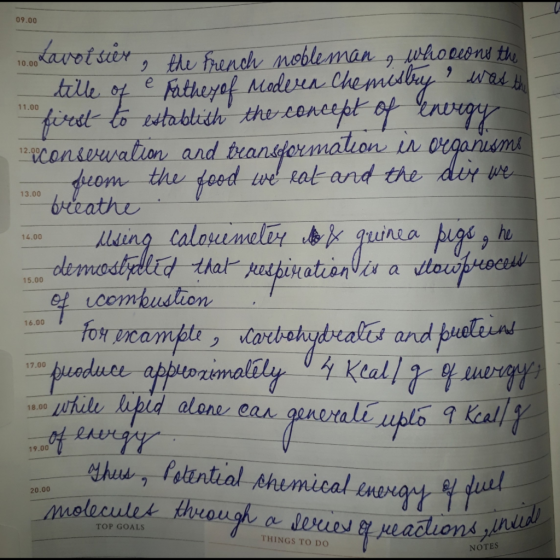
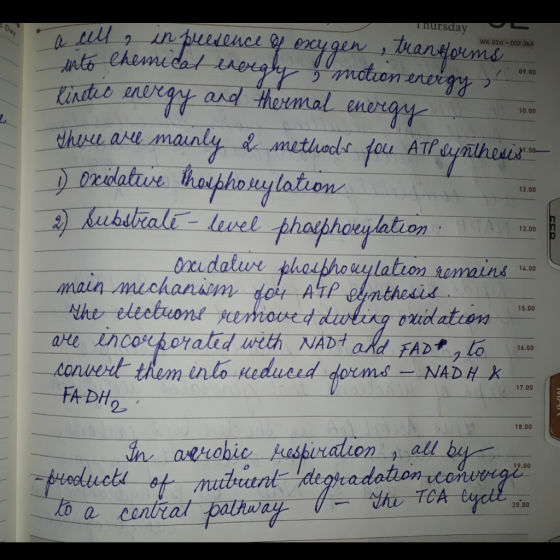
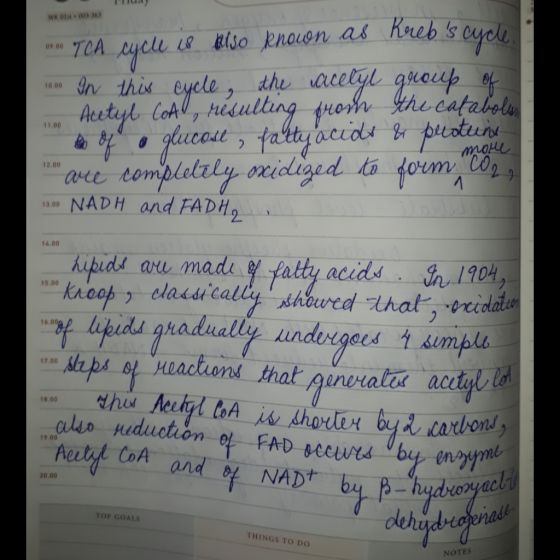
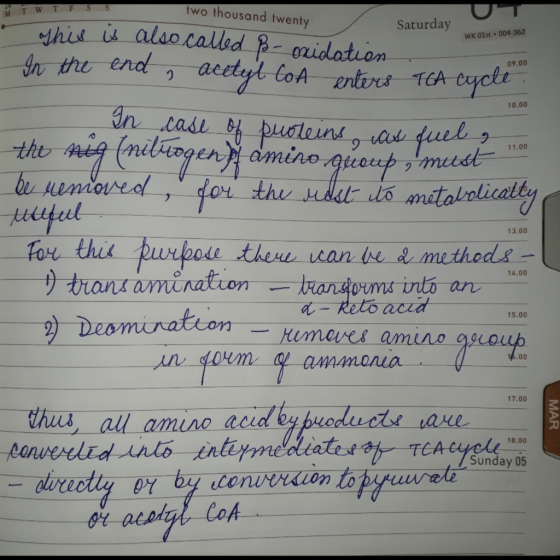
Explain the activity of glycolysis and the Krebs cycle in organisms that obtain energy from diets...
Homework Answers
Add Answer to:
Explain the activity of glycolysis and the Krebs cycle in organisms
that obtain energy from diets...
Question 6 pts After glycolysis, the metabolism of glucose continues via the Krebs cycle. The starting...
 Question 6 pts After glycolysis, the metabolism of glucose continues via the Krebs cycle. The starting material for this pathway is (A) and the process occurs (inside outside) the mitochondria. "Please be sure to spell the words correctly to get credit Question 7 Where does "A" come from? Glycolysis of glucose for energy B-oxidation of fatty acids for energy Metabolism of amino acids for energy Conversion of amino acids to neurotransmitters Use of amino acids to build proteins
explain what happens in (glycolysis, transition step, krebs cycle, light reactions, Calvin cycle) What us oxidized?...
explain what happens in (glycolysis, transition step, krebs cycle, light reactions, Calvin cycle) What us oxidized? What is reduced? Inputs? Outputs?
Which one of the following statements about glycolysis and Krebs cycle is correct? A. Succinate is...
Which one of the following statements about glycolysis and Krebs cycle is correct? A. Succinate is the oxidized product of a redox reaction in Krebs cycle. B. For every pyruvate, 8 NADH result from Krebs cycle. C. The coenzyme in the oxidation of isocitrate is CO2. D. Pyruvate can be found in the cytoplasm and mitochondrial matrix of eukaryotic cells. E. Oxaloacetate is the reduced product of a redox reaction in Krebs cycle.
Biology Help. 15.) "Explain the purpose of making NADH in glycolysis, the Grooming Phase, and Krebs...
Biology Help. 15.) "Explain the purpose of making NADH in glycolysis, the Grooming Phase, and Krebs Cycle, and FADH2 in the Krebs Cycle." 16.) "What is removed from the catabolic products of glucose during NAD+ to NADH and the reduction of FAD to FADH2?"
Select ALL of the statements that correctly describe the Krebs cycle. A. Pyruvic acid must be...
Select ALL of the statements that correctly describe the Krebs cycle. A. Pyruvic acid must be converted to acetyl CoA prior to entering the cycle B. The molecule oxaloacetic acid picks up the acetyl group from acetylCoA, and in the last step of the cycle, oxaloacetic acid is regenerated. C. Electrons removed during oxidation steps are picked up by NAD or FAD. D. Each turn of the cycle generates one ATP molecule for a total of two per molecule of...
E) the Krebs cycle 13) Pyruvate is the last product of glycolysis. Which statement below is...
 E) the Krebs cycle 13) Pyruvate is the last product of glycolysis. Which statement below is TRUE? A) There is less energy in two molecules of pyruvate than in one molecule of glucose. B) There is more energy in 6 molecules of carbon dioxide than in 2 molecules of pyruvate. C) Pyruvate is in a more reduced state than glucose. D) There is more energy in pyruvate than in lactate. E) Pyruvate is in a more oxidized state than carbon...
Cellular Respiration Worksheet 1.Where does each reaction take place? -Glycolysis -Fermentation -Acetyl CoA formation -Krebs Cycle...
Cellular Respiration Worksheet 1.Where does each reaction take place? -Glycolysis -Fermentation -Acetyl CoA formation -Krebs Cycle -ETC 2.What goes in/comes out of each reaction/name of each reaction? -Glycolysis -Fermentation -Acetyl CoA formation -Krebs Cycle -ETC 3.What are the electron carriers? Where are the electrons actually located? 4.What are the energy carrying molecules? Where is the energy actually located? 5.Where is oxygen used? Where’s CO2 released in cellular respiration? 6.Where is most of the ATP made? 7.What is the point/purpose of...
Briefly discuss what happens during the following stages of carbohydrate metabolism a) Glycolysis b) Krebs cycle...
Briefly discuss what happens during the following stages of carbohydrate metabolism a) Glycolysis b) Krebs cycle c) Electron Transport Chain. PLEASE DO NOT COPY WORD FROM WORD FROM A SOURCE!!! THANK YOU
QUESTION 65 Free energy (delta G) is higher during the citric acid cycle than during glycolysis....
 QUESTION 65 Free energy (delta G) is higher during the citric acid cycle than during glycolysis. Despite this, only two molecules of ATP will be generated in the krebs cycle. Most of the remaining free energy that is released during the krebs cycle will be O a. Used to synthesize GTP O b. Converted into kinetic energy O c.Lost as heat d. Used to reduce pyruvate Oe. Used to reduce electron carriers such as NADH and FADH2
Where are different Krebs cycle enzyme localized in mitochondria? Who is the odd one out in...
Where are different Krebs cycle enzyme localized in mitochondria? Who is the odd one out in terms of its location? Explain why Acetyl CoA is a hub in the catabolic network of metabolism? Most enzymes in the citric acid cycle belong to the class known as ______________. What kind of reactions do they catalyze and what common kinds of byproducts do they produce? What is the structure of the mitochondria and what are the various membranes and compartments of the...
 Question 6 pts After glycolysis, the metabolism of glucose continues via the Krebs cycle. The starting material for this pathway is (A) and the process occurs (inside outside) the mitochondria. "Please be sure to spell the words correctly to get credit Question 7 Where does "A" come from? Glycolysis of glucose for energy B-oxidation of fatty acids for energy Metabolism of amino acids for energy Conversion of amino acids to neurotransmitters Use of amino acids to build proteins
 E) the Krebs cycle 13) Pyruvate is the last product of glycolysis. Which statement below is TRUE? A) There is less energy in two molecules of pyruvate than in one molecule of glucose. B) There is more energy in 6 molecules of carbon dioxide than in 2 molecules of pyruvate. C) Pyruvate is in a more reduced state than glucose. D) There is more energy in pyruvate than in lactate. E) Pyruvate is in a more oxidized state than carbon...
 QUESTION 65 Free energy (delta G) is higher during the citric acid cycle than during glycolysis. Despite this, only two molecules of ATP will be generated in the krebs cycle. Most of the remaining free energy that is released during the krebs cycle will be O a. Used to synthesize GTP O b. Converted into kinetic energy O c.Lost as heat d. Used to reduce pyruvate Oe. Used to reduce electron carriers such as NADH and FADH2
Most questions answered within 3 hours.
-
Where is the error in this code sequence?
String s1 = "Hello";
String s2 = "ello";...
asked 11 months ago -
Financial data for Joel de Paris, Inc., for last year
follow:
Joel de Paris, Inc.
Balance...
asked 11 months ago -
Consider this reaction:
Al2(SO4)3 (aq)+ BaCl3
(aq) Al2Cl6 (aq)- +
3BaSO4(s) . What is the...
asked 11 months ago -
Suppose that Savneet is considering increasing her
recent random sample from 20 car rentals to 40...
asked 11 months ago -
Trucks arrive at an unloading terminal at an average rate of 120
per hour.
Trucks arrive...
asked 11 months ago -
Why are methanol and ethanol completely soluble in water while
octanol is not very little soluble....
asked 11 months ago -
A facilities manager at a university reads in a research report
that the mean amount of...
asked 11 months ago -
When the CuSO4 is rehydrated by adding water to the anhydrous
compound, is this an endothermic...
asked 11 months ago -
A ray of sunlight is passing from diamond into crown glass; the
angle of incidence is...
asked 11 months ago -
A block of mass 0.249 kg is placed on top of a light, vertical
spring of...
asked 11 months ago -
how do the kidneys compensate in the presences of acidosis
a) trigger hyperventilate
b) reserve acid...
asked 11 months ago -
Question 501 pts
The rental rate of capital to the firm increases. Which of the
following...
asked 11 months ago