explain what happens in (glycolysis, transition step, krebs cycle, light reactions, Calvin cycle) What us oxidized?...
Homework Answers
1.GLYCOLYSIS:The process takes place in the cytoplasm.The process creates 2ATP's and 2NADP's,but in the end uses these products glucose(6c)is broken down into 2PGALS(phosphoglyceraldehide -3 carbon molecules)This process takes 2ATPmolecules,3PGAL's(3C) are convereted into 2 pyruvates and this creates 4ATPS AND 2NADPH'S.The net ATPproduction of glycolysis is 2ATP'S
2.CALVIN CYCLE:
In plants, carbon dioxide (\text{CO}_2CO2start text, C, O, end text, start subscript, end subscript) enters the interior of a leaf via pores called stomata and diffuses into the stroma of the chloroplast—the site of the Calvin cycle reactions, where sugar is synthesized. These reactions are also called the light-independent reactions because they are not directly driven by light.
In the Calvin cycle, carbon atoms from \text {CO}_2CO2start
text, C, O, end text, start subscript, , end subscript are
fixed (incorporated into organic molecules) and
used to build three-carbon sugars. This process is fueled by, and
dependent on, ATP and NADPH from the light reactions. Unlike the
light reactions, which take place in the thylakoid membrane, the
reactions of the Calvin cycle take place in the stroma (the inner
space of chloroplast)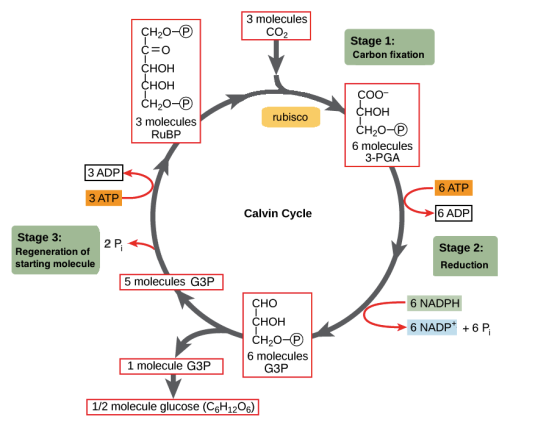
KREBS CYCLE: The Krebs cycle, also known as the citric acid cycle or the tricarboxylic acid cycle, is one of the most important reaction sequences in biochemistry. Not only is this series of reactions responsible for most of the energy needs in complex organisms, the molecules that are produced in these reactions can be used as building blocks for a large number of important processes, including the synthesis of fatty acids, steroids, cholesterol, amino acids for building proteins, and the purines and pyrimidines used in the synthesis of DNA. Fuel for the Krebs cycle comes from lipids (fats) and carbohydrates, which both produce the molecule acetyl coenzyme-A (acetyl-CoA). This acetyl-CoA reacts in the first step of the eight step sequence of reactions that comprise the Krebs cycle, all of which occur inside mitochondria of eukaryotic cells. While the Krebs cycle does produce carbon dioxide, this cycle does not produce significant chemical energy in the form of adenosine triphosphate (ATP) directly, and this reaction sequence does not require any oxygen. Instead, this cycle produces NADH and FADH2, which feed into the respiratory cycle, also located inside of the mitochondria.
TRANSISTION CYCLE:
Formation of Acetyl-CoA through the Transition Reaction
The transition reaction connects glycolysis to the citric acid (Krebs) cycle. Through a process called oxidative decarboxylation, the transition reaction converts the two molecules of the 3-carbon pyruvate from glycolysis (and other pathways) into two molecules of the 2-carbon molecule acetyl Coenzyme A (acetyl-CoA) and 2 molecules of carbon dioxide. First, a carboxyl group of each pyruvate is removed as carbon dioxide and then the remaining acetyl group combines with coenzyme A (CoA) to form acetyl-CoA.
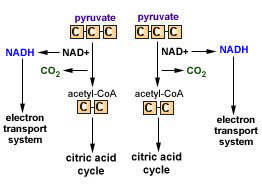
The Transition Reaction between Glycolysis and the Citric Acid Cycle. Before the pyruvates from glycolysis can enter the citric acid cycle, they must undergo a transition reaction. The 3-carbon pyruvate is converted into a 2-carbon acetyl group with a carboxyl being removed as CO2. The acetyl group is attached to coenzyme A to form acetyl coenzyme A (acetyl-CoA), a key precursor metabolite. As the two acetyl groups become oxidized to acetyl-CoA, two molecules of NAD+ are reduced to 2NADH + 2H+.
Add Answer to:
explain what happens in (glycolysis, transition step, krebs cycle,
light reactions, Calvin cycle) What us oxidized?...
describing photosynthesis (light reactions and Calvin cycle) and fill in the following table. Light reactions Calvin...
describing photosynthesis (light reactions and Calvin cycle) and fill in the following table. Light reactions Calvin cycle Inputs (both external and from within the cell) Outputs (both released externally and within the cell)
uit OT 50 Identify the following characteristics as applying to either glycolysis or the Krebs cycle....
 uit OT 50 Identify the following characteristics as applying to either glycolysis or the Krebs cycle. Characteristics (8 items) Drag and drop into the appropriate area Cellular Respiration Glycolysis Krebs Cycle Outputs: FADH2, NADH, carbon dioxide, 2 ATP Outputs 2 ATP, pyruvate, NADH Input pyruvate Input glucose Happens in cytoplasm Happens in mitochondna Is aerobic Is anaerobic
Which one of the following statements about glycolysis and Krebs cycle is correct? A. Succinate is...
Which one of the following statements about glycolysis and Krebs cycle is correct? A. Succinate is the oxidized product of a redox reaction in Krebs cycle. B. For every pyruvate, 8 NADH result from Krebs cycle. C. The coenzyme in the oxidation of isocitrate is CO2. D. Pyruvate can be found in the cytoplasm and mitochondrial matrix of eukaryotic cells. E. Oxaloacetate is the reduced product of a redox reaction in Krebs cycle.
4. Compare the function ATP in the light dependent and light independent(Calvin Cycle) reaction of photosynthesis...
 4. Compare the function ATP in the light dependent and light independent(Calvin Cycle) reaction of photosynthesis to the three main activities of respiration (glycolysis, Krebs Cycle, and electron transport).
6. What wavelengths of light provide energy for photosynthesis? 7. What does the light do? 8....
 6. What wavelengths of light provide energy for photosynthesis? 7. What does the light do? 8. Summarize photosynthesis in a chemical reaction. What is oxidized and what is reduced? 9. What part of the visible light spectrum is best at driving photosynthesis? 10. What happens in the light harvesting complex? The reaction center complex? 11. What donates the electrons to the primary electron acceptor in photosystem I? What replaces those electrons? 12. What donates electrons to photosystems 1? 13. How...
Light independent reactions/ calvin cycle 1. Where does the Calvin cycle take place? 2. Before the...
 Light independent reactions/
calvin cycle
1. Where does the Calvin cycle take place? 2. Before the Calvin cycle begins, where is the energy stored? 4. What are the inputs to the Calvin cycle? Where do they come from? 5. Circle the letter of each statement that is true about the Calvin cycle. Correct the false statements. a. The main products of the Calvin cycle are six carbon dioxide molecules. b. Carbon dioxide molecules enter the Calvin cycle from the atmosphere....
Light independent reactions/
calvin cycle
1. Where does the Calvin cycle take place? 2. Before the Calvin cycle begins, where is the energy stored? 4. What are the inputs to the Calvin cycle? Where do they come from? 5. Circle the letter of each statement that is true about the Calvin cycle. Correct the false statements. a. The main products of the Calvin cycle are six carbon dioxide molecules. b. Carbon dioxide molecules enter the Calvin cycle from the atmosphere....
Briefly discuss what happens during the following stages of carbohydrate metabolism a) Glycolysis b) Krebs cycle...
Briefly discuss what happens during the following stages of carbohydrate metabolism a) Glycolysis b) Krebs cycle c) Electron Transport Chain. PLEASE DO NOT COPY WORD FROM WORD FROM A SOURCE!!! THANK YOU
What is produced in the light reactions? What occurs in the Calvin Cycle?
What is produced in the light reactions? What occurs in the Calvin Cycle?
QUESTION 38 Yyu add a chemical that blocks the light-dependent reactions. What happens to the rate...
 QUESTION 38 Yyu add a chemical that blocks the light-dependent reactions. What happens to the rate of the Calvin Cycle and why - be specific QUESTION 39 You add a chemical that blocks the Calvin Cycle. What happens to the rate of the light-dependent reactions and why - be specific QUESTION 40 Assume we add a chemical that blocks the reduction of NADP+ to NADPH at the end of the electron transport chain in the light dependent reactions of photosynthesis....
77. Of the following, which occurs during the Calvin cycle? a) Excited electrons are conveyed from...
 77. Of the following, which occurs during the Calvin cycle? a) Excited electrons are conveyed from chlorophyll to an electron acceptor b) Light energy is converted to chemical energy C) ATP and NADPH are synthesized d) Photons are absorbed e) CO2 is reduced 78. Which of the following occurs during the Calvin cycle? a) Linear electron flow produces the materials required for the fixation of carbon from carbon dioxide. b) Light energy is converted to chemical energy c) ATP is...
 uit OT 50 Identify the following characteristics as applying to either glycolysis or the Krebs cycle. Characteristics (8 items) Drag and drop into the appropriate area Cellular Respiration Glycolysis Krebs Cycle Outputs: FADH2, NADH, carbon dioxide, 2 ATP Outputs 2 ATP, pyruvate, NADH Input pyruvate Input glucose Happens in cytoplasm Happens in mitochondna Is aerobic Is anaerobic
 4. Compare the function ATP in the light dependent and light independent(Calvin Cycle) reaction of photosynthesis to the three main activities of respiration (glycolysis, Krebs Cycle, and electron transport).
 6. What wavelengths of light provide energy for photosynthesis? 7. What does the light do? 8. Summarize photosynthesis in a chemical reaction. What is oxidized and what is reduced? 9. What part of the visible light spectrum is best at driving photosynthesis? 10. What happens in the light harvesting complex? The reaction center complex? 11. What donates the electrons to the primary electron acceptor in photosystem I? What replaces those electrons? 12. What donates electrons to photosystems 1? 13. How...
 Light independent reactions/
calvin cycle
1. Where does the Calvin cycle take place? 2. Before the Calvin cycle begins, where is the energy stored? 4. What are the inputs to the Calvin cycle? Where do they come from? 5. Circle the letter of each statement that is true about the Calvin cycle. Correct the false statements. a. The main products of the Calvin cycle are six carbon dioxide molecules. b. Carbon dioxide molecules enter the Calvin cycle from the atmosphere....
Light independent reactions/
calvin cycle
1. Where does the Calvin cycle take place? 2. Before the Calvin cycle begins, where is the energy stored? 4. What are the inputs to the Calvin cycle? Where do they come from? 5. Circle the letter of each statement that is true about the Calvin cycle. Correct the false statements. a. The main products of the Calvin cycle are six carbon dioxide molecules. b. Carbon dioxide molecules enter the Calvin cycle from the atmosphere....
 QUESTION 38 Yyu add a chemical that blocks the light-dependent reactions. What happens to the rate of the Calvin Cycle and why - be specific QUESTION 39 You add a chemical that blocks the Calvin Cycle. What happens to the rate of the light-dependent reactions and why - be specific QUESTION 40 Assume we add a chemical that blocks the reduction of NADP+ to NADPH at the end of the electron transport chain in the light dependent reactions of photosynthesis....
 77. Of the following, which occurs during the Calvin cycle? a) Excited electrons are conveyed from chlorophyll to an electron acceptor b) Light energy is converted to chemical energy C) ATP and NADPH are synthesized d) Photons are absorbed e) CO2 is reduced 78. Which of the following occurs during the Calvin cycle? a) Linear electron flow produces the materials required for the fixation of carbon from carbon dioxide. b) Light energy is converted to chemical energy c) ATP is...
Most questions answered within 3 hours.
-
Where is the error in this code sequence?
String s1 = "Hello";
String s2 = "ello";...
asked 10 months ago -
Financial data for Joel de Paris, Inc., for last year
follow:
Joel de Paris, Inc.
Balance...
asked 10 months ago -
Consider this reaction:
Al2(SO4)3 (aq)+ BaCl3
(aq) Al2Cl6 (aq)- +
3BaSO4(s) . What is the...
asked 10 months ago -
Suppose that Savneet is considering increasing her
recent random sample from 20 car rentals to 40...
asked 10 months ago -
Trucks arrive at an unloading terminal at an average rate of 120
per hour.
Trucks arrive...
asked 10 months ago -
Why are methanol and ethanol completely soluble in water while
octanol is not very little soluble....
asked 10 months ago -
A facilities manager at a university reads in a research report
that the mean amount of...
asked 10 months ago -
When the CuSO4 is rehydrated by adding water to the anhydrous
compound, is this an endothermic...
asked 10 months ago -
A ray of sunlight is passing from diamond into crown glass; the
angle of incidence is...
asked 10 months ago -
A block of mass 0.249 kg is placed on top of a light, vertical
spring of...
asked 10 months ago -
how do the kidneys compensate in the presences of acidosis
a) trigger hyperventilate
b) reserve acid...
asked 10 months ago -
Question 501 pts
The rental rate of capital to the firm increases. Which of the
following...
asked 10 months ago