describing photosynthesis (light reactions and Calvin cycle) and fill in the following table. Light reactions Calvin...
- describing photosynthesis (light reactions and Calvin cycle) and fill in the following table.
|
Light reactions |
Calvin cycle |
|
|
Inputs (both external and from within the cell) |
||
|
Outputs (both released externally and within the cell) |
Homework Answers
| Light reaction | Calvin cycle | |
| Input | Light, water | ATP and NADPH, CO2 |
| Outputs | ATP and NADPH and oxygen | Triose phosphate |
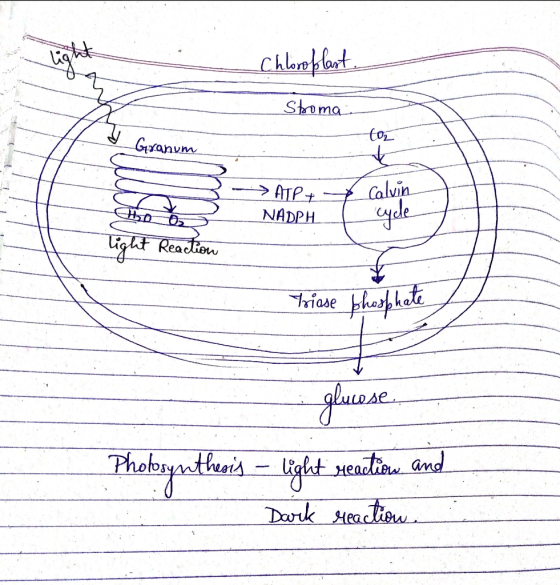
Please give a thumbs up!!!!!!!! Ask any doubts regarding the above question in the comment section !!!!!!!!!!! Thank you!!!!!
Add Answer to:
describing photosynthesis (light reactions and Calvin cycle)
and fill in the following table.
Light reactions
Calvin...
During photosynthesis, when is CO 2 utilized? 1.During the light reactions only 2.During the Calvin cycle...
During photosynthesis, when is CO 2 utilized? 1.During the light reactions only 2.During the Calvin cycle only 3.During both the light reactions and the Calvin cycle 4.During neither the light reactions nor the Calvin cycle
explain what happens in (glycolysis, transition step, krebs cycle, light reactions, Calvin cycle) What us oxidized?...
explain what happens in (glycolysis, transition step, krebs cycle, light reactions, Calvin cycle) What us oxidized? What is reduced? Inputs? Outputs?
Why is it possible for the Calvin cycle to occur in the dark? A. The Calvin...
 Why is it possible for the Calvin cycle to occur in the dark? A. The Calvin cycle uses energy stored previously during the light-dependent reactions of photosynthesis. B. It is not possible for any part of photosynthesis to occur without light. C. None of the products of the light-dependent reactions are involved in the Calvin cycle. D. The Calvin cycle obtains energy from sugars made previously by the light-dependent reactions of photosynthesis.
Name the principal products of photosynthesis light reactions and Calvin cycle, and clearly explain how they...
Name the principal products of photosynthesis light reactions and Calvin cycle, and clearly explain how they are used by the plant. Also name byproducts and how they may affect the environment. Clearly distinguish between principal versus byproducts.
QUESTION 7 In photosynthesis, the reactions that produce O2 take place in A. the light reactions...
 QUESTION 7 In photosynthesis, the reactions that produce O2 take place in A. the light reactions only. B. neither the light reactions nor the Calvin cycle. C. the TCA cycle only. D.the Calvin cycle only. E. the light reactions and the Calvin cycle. F. the TCA cycle, the light reactions, and the Calvin cycle
In photosynthesis, a redox compound that is produced in the light reactions is required to drive...
 In photosynthesis, a redox compound that is produced in the light reactions is required to drive other redox reactions in the Calvin cycle, as shown in this fiqure along with other components of photosynthesis. но CO. sight NADP" aADe +P Calvin cydle Light reactions sJet. ATP NADPH chioroplast G3P (sugar) Drag the terms to the appropriate blanks to complete the following sentences summarizing the redox reactions of photosynthesis. Terms may be used once,, more than once, or not at all....
Nelson 46. The final product of the Calvin cycle is A) Ribulose Bisphosphate B) PGA C)...
 Nelson 46. The final product of the Calvin cycle is A) Ribulose Bisphosphate B) PGA C) АТР D)Glyceraldehyde-3-phosphate 47. Water vapor exits and Co, enters a leaf through the A) stomata B) grana C) porphyrin rings D) photons E) stroma 48. In a plant leaf, the reactions that produce NADPH occur in A) the light reactions alone. B) the Calvin cycle alone. C) both the light reactions and the Calvin cycle. D) neither the light reactions nor the Calvin cycle....
Light independent reactions/ calvin cycle 1. Where does the Calvin cycle take place? 2. Before the...
 Light independent reactions/
calvin cycle
1. Where does the Calvin cycle take place? 2. Before the Calvin cycle begins, where is the energy stored? 4. What are the inputs to the Calvin cycle? Where do they come from? 5. Circle the letter of each statement that is true about the Calvin cycle. Correct the false statements. a. The main products of the Calvin cycle are six carbon dioxide molecules. b. Carbon dioxide molecules enter the Calvin cycle from the atmosphere....
Light independent reactions/
calvin cycle
1. Where does the Calvin cycle take place? 2. Before the Calvin cycle begins, where is the energy stored? 4. What are the inputs to the Calvin cycle? Where do they come from? 5. Circle the letter of each statement that is true about the Calvin cycle. Correct the false statements. a. The main products of the Calvin cycle are six carbon dioxide molecules. b. Carbon dioxide molecules enter the Calvin cycle from the atmosphere....
The photosynthetic reactions are divided into a. the light reactions in the stroma and the Calvin...
The photosynthetic reactions are divided into a. the light reactions in the stroma and the Calvin cycle in the thylakoids of the chloroplasts b. the light reactions in the thylakoids and the Calvin cycle in the stroma of the chloroplasts c. the light reactions and the Calvin cycle, both in the stroma of the chloroplasts d. the light reactions and the Calvin cycle, both in the thylakoids of the chloroplasts
QUESTION 1 Which of the following are produced by the light reactions of photosynthesis and then...
 QUESTION 1 Which of the following are produced by the light reactions of photosynthesis and then used during the Calvin cycle? A oxygen and carbon dioxide B. ATP and NADP+C. ATP, NADPH and oxygen D. ADP, Pi and NADP E. ATP and carbon dioxide QUESTION 2 Which of the following is a correct sequence of the cell cycle? QUESTION3 At various times, DNA was isolated from the nuclei of cells growing in cell culture. The measured DNA levels ranged from 3 to 6 picograms per nucleus. In which stage...
 Why is it possible for the Calvin cycle to occur in the dark? A. The Calvin cycle uses energy stored previously during the light-dependent reactions of photosynthesis. B. It is not possible for any part of photosynthesis to occur without light. C. None of the products of the light-dependent reactions are involved in the Calvin cycle. D. The Calvin cycle obtains energy from sugars made previously by the light-dependent reactions of photosynthesis.
 QUESTION 7 In photosynthesis, the reactions that produce O2 take place in A. the light reactions only. B. neither the light reactions nor the Calvin cycle. C. the TCA cycle only. D.the Calvin cycle only. E. the light reactions and the Calvin cycle. F. the TCA cycle, the light reactions, and the Calvin cycle
 In photosynthesis, a redox compound that is produced in the light reactions is required to drive other redox reactions in the Calvin cycle, as shown in this fiqure along with other components of photosynthesis. но CO. sight NADP" aADe +P Calvin cydle Light reactions sJet. ATP NADPH chioroplast G3P (sugar) Drag the terms to the appropriate blanks to complete the following sentences summarizing the redox reactions of photosynthesis. Terms may be used once,, more than once, or not at all....
 Nelson 46. The final product of the Calvin cycle is A) Ribulose Bisphosphate B) PGA C) АТР D)Glyceraldehyde-3-phosphate 47. Water vapor exits and Co, enters a leaf through the A) stomata B) grana C) porphyrin rings D) photons E) stroma 48. In a plant leaf, the reactions that produce NADPH occur in A) the light reactions alone. B) the Calvin cycle alone. C) both the light reactions and the Calvin cycle. D) neither the light reactions nor the Calvin cycle....
 Light independent reactions/
calvin cycle
1. Where does the Calvin cycle take place? 2. Before the Calvin cycle begins, where is the energy stored? 4. What are the inputs to the Calvin cycle? Where do they come from? 5. Circle the letter of each statement that is true about the Calvin cycle. Correct the false statements. a. The main products of the Calvin cycle are six carbon dioxide molecules. b. Carbon dioxide molecules enter the Calvin cycle from the atmosphere....
Light independent reactions/
calvin cycle
1. Where does the Calvin cycle take place? 2. Before the Calvin cycle begins, where is the energy stored? 4. What are the inputs to the Calvin cycle? Where do they come from? 5. Circle the letter of each statement that is true about the Calvin cycle. Correct the false statements. a. The main products of the Calvin cycle are six carbon dioxide molecules. b. Carbon dioxide molecules enter the Calvin cycle from the atmosphere....
 QUESTION 1 Which of the following are produced by the light reactions of photosynthesis and then used during the Calvin cycle? A oxygen and carbon dioxide B. ATP and NADP+C. ATP, NADPH and oxygen D. ADP, Pi and NADP E. ATP and carbon dioxide QUESTION 2 Which of the following is a correct sequence of the cell cycle? QUESTION3 At various times, DNA was isolated from the nuclei of cells growing in cell culture. The measured DNA levels ranged from 3 to 6 picograms per nucleus. In which stage...
Most questions answered within 3 hours.
-
Where is the error in this code sequence?
String s1 = "Hello";
String s2 = "ello";...
asked 10 months ago -
Financial data for Joel de Paris, Inc., for last year
follow:
Joel de Paris, Inc.
Balance...
asked 10 months ago -
Consider this reaction:
Al2(SO4)3 (aq)+ BaCl3
(aq) Al2Cl6 (aq)- +
3BaSO4(s) . What is the...
asked 10 months ago -
Suppose that Savneet is considering increasing her
recent random sample from 20 car rentals to 40...
asked 10 months ago -
Trucks arrive at an unloading terminal at an average rate of 120
per hour.
Trucks arrive...
asked 10 months ago -
Why are methanol and ethanol completely soluble in water while
octanol is not very little soluble....
asked 10 months ago -
A facilities manager at a university reads in a research report
that the mean amount of...
asked 10 months ago -
When the CuSO4 is rehydrated by adding water to the anhydrous
compound, is this an endothermic...
asked 10 months ago -
A ray of sunlight is passing from diamond into crown glass; the
angle of incidence is...
asked 10 months ago -
A block of mass 0.249 kg is placed on top of a light, vertical
spring of...
asked 10 months ago -
how do the kidneys compensate in the presences of acidosis
a) trigger hyperventilate
b) reserve acid...
asked 10 months ago -
Question 501 pts
The rental rate of capital to the firm increases. Which of the
following...
asked 10 months ago