Are the following bacteria motile? S. Epidermis P. Mirabilis P. Putida
Are the following bacteria motile?
S. Epidermis
P. Mirabilis
P. Putida
Homework Answers
S. epidermis shows darting motility.
P. mirabilis is peritrichous (flagella all over the cell). So this is motile.
P. putida is lophotrichous (tuft of flagella at one end). So, it is motile.
Please rate high.
Add Answer to:
Are the following bacteria motile?
S. Epidermis
P. Mirabilis
P. Putida
are the following bacteria aerobic, anaerobic or facilitative anaerobes? E. Coli S. Epidermidis P. Mirabilis P....
are the following bacteria aerobic, anaerobic or facilitative anaerobes? E. Coli S. Epidermidis P. Mirabilis P. Putida
Bacteria used Staphyloccocus epidermis Enterococcus faecalis 1. Describe the process you used to trace the infection...
Bacteria used Staphyloccocus epidermis Enterococcus faecalis 1. Describe the process you used to trace the infection back to its source 2. Was this an example of a common source epidemic or propagated transmission? Explain? 3. Explain Direct versus Indirect transmission
Organize the following layers of the epidermis from Superficial to deep.
 Organize the following layers of the epidermis from Superficial to deep.
1) are the following bacteria neg or positive for nitrate reductase ? S. aureus S. pyogenes...
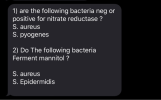 1) are the following bacteria neg or positive for nitrate reductase ? S. aureus S. pyogenes 2) Do The following bacteria Ferment mannitol ? S. aureus S. Epidermidis
A paramecium pushes against the water surrounding it with its motile cilia in order to propel...
A paramecium pushes against the water surrounding it with its motile cilia in order to propel itself forward. If the net force applied by the paramecium on the water is F~p, which of the following is true? A. The water pushes back with net force –F~p. B. The water pushes back with net force greater than F~p. C. The water pushes back with net force less than F~p. D. The water does not push back, since it is a liquid.
Which of the following is characteristic of cilia? They are whiplike, motile cellular extensions that occur...
Which of the following is characteristic of cilia? They are whiplike, motile cellular extensions that occur in large numbers on the exposed surfaces of certain cells. They are used for cellular adhesion. They are substantially longer then flagella, and are less common than flagella in humans. They move substances in many directions across a cell's surfaces.
Identify the bacteria based on the pictures and flow chart. Streak for Isolation from Sample Culture...
 Identify the bacteria based on
the pictures and flow chart.
Streak for Isolation from Sample Culture Positive Negative Gram Stain Bacillus negaterium Bacilus subnis Staphylococpidermidis Smoptococcusammanhäus Micrococcus teus Providevale sfuertii Escherichia coli Enterobacter aerogenes Citrobacter freund Puedang tida Moraxella caramela Alcaligenes faecalis Strict Aerobe Facultative Anaerobe Strict Aerobe Facultative Anaerobe Aerotolerance Aerotolerance 8 megalen 8 Subtilis M. Mateus P. punda M. calamhalis A roscais P E000 E acrogones C freund Positive Positive S. spillermidis S thermogrilus Positive Negative Negative DNase...
Identify the bacteria based on
the pictures and flow chart.
Streak for Isolation from Sample Culture Positive Negative Gram Stain Bacillus negaterium Bacilus subnis Staphylococpidermidis Smoptococcusammanhäus Micrococcus teus Providevale sfuertii Escherichia coli Enterobacter aerogenes Citrobacter freund Puedang tida Moraxella caramela Alcaligenes faecalis Strict Aerobe Facultative Anaerobe Strict Aerobe Facultative Anaerobe Aerotolerance Aerotolerance 8 megalen 8 Subtilis M. Mateus P. punda M. calamhalis A roscais P E000 E acrogones C freund Positive Positive S. spillermidis S thermogrilus Positive Negative Negative DNase...
Please help Given an example of an organism that fits the following descriptions: Invertebrate chordate Motile...
 Please help
Given an example of an organism that fits the following descriptions: Invertebrate chordate Motile fungus Non-insect hexapod Mushroom-forming, ascomycete Cuticle, pseudocoelomate Internal vertebrate parasites, no digestive system Diapsid, no openings behind orbits Sarcopterygian closest relative to tetrapods Segmented, produce anticoagulant hirudin Six legs, holometabolous development Non-vertebrate chordate Non-chordate vertebrate Which of the following did NOT occur in both deuterostomes?
Please help
Given an example of an organism that fits the following descriptions: Invertebrate chordate Motile fungus Non-insect hexapod Mushroom-forming, ascomycete Cuticle, pseudocoelomate Internal vertebrate parasites, no digestive system Diapsid, no openings behind orbits Sarcopterygian closest relative to tetrapods Segmented, produce anticoagulant hirudin Six legs, holometabolous development Non-vertebrate chordate Non-chordate vertebrate Which of the following did NOT occur in both deuterostomes?
QUESTIONS 33 43 MANY BACTERIA ARE ASSOCIATED WITH COMMONLY OCCURRING ILLNESSES. ROUTINE MICROSCOPIC ANALYSIS OF CULTURES,...
 QUESTIONS 33 43 MANY BACTERIA ARE ASSOCIATED WITH COMMONLY OCCURRING ILLNESSES. ROUTINE MICROSCOPIC ANALYSIS OF CULTURES, IN MANY CAASES, FORMS THE BASIS FOR HIGHLY RELAIBEL PRELIMINARY DIAGNOSIS OF INFECTIONS, MATCH THE FOLLOWING DESCRIPTIONS OF BACTERIA STRUCTURE AND ILLNESSES WITH THE MOST COMMONLY ASSOCIATED GRAM- NEGATIVE AND GRAM VARIABLE BACTERIA. A. PASTEURELLA MULTOCIDA B. PROTEUS MIRABILIS C. PROTEUS VULGARIS D. PSEUDOMONAS AERUGINOSA E. PSEUDOMONAS PSEUDOMALLEI F. RICKETTSIA PROWAZEKI G. RICKETTSIA RICKETTSII H. RICKETTSIA TSUTSUGAMUSHI I. SALMONELLA ENTERITIDIS J. SALMONELLA TYPHI K....
2. The growth rate of a population of bacteria is directly proportional to the population p()...
 2. The growth rate of a population of bacteria is directly proportional to the population p() (measured in millions) at time t (measured in hours). (a) Model this situation using a differential equation. (b) Find the general solution to the differential equation (c) If the number of bacteria in the culture grew from p(0) = 200 to p(24) = 800 in 24 hours, what was the population after the first 12 hours?
 Organize the following layers of the epidermis from Superficial to deep.
 1) are the following bacteria neg or positive for nitrate reductase ? S. aureus S. pyogenes 2) Do The following bacteria Ferment mannitol ? S. aureus S. Epidermidis
 Identify the bacteria based on
the pictures and flow chart.
Streak for Isolation from Sample Culture Positive Negative Gram Stain Bacillus negaterium Bacilus subnis Staphylococpidermidis Smoptococcusammanhäus Micrococcus teus Providevale sfuertii Escherichia coli Enterobacter aerogenes Citrobacter freund Puedang tida Moraxella caramela Alcaligenes faecalis Strict Aerobe Facultative Anaerobe Strict Aerobe Facultative Anaerobe Aerotolerance Aerotolerance 8 megalen 8 Subtilis M. Mateus P. punda M. calamhalis A roscais P E000 E acrogones C freund Positive Positive S. spillermidis S thermogrilus Positive Negative Negative DNase...
Identify the bacteria based on
the pictures and flow chart.
Streak for Isolation from Sample Culture Positive Negative Gram Stain Bacillus negaterium Bacilus subnis Staphylococpidermidis Smoptococcusammanhäus Micrococcus teus Providevale sfuertii Escherichia coli Enterobacter aerogenes Citrobacter freund Puedang tida Moraxella caramela Alcaligenes faecalis Strict Aerobe Facultative Anaerobe Strict Aerobe Facultative Anaerobe Aerotolerance Aerotolerance 8 megalen 8 Subtilis M. Mateus P. punda M. calamhalis A roscais P E000 E acrogones C freund Positive Positive S. spillermidis S thermogrilus Positive Negative Negative DNase...
 Please help
Given an example of an organism that fits the following descriptions: Invertebrate chordate Motile fungus Non-insect hexapod Mushroom-forming, ascomycete Cuticle, pseudocoelomate Internal vertebrate parasites, no digestive system Diapsid, no openings behind orbits Sarcopterygian closest relative to tetrapods Segmented, produce anticoagulant hirudin Six legs, holometabolous development Non-vertebrate chordate Non-chordate vertebrate Which of the following did NOT occur in both deuterostomes?
Please help
Given an example of an organism that fits the following descriptions: Invertebrate chordate Motile fungus Non-insect hexapod Mushroom-forming, ascomycete Cuticle, pseudocoelomate Internal vertebrate parasites, no digestive system Diapsid, no openings behind orbits Sarcopterygian closest relative to tetrapods Segmented, produce anticoagulant hirudin Six legs, holometabolous development Non-vertebrate chordate Non-chordate vertebrate Which of the following did NOT occur in both deuterostomes?
 QUESTIONS 33 43 MANY BACTERIA ARE ASSOCIATED WITH COMMONLY OCCURRING ILLNESSES. ROUTINE MICROSCOPIC ANALYSIS OF CULTURES, IN MANY CAASES, FORMS THE BASIS FOR HIGHLY RELAIBEL PRELIMINARY DIAGNOSIS OF INFECTIONS, MATCH THE FOLLOWING DESCRIPTIONS OF BACTERIA STRUCTURE AND ILLNESSES WITH THE MOST COMMONLY ASSOCIATED GRAM- NEGATIVE AND GRAM VARIABLE BACTERIA. A. PASTEURELLA MULTOCIDA B. PROTEUS MIRABILIS C. PROTEUS VULGARIS D. PSEUDOMONAS AERUGINOSA E. PSEUDOMONAS PSEUDOMALLEI F. RICKETTSIA PROWAZEKI G. RICKETTSIA RICKETTSII H. RICKETTSIA TSUTSUGAMUSHI I. SALMONELLA ENTERITIDIS J. SALMONELLA TYPHI K....
 2. The growth rate of a population of bacteria is directly proportional to the population p() (measured in millions) at time t (measured in hours). (a) Model this situation using a differential equation. (b) Find the general solution to the differential equation (c) If the number of bacteria in the culture grew from p(0) = 200 to p(24) = 800 in 24 hours, what was the population after the first 12 hours?
Most questions answered within 3 hours.
-
Where is the error in this code sequence?
String s1 = "Hello";
String s2 = "ello";...
asked 11 months ago -
Financial data for Joel de Paris, Inc., for last year
follow:
Joel de Paris, Inc.
Balance...
asked 11 months ago -
Consider this reaction:
Al2(SO4)3 (aq)+ BaCl3
(aq) Al2Cl6 (aq)- +
3BaSO4(s) . What is the...
asked 11 months ago -
Suppose that Savneet is considering increasing her
recent random sample from 20 car rentals to 40...
asked 11 months ago -
Trucks arrive at an unloading terminal at an average rate of 120
per hour.
Trucks arrive...
asked 11 months ago -
Why are methanol and ethanol completely soluble in water while
octanol is not very little soluble....
asked 11 months ago -
A facilities manager at a university reads in a research report
that the mean amount of...
asked 11 months ago -
When the CuSO4 is rehydrated by adding water to the anhydrous
compound, is this an endothermic...
asked 11 months ago -
A ray of sunlight is passing from diamond into crown glass; the
angle of incidence is...
asked 11 months ago -
A block of mass 0.249 kg is placed on top of a light, vertical
spring of...
asked 11 months ago -
how do the kidneys compensate in the presences of acidosis
a) trigger hyperventilate
b) reserve acid...
asked 11 months ago -
Question 501 pts
The rental rate of capital to the firm increases. Which of the
following...
asked 11 months ago