are the following bacteria aerobic, anaerobic or facilitative anaerobes? E. Coli S. Epidermidis P. Mirabilis P....
Homework Answers
Answer:
E. coli, S. epidermis, P. mirabilis and P. putida all are facultative anaerobic bacteria.
Explanation: Facultative anaerobes are those organisms who in the presence of oxygen can generate ATP by aerobic respiration but also can switch to anaerobic respiration and do fermentation if oxygen is absent.
Add Answer to:
are
the following bacteria aerobic, anaerobic or facilitative
anaerobes?
E. Coli
S. Epidermidis
P. Mirabilis
P....
Are the following bacteria motile? S. Epidermis P. Mirabilis P. Putida
Are the following bacteria motile? S. Epidermis P. Mirabilis P. Putida
please answer #2 only 2- Anaerobic Jar OBSERVATIONS AND INTERPRETATIONS Indicate the amount of growth of...
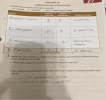 please answer #2 only
2- Anaerobic Jar OBSERVATIONS AND INTERPRETATIONS Indicate the amount of growth of each organism on each plate. no growth "3" = dense growth and "2" - degrees of growth in between Growth on Growth on Aerobic Plate Anaerobic Plate Organism Aerotolerance Category Al caligenes faecalis saerobes C. Sporagenes 3 S. anaerobes S. epidermidis 3 3 facultativer anderob P. Plbores ces 5. aerobes QUESTIONS Suppose that after incubation you examine the jar before opening it and see...
please answer #2 only
2- Anaerobic Jar OBSERVATIONS AND INTERPRETATIONS Indicate the amount of growth of each organism on each plate. no growth "3" = dense growth and "2" - degrees of growth in between Growth on Growth on Aerobic Plate Anaerobic Plate Organism Aerotolerance Category Al caligenes faecalis saerobes C. Sporagenes 3 S. anaerobes S. epidermidis 3 3 facultativer anderob P. Plbores ces 5. aerobes QUESTIONS Suppose that after incubation you examine the jar before opening it and see...
What are the expected slant growths (filiform, beaded, or spreading) for the following bacteria: E. coli,...
What are the expected slant growths (filiform, beaded, or spreading) for the following bacteria: E. coli, Staphylococcus aureus, Bacillus subtilis microbiology
1) are the following bacteria neg or positive for nitrate reductase ? S. aureus S. pyogenes...
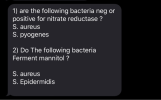 1) are the following bacteria neg or positive for nitrate reductase ? S. aureus S. pyogenes 2) Do The following bacteria Ferment mannitol ? S. aureus S. Epidermidis
Definitions a. Polypharmacy b. Bacteriostatic c. Bactericidal d. Aerobic e. Anaerobic f. Broad Spectrum g. Narrow...
Definitions a. Polypharmacy b. Bacteriostatic c. Bactericidal d. Aerobic e. Anaerobic f. Broad Spectrum g. Narrow Spectrum h. Superinfection i. Nosocomial infection j. Resistant infection k. Opportunistic infection l. Antibiotic resistance m. community-acquired infection n. community-acquired methicillin-resistant Staphylococcus aureus (CA-MRSA) o. Red man syndrome p. Stevens-Johnson syndrome q. CDAD r. Kernicterus s. Crystalluria – what is it and how can you minimize risk / treat t. Peripheral neuropathy u. Myopathy v. rhabdomyolysis
Explain how you might use E. coli bacteria to produce human growth hormone using the following:...
Explain how you might use E. coli bacteria to produce human growth hormone using the following: plasmid, b. Gene segment for human growth hormone that contains only exons, DNA ligase, Restriction enzymes, and Incubator for growing bacteria cells.
1. On which plate(s) would you expect to find bacteria most like the E. coli on...
 1. On which plate(s) would you expect to find bacteria most like the E. coli on the source plate? Explain. 2. On which plate(s) would you find only genetically transformed bacterial cells? Why? 3. What is the purpose of the control plates? Explain the difference between the controls and why each one is necessary. 4. Why would one compare the -DNA/+Amp and DNA/+Amp plates?
Topic: Bacteria Chemotaxis (E. coli) 1. You are studying the interaction of CheY and the P1-P2...
 Topic: Bacteria Chemotaxis (E. coli)
1. You are studying the interaction of CheY and the P1-P2
domains of CheA. You have used site specific mutagenesis to replace
F214 of CheA with an alanine residue.
A. What genetic experimental assay could you use to determine
the effect of the F214 to A214 substitution on the interaction
between CheA-P1P2 and CheY. Explain how the assay works.
B. What would be the effect of the F214 to A214 substitution on
the interaction between...
Topic: Bacteria Chemotaxis (E. coli)
1. You are studying the interaction of CheY and the P1-P2
domains of CheA. You have used site specific mutagenesis to replace
F214 of CheA with an alanine residue.
A. What genetic experimental assay could you use to determine
the effect of the F214 to A214 substitution on the interaction
between CheA-P1P2 and CheY. Explain how the assay works.
B. What would be the effect of the F214 to A214 substitution on
the interaction between...
Categorize the following: Aerobic respiration, Anaerobic respiration, Fermentation, None of these .Assume in all cases that...
Categorize the following: Aerobic respiration, Anaerobic respiration, Fermentation, None of these .Assume in all cases that these processes follow breakdown of glucose by glycolysis. Results in complete oxidation of glucose to CO2 Involves regeneration of reduced co-factors (e.g. regenerating NAD+ from NADH) Generates energy by substrate level phosphorylation only Generates ATP by oxidative phosphorylation Utilizes an electron transport chain Uses molecules such as NO3 - , SO4 2- , or Fe3+ as terminal electron acceptors Products include organic acids, alcohols,...
You plate colonies of E. coli with the lac operon genotype of I+P+OCZ+CAP+ on 1) a...
You plate colonies of E. coli with the lac operon genotype of I+P+OCZ+CAP+ on 1) a medium containing only glucose, and 2) a medium containing only lactose. You isolate mRNA from bacteria from each medium and do a Northern blot with a probe for β-galactosidase. Draw the results.
 please answer #2 only
2- Anaerobic Jar OBSERVATIONS AND INTERPRETATIONS Indicate the amount of growth of each organism on each plate. no growth "3" = dense growth and "2" - degrees of growth in between Growth on Growth on Aerobic Plate Anaerobic Plate Organism Aerotolerance Category Al caligenes faecalis saerobes C. Sporagenes 3 S. anaerobes S. epidermidis 3 3 facultativer anderob P. Plbores ces 5. aerobes QUESTIONS Suppose that after incubation you examine the jar before opening it and see...
please answer #2 only
2- Anaerobic Jar OBSERVATIONS AND INTERPRETATIONS Indicate the amount of growth of each organism on each plate. no growth "3" = dense growth and "2" - degrees of growth in between Growth on Growth on Aerobic Plate Anaerobic Plate Organism Aerotolerance Category Al caligenes faecalis saerobes C. Sporagenes 3 S. anaerobes S. epidermidis 3 3 facultativer anderob P. Plbores ces 5. aerobes QUESTIONS Suppose that after incubation you examine the jar before opening it and see...
 1) are the following bacteria neg or positive for nitrate reductase ? S. aureus S. pyogenes 2) Do The following bacteria Ferment mannitol ? S. aureus S. Epidermidis
 1. On which plate(s) would you expect to find bacteria most like the E. coli on the source plate? Explain. 2. On which plate(s) would you find only genetically transformed bacterial cells? Why? 3. What is the purpose of the control plates? Explain the difference between the controls and why each one is necessary. 4. Why would one compare the -DNA/+Amp and DNA/+Amp plates?
 Topic: Bacteria Chemotaxis (E. coli)
1. You are studying the interaction of CheY and the P1-P2
domains of CheA. You have used site specific mutagenesis to replace
F214 of CheA with an alanine residue.
A. What genetic experimental assay could you use to determine
the effect of the F214 to A214 substitution on the interaction
between CheA-P1P2 and CheY. Explain how the assay works.
B. What would be the effect of the F214 to A214 substitution on
the interaction between...
Topic: Bacteria Chemotaxis (E. coli)
1. You are studying the interaction of CheY and the P1-P2
domains of CheA. You have used site specific mutagenesis to replace
F214 of CheA with an alanine residue.
A. What genetic experimental assay could you use to determine
the effect of the F214 to A214 substitution on the interaction
between CheA-P1P2 and CheY. Explain how the assay works.
B. What would be the effect of the F214 to A214 substitution on
the interaction between...
Most questions answered within 3 hours.
-
Where is the error in this code sequence?
String s1 = "Hello";
String s2 = "ello";...
asked 11 months ago -
Financial data for Joel de Paris, Inc., for last year
follow:
Joel de Paris, Inc.
Balance...
asked 11 months ago -
Consider this reaction:
Al2(SO4)3 (aq)+ BaCl3
(aq) Al2Cl6 (aq)- +
3BaSO4(s) . What is the...
asked 11 months ago -
Suppose that Savneet is considering increasing her
recent random sample from 20 car rentals to 40...
asked 11 months ago -
Trucks arrive at an unloading terminal at an average rate of 120
per hour.
Trucks arrive...
asked 11 months ago -
Why are methanol and ethanol completely soluble in water while
octanol is not very little soluble....
asked 11 months ago -
A facilities manager at a university reads in a research report
that the mean amount of...
asked 11 months ago -
When the CuSO4 is rehydrated by adding water to the anhydrous
compound, is this an endothermic...
asked 11 months ago -
A ray of sunlight is passing from diamond into crown glass; the
angle of incidence is...
asked 11 months ago -
A block of mass 0.249 kg is placed on top of a light, vertical
spring of...
asked 11 months ago -
how do the kidneys compensate in the presences of acidosis
a) trigger hyperventilate
b) reserve acid...
asked 11 months ago -
Question 501 pts
The rental rate of capital to the firm increases. Which of the
following...
asked 11 months ago